
Pexar unveils the PexarBolt Ultra at IFA Berlin, a high-end docking station featuring 22 ports, a touchscreen dashboard, and advanced storage for professionals, challenging traditional desktop expansion tools.
After lining up its first public showing at IFA Berlin on 4 September, Pexar is pitching the PexarBolt Ultra as something more ambitious than a conventional laptop dock. The device, sold under Lexar’s Pexar sub-brand, is the brand’s first docking station and combines 22 ports with a 5-inch touch display, a rotary controller, 10GbE networking and an internal NVMe bay. That places it squarely in the market for photographers, video editors and other workstation users rather than buyers who simply need extra USB sockets.
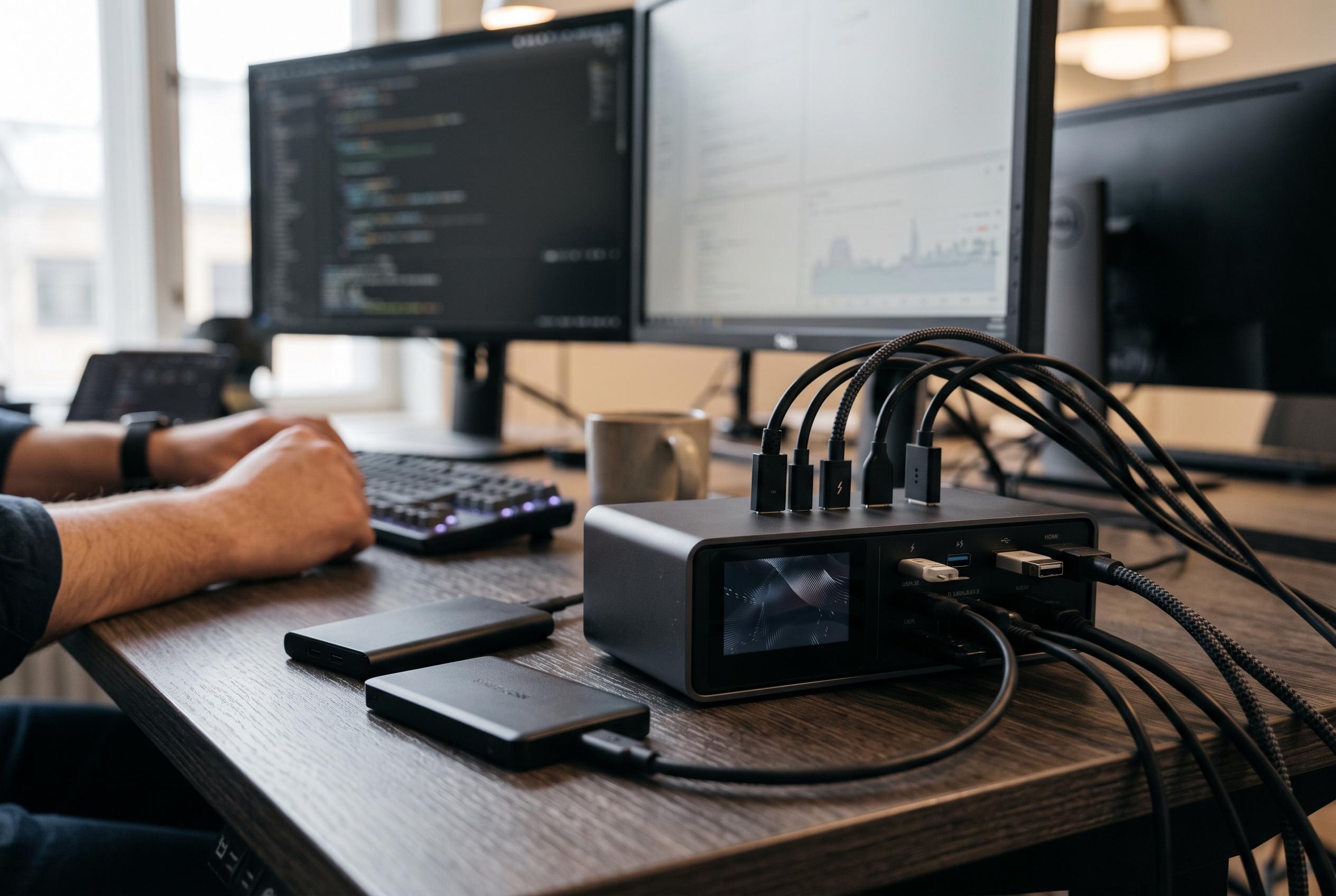
The screen is the feature that most clearly separates it from rival Thunderbolt 5 docks. Reports from PCWorld and Digital Citizen say Pexar wants the panel to act as a live dashboard for port status, power draw, temperatures and transfer activity, while also extending into software monitoring. PCWorld said the company was even highlighting Claude Code token tracking, and other coverage described broader AI workflow read-outs for supported applications. In practice, that makes the display a companion interface for a desktop app, not a fully self-sufficient hardware console.
The rest of the specification reads like a top-end dock aimed at desks with multiple displays and fast storage. Notebookcheck said the unit carries three Thunderbolt 5 ports in total, with 80Gbps bandwidth rising to 120Gbps in one direction when extra display bandwidth is needed. It is rated to supply up to 140W to the host laptop, while the downstream Thunderbolt ports offer 15W each. Video can be routed through Thunderbolt, DisplayPort 2.1 or HDMI 2.1, although PetaPixel noted that the DisplayPort and HDMI outputs share a path, so only one of those can be used at a time. The headline display claim is support for two 8K monitors at 60Hz or three 4K screens at 144Hz, subject to host hardware.
For creators, the more interesting details may be the storage and ingest options. The front panel includes a CFexpress Type B reader, plus SD and microSD slots intended to speed camera-card transfers. PetaPixel’s port breakdown adds two front USB-C ports with a combined 45W charging budget, a USB-A port and a 3.5mm combo jack, while the rear carries additional USB-C and USB-A connections, separate audio in and out, and 10GbE for direct high-speed links to network storage. Inside the chassis is an M.2 slot running at PCIe Gen 4 x2 rather than the faster x4 variant, with quoted transfer rates of roughly 3,600MB/s when a compatible drive is installed. Several reports also note active cooling, including a fan and metal heat-dissipation hardware, which suggests Pexar expects the dock to handle sustained loads rather than occasional desk duty.
Pricing remains aggressive by dock standards, but the sales route is just as notable as the hardware. Early coverage from PCWorld, Digital Citizen, Gagadget and others put the launch offer at $479 on Kickstarter, against a stated retail price of $649. As of 6 September, Pexar was still taking refundable deposits ahead of the crowdfunding campaign and saying those reservations could reduce the effective entry price further. That is likely to attract attention, but it also means the product is still being sold through a pre-launch campaign structure instead of a normal retail channel.
There are practical limits beneath the specification sheet. Gagadget pointed out that Thunderbolt 5 laptops remain rare, which immediately narrows the audience for any dock sold on next-generation bandwidth. PCWorld made a related point from another angle: 140W is strong enough for mainstream productivity notebooks, but it may still fall short of what a gaming machine wants when its discrete graphics are working hard. Even where the dock’s bandwidth is available, the most ambitious multi-monitor claims depend on the host computer, graphics support and operating-system behaviour, so the top figures will not translate equally across every Mac or Windows machine.
Even so, the concept is not as frivolous as it first appears. A photographer moving CFexpress footage, writing to an internal scratch SSD and sending files over 10GbE to a NAS could use much of this hardware every day. That helps explain why several outlets have described the dock as being built for imaging workflows first and general desktop expansion second. The broader question is whether buyers will trust a first-generation dock from a brand that first became known through digital picture frames in 2024. Pexar is clearly trying to stretch beyond that identity, and the PexarBolt Ultra will show whether a more visible, software-heavy dock can justify premium pricing in a market that usually rewards simpler tools.
Disclaimer: This content is intended for informational purposes only. Readers are advised to exercise their own judgement, conduct due diligence, or consult a qualified expert before acting on any information provided.