
Signify introduces lower-cost, flexible options for TV-synchronised lighting, including a new camera and HDMI sync box, aiming to broaden appeal and simplify setup for Hue users.
Signify has lowered the cost of Philips Hue’s TV-synchronised lighting with two new devices aimed at people who found the existing setup too expensive or too restrictive. The new Philips Hue Play Screen Sync camera is priced at $119.99, while the Philips Hue Play HDMI sync box 4K starts at $149.99. Both went on sale in the United States on 3 September, and both also support a simpler entry setup in which one Play gradient TV strip light can be synchronised over Bluetooth without first buying a Hue Bridge.
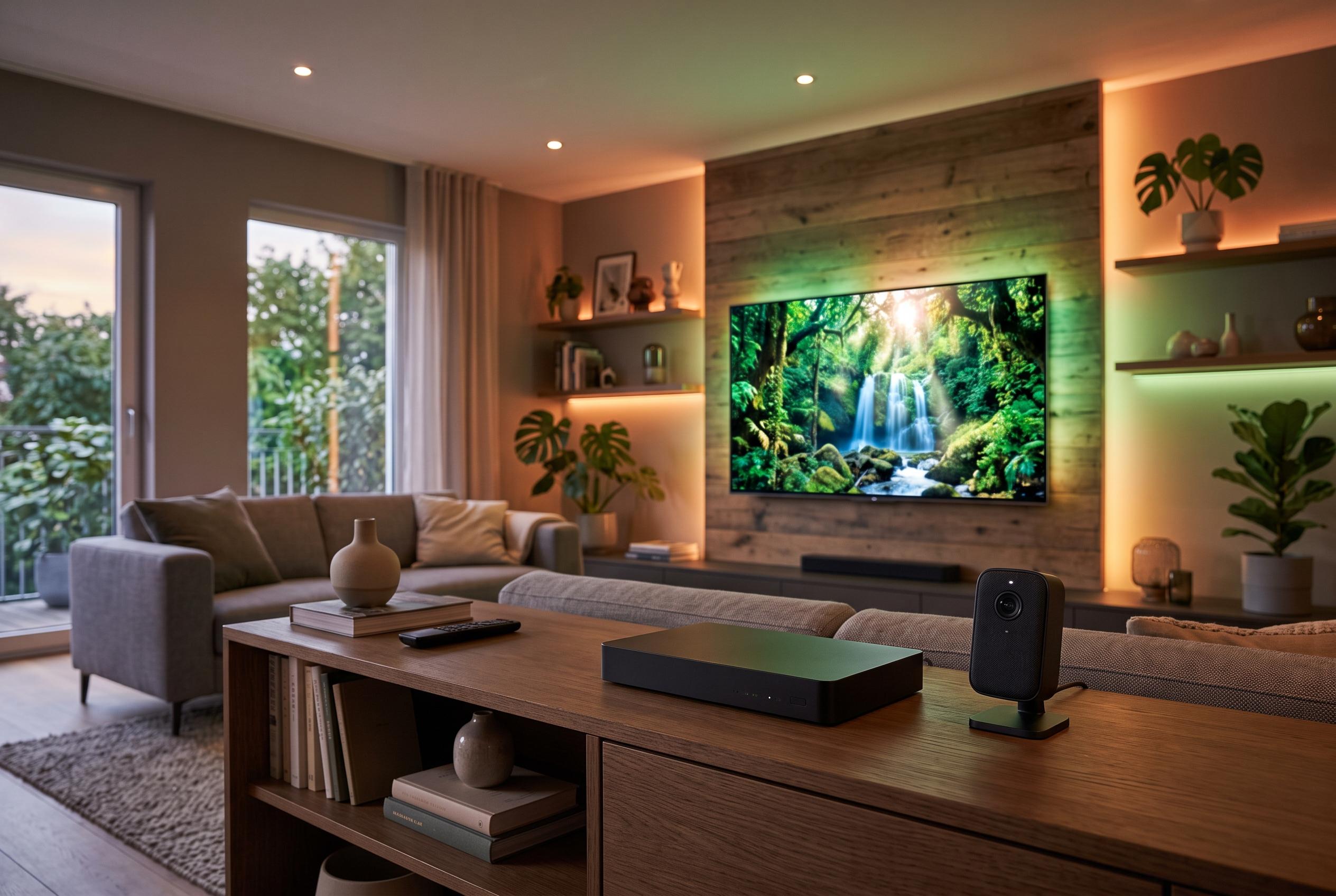
The more significant of the two is the camera. Fitted above the television, it uses a fisheye lens, automatic calibration and colour-matching software to analyse whatever is actually being shown on screen. That means it can follow native smart-TV apps and broadcast channels as well as content from consoles and streaming boxes. For Hue, that removes a long-standing limitation: previous TV synchronisation depended on HDMI, so anything generated inside the television itself was effectively invisible to the system. Signify has also acknowledged the compromise, saying the HDMI-based method remains the more accurate option.
That distinction helps explain why the company is selling both approaches at the same time. The new camera is meant to broaden compatibility and simplify installation, rather than replace HDMI outright. George Yianni, Philips Hue’s head of technology, told The Verge that the company had designed algorithms to recognise the TV panel type, screen corners, room lighting and white balance automatically, avoiding the manual tuning common with rival products. As he put it, users of competing systems often have to “go through quite some steps to make it work well”.
The cheaper 4K sync box, by contrast, keeps the direct HDMI method but strips it back. It has one HDMI input and one output, supports 4K at up to 60Hz, and uses HDMI 2.0 rather than HDMI 2.1. That makes it far cheaper than the 8K Hue sync box, which The Verge said sells for about $385 and still remains the only choice for people who want several HDMI inputs connected at once. In practice, Philips Hue has created a clearer product ladder: a lower-cost camera for maximum source compatibility, a one-input 4K box for simpler wired setups, and the existing 8K model for more demanding home cinema or gaming systems.
The television products arrived as part of a broader Hue push timed to IFA week in Berlin. Forbes described this year’s event, which opened on Friday, 4 September, as part of a wider shift towards devices that combine software with physical sensing and real-world interaction. Signify used the same moment to introduce new software for Hue, most notably Custom AI Behaviours, due in early October for Bridge Pro users in supported languages. According to the company, the feature turns plain-language requests into automations by combining triggers, conditions and lighting actions. Signify also said a cloud-based Back-up & Restore system is in development, while Sonos integration is scheduled for a software update in November.
The company is also widening the Hue ecosystem around those launches. Signify said a Philips Hue x Nanoleaf Wall Light Module would go on sale in the US from $39.99 on 3 September, with Nanoleaf Hexagon and Triangle starter kits and extensions to follow through the Hue website from 1 October. T3 reported that the arrangement will bring compatible Nanoleaf Shapes into the Hue environment, extending the platform beyond Signify’s own lighting hardware.
Alongside the entertainment products, Signify introduced a sizeable batch of new lights. The Verge reported that new cuttable Play gradient strip lights are being joined by a Pro version for 65-inch and 100-inch televisions, starting at $179.99 and due from 15 September. Signify’s own launch material also lists a Liane 360° rope light from $399.99, Festavia curtain, net and icicle lights at $249.99, and an OmniGlow outdoor strip light from $229.99. T3 added that the Signe pendant and pendulum models are available in Europe immediately from £309.99/€349.99, with North American availability following in November, while the Signe pole will come later.
For existing Hue users, the practical change is straightforward. Philips Hue now has a first-party way to synchronise room lighting with whatever a smart TV is actually showing, without forcing viewers to route everything through an external HDMI device. That does not end the trade-off between flexibility and precision, and Signify itself says HDMI still wins on accuracy. But by bringing the starting price down to $119.99 and removing the Bridge requirement for a basic one-strip setup, the company is clearly trying to turn TV-reactive lighting from a premium niche into a more attainable part of the wider Hue system.
Disclaimer: This content is intended for informational purposes only. Readers are advised to exercise their own judgement, conduct due diligence, or consult a qualified expert before acting on any information provided.