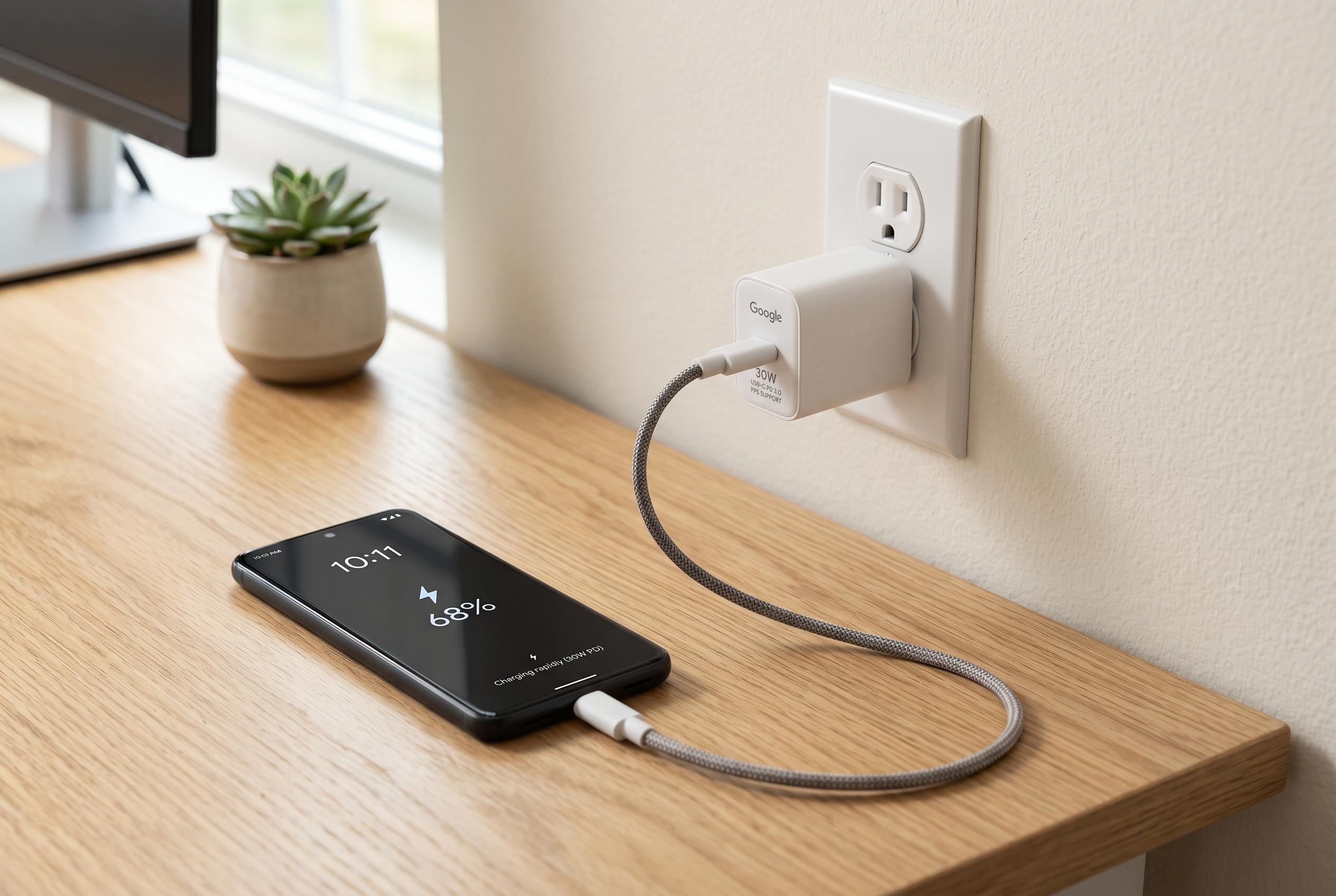

To maximise charging efficiency and safety, Pixel 8 owners should select a 30W USB-C wall adapter supporting USB-PD and PPS, following Google’s recommended guidelines for optimal power delivery.
For most Pixel 8 owners, the most sensible charger is a reputable 30W USB-C wall adapter that supports USB Power Delivery 3.0 and PPS. Google’s own charging guidance says the phone’s wired charging tops out at about 27W, so a 30W charger gives enough headroom without paying for power the handset cannot use. That makes it the best match for a phone-first setup.
The key detail is not just wattage. The charger should have a USB-C output, support USB-PD and, ideally, PPS, or Programmable Power Supply. USB-PD allows the phone and charger to negotiate the amount of power delivered, while PPS helps the charger fine-tune voltage for a closer match to Google’s preferred fast-charging profile. A USB-C-to-USB-C cable is also the right choice if charging speed matters.
Higher-wattage chargers are not a problem if they are properly specified. Google says 45W and 67W USB-C chargers are safe to use with the Pixel 8, but they do not make the phone charge at those levels. They become useful when the same adapter also needs to power a laptop, tablet or another phone, or when a multi-port charger must split power across several devices. In that case, buyers should check the charger’s per-port allocation, since the headline rating may not be available on every port at once.
Cable choice still matters. Google recommends a USB-C-to-USB-C cable for the best result, and notes that USB-A-to-USB-C charging is slower. The Pixel 8 ships with a 1-metre USB 2.0 USB-C cable that is adequate for charging, but a replacement should come from a trustworthy seller and be built for charging rather than chosen on the basis of a high wattage claim alone.
Wireless charging is available too, but it is a convenience choice rather than a speed choice. Google lists up to 18W with the Pixel Stand, second generation, and up to 12W with Qi-certified EPP chargers. For bedside or desk use, a Qi-certified stand or pad is usually the most practical option, though alignment, case thickness and heat can all affect performance. If maximum and most predictable speed are the priority, wired charging remains the better answer.
Disclaimer: This content is intended for informational purposes only. Readers are advised to exercise their own judgement, conduct due diligence, or consult a qualified expert before acting on any information provided.