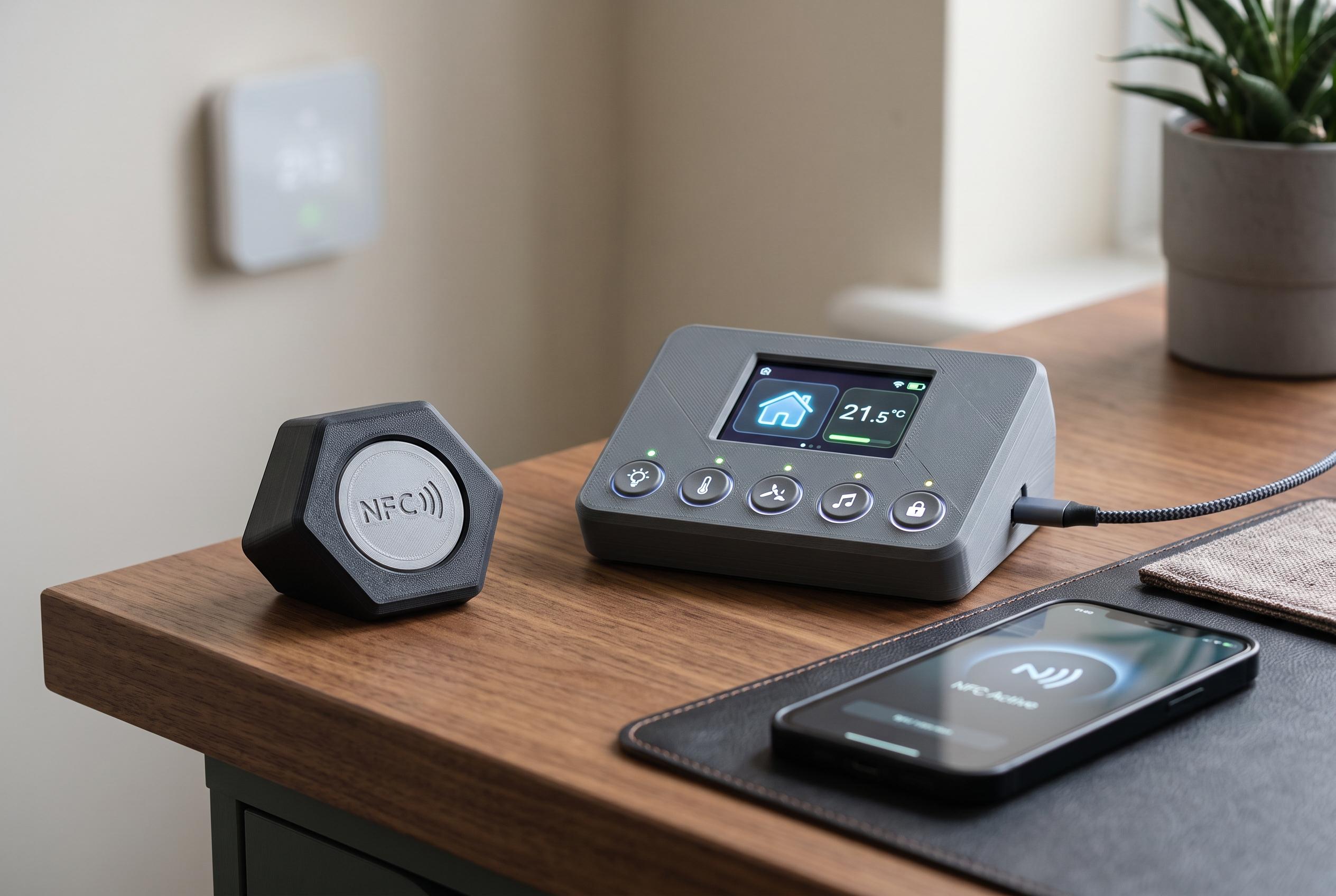

Advancements in 3D printing enable personalised and practical accessories for smart homes, from NFC housings to custom control panels, transforming everyday automation with tailored hardware solutions.
A 3D printer can do more than produce decorative objects and spare parts. In a smart home, it can become a practical manufacturing tool for fittings, mounts and interfaces that make automation easier to use and better integrated into daily life. Home Assistant is especially well suited to this kind of work because it supports NFC-triggered actions and device-level customisation with a flexibility that is hard to match.
One of the most useful applications is NFC hardware. Instead of leaving a plain sticker on a wall or shelf, users can print a housing that hides the tag inside a more finished object. NFC tags can still be read through thin plastic, which makes them suitable for cases shaped like cassette tapes, signs for guest Wi-Fi or small decorative tokens that launch audio, scenes or routines when tapped. NFC tags are inexpensive, reusable and straightforward to program for smartphone-triggered actions.
The same idea works well for ESPHome projects. Small Espressif-based boards are often used for sensors and controllers in Home Assistant, but bare electronics rarely suit a domestic setting. 3D-printed enclosures give those projects a neater finish, whether the aim is a compact desk display, a sensor module or a wall-mounted controller. OpenTag3D and similar efforts around filament and smart-object tagging also show how the 3D-printing ecosystem is moving towards interoperable, practical hardware rather than one-off prototypes.
Physical control panels are another sensible use. A printed case can hold arcade-style buttons, keys or other tactile switches that trigger routines such as lighting scenes, media playback or whole-room shutdowns. That approach gives a home a shared control point that is easier to use than a phone for visitors or family members, and it can be built to the exact size and layout required. NFC and Home Assistant guides increasingly present this as a low-friction alternative to voice control or app-based navigation.
Tablet mounts are equally practical. An older Kindle Fire or unused Android tablet can be turned into a wall-mounted command centre, provided there is a printed bracket that fits the device and routes power cleanly. That can make a hallway, kitchen or utility room a more useful place for controlling lighting, climate and media than a loose tablet on a desk. Presence sensors follow the same pattern: the hardware works best when it is hidden, flush-mounted or boxed into a small printed enclosure that looks intentional rather than temporary.
The larger point is that 3D printing is not just for novelty items. In a smart home, it can fill the gap between off-the-shelf devices and the exact form factor a household actually needs. With NFC tags, ESPHome boards, control panels, tablets and presence sensors, the printer becomes a small workshop for making automation visible, reachable and tidy.
Disclaimer: This content is intended for informational purposes only. Readers are advised to exercise their own judgement, conduct due diligence, or consult a qualified expert before acting on any information provided.