
RISUKAI introduces the K61, a combined charger and battery pack, offering new convenience for mobile power needs amid competitive pricing on Japanese marketplaces.
RISUKAI has started selling a new combined charger and battery pack in Japan, positioning the K61 as a single device for both daily phone charging and short-notice backup use. The model is now listed through the company’s own channels and major marketplaces, with RISUKAI’s official web shop showing a price of ¥6,980, while marketplace listings on Rakuten and Yahoo Shopping were advertising materially lower sale prices on Tuesday.
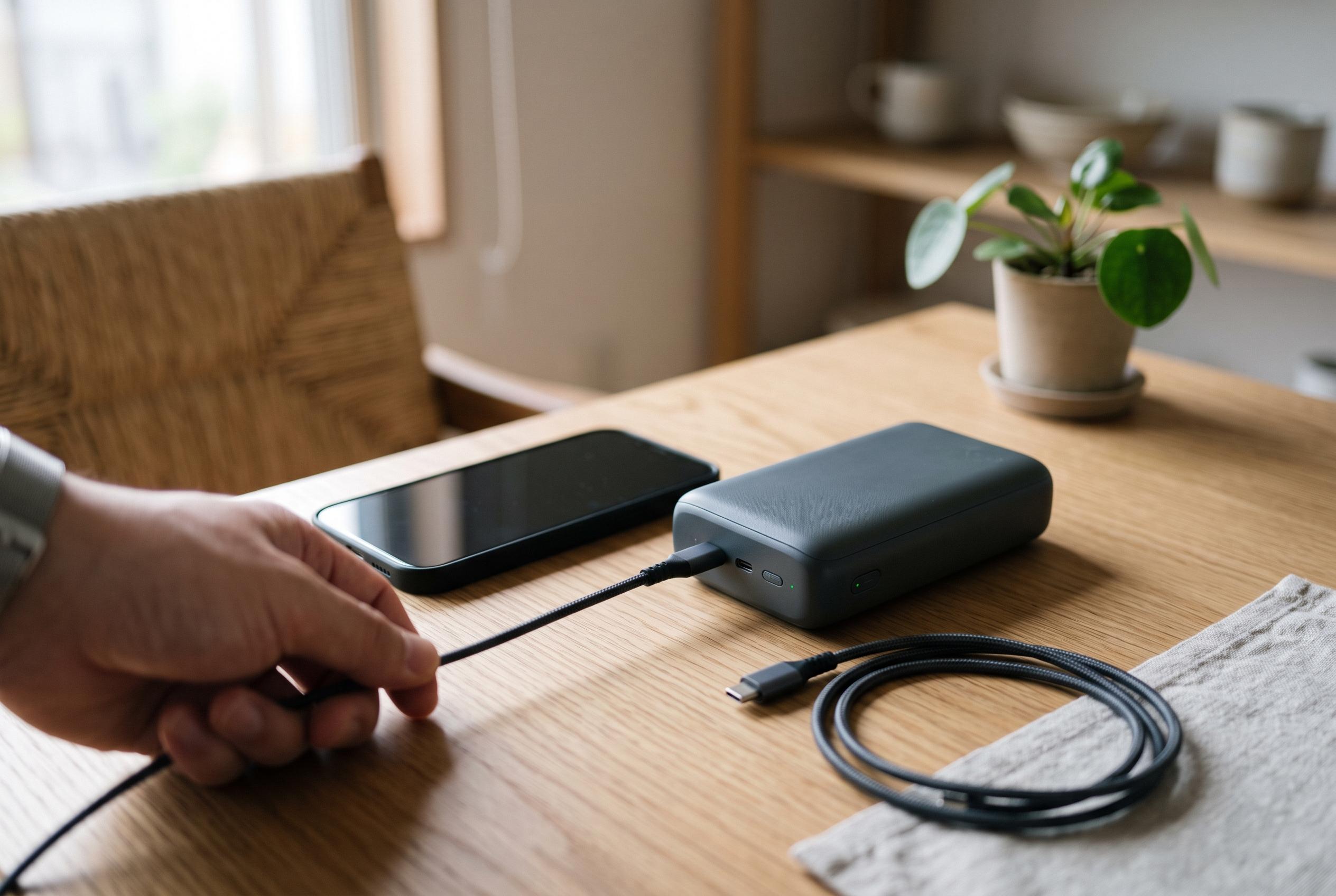
The product is aimed at a familiar inconvenience: carrying a wall charger, a cable and a spare battery separately, then discovering one of them has been left behind. In RISUKAI’s account, the K61 folds those three functions into one unit by combining an AC plug, a 5,000mAh battery and a built-in USB-C lead. The company is also marketing it for emergency situations such as power cuts and evacuations, although its own materials make clear that a dead wall socket during an outage will not recharge the device; away from mains power, it can only deliver whatever charge remains in its internal cell.
On paper, the K61 is a compact, phone-first accessory rather than a high-capacity travel bank. RISUKAI says it measures about 83mm by 50mm by 30mm, weighs roughly 160g and includes a built-in USB-C cable of about 25cm as well as a USB-C port. In battery mode, a single output can deliver up to 20W, with stated profiles of 5V/3A, 9V/2.22A and 12V/1.67A. In charger mode, output falls to a maximum of 10W, and when two outputs are used together in battery mode the total is capped at 15W. A small digital display shows the remaining battery level, and the unit is offered in black and white.
Retail listings broaden the picture beyond the company’s launch copy. RISUKAI’s own Rakuten store describes the K61 as a “2WAY” mobile battery and charger, while third-party sellers on Rakuten present it as compatible with a wide range of recent Apple handsets, including the iPhone 17, 17 Air, 17 Pro and 17 Pro Max, alongside iPhone 16, 15, 14 and 13 models. Those sellers also extend the intended use case to Android phones, tablets, wireless earphones and handheld games consoles. That said, the built-in lead is USB-C only. For older Lightning-equipped Apple devices, sellers and the company alike say a separate cable is still required.
RISUKAI is putting unusual weight on compliance and test documentation for a low-cost consumer charger. In its release, the company says the K61 meets both Japanese PSE requirements for the AC charger section and the lithium-ion battery section. It identifies the battery as a single cylindrical lithium-ion cell rated at 5,000mAh, 3.6V and 18Wh. The company also cites CVC Testing Technology reports referencing J62368-1:2023 and J62133-2:2021, standards used in Japan for electrical and battery safety.
The same company material sets out six test categories: external short circuit, overcharge, free-fall, temperature cycling, vibration and mechanical shock. RISUKAI says those tests produced no fire or explosion, and no leakage in the cases where leakage was part of the assessment. The sample sizes disclosed were small, ranging from three units in the drop test to five in the battery and environmental tests. RISUKAI also says its control system stops charging when cell temperature reaches about 59C and reduces charging current at 0C. It adds that the casing, circuit board and insulation sheet use V-0 flame-retardant materials at specified thicknesses. Those claims come from company-supplied test references rather than an independent product review, but they are more detailed than is typical in marketplace copy.
That marketplace copy also reveals a notable pricing gap. Although RISUKAI’s own website lists the K61 at ¥6,980, the company’s Rakuten shop was showing a promotional price of ¥2,780, down from ¥3,280, when viewed on Tuesday. Yahoo Shopping listings for RISUKAI’s plug-integrated battery products were clustered at roughly ¥3,273 to ¥3,455, with sellers stressing travel, commuting and disaster-readiness. Some Yahoo and Rakuten listings additionally highlight 100-240V input and aircraft carry-on suitability, presenting the device as a lightweight option for short trips as much as for emergency storage at home.
The launch also places the K61 inside a wider charging-accessories range rather than as a one-off release. RISUKAI’s official site lists it alongside other products including the K38, K47, K60 and K66S. In the corporate details attached to the release, Risukai Co., Ltd. says it is based in Katsushika ward, Tokyo, was established in September 2013 and is led by Yuna Osaka. Judged by the specification and the way retailers are selling it, the K61 is best understood as a compact top-up charger with built-in redundancy: convenient for one smartphone and easier to keep with you than a loose charger-cable-battery bundle, but not a substitute for a larger power bank if runtime matters more than portability.
Disclaimer: This content is intended for informational purposes only. Readers are advised to exercise their own judgement, conduct due diligence, or consult a qualified expert before acting on any information provided.