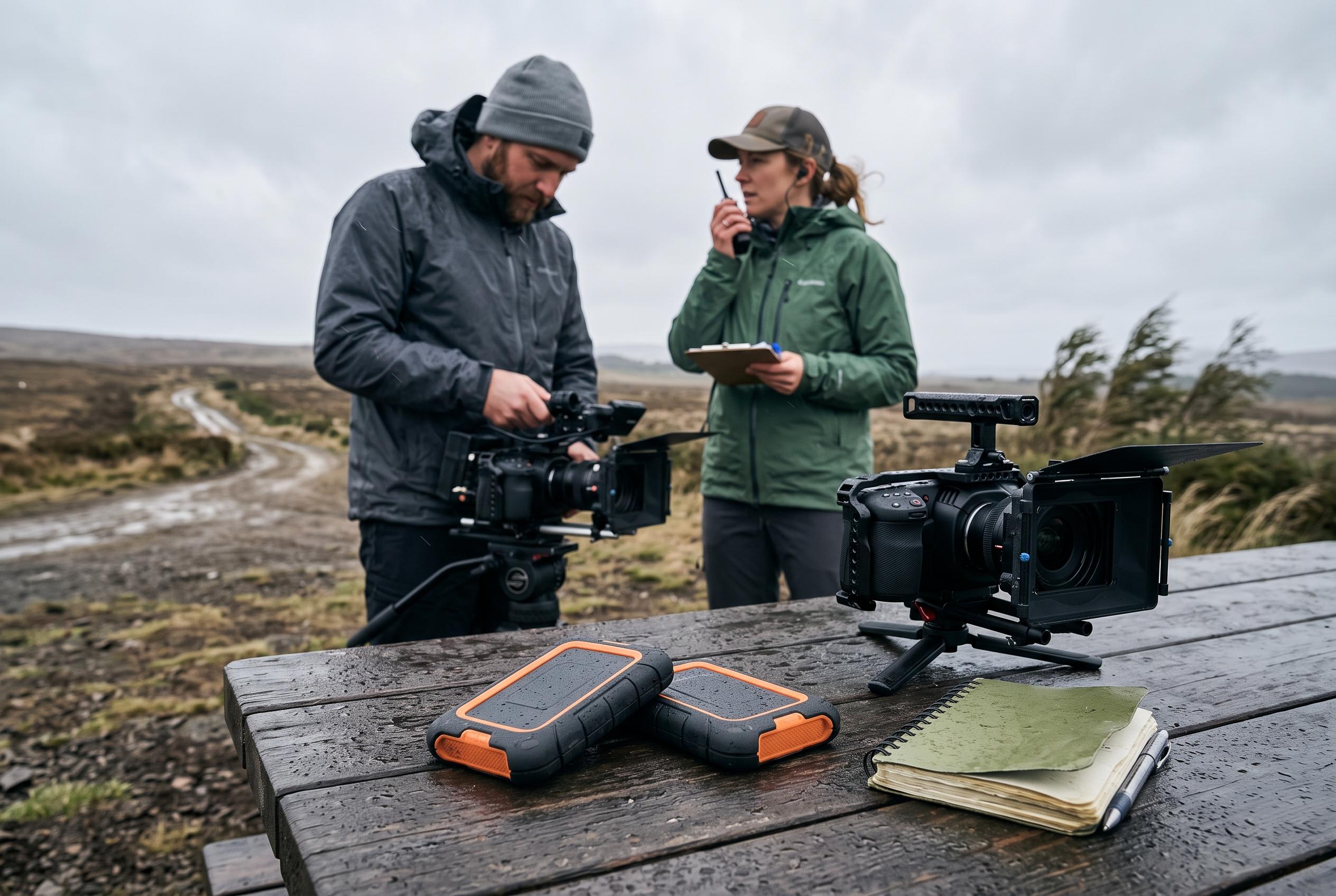

As location shoots become more demanding, documentary crews are increasingly relying on rugged portable SSDs like the SanDisk PRO-G40 and Crucial X10 to deliver faster, more reliable data transfer in the toughest conditions, reshaping the standard for on-the-go storage.
For documentary crews, storage has become a field tool rather than a desk accessory. A drive that survives a studio edit suite may still fail on a wet trail, in a dusty market, or after being crushed in a packed camera bag. The guide published by Short Film Central argues that rugged portable SSDs are now essential for location work because they combine faster transfers with better protection than spinning hard drives, and that remains the central case for choosing them over cheaper, more fragile storage. The site’s current ranking puts the SanDisk Professional PRO-G40 at the top, with the Crucial X10, Lexar Armor 700, and LaCie Rugged SSD4 close behind for different budgets and workflows.
The strongest option for extreme conditions is the SanDisk Professional PRO-G40. Short Film Central says it offers a rare mix of IP68 protection, a metal-and-rubber build, dual-mode Thunderbolt 3 and USB-C connectivity, and a 4TB capacity that suits long shoots. Third-party reviews back up that positioning: Tom’s Hardware notes the drive’s reinforced housing, IP68 rating, and useful compatibility across Thunderbolt and standard USB-C systems, while TechRadar and Creative Bloq both found that its sustained performance and rugged design justify its premium price for professional users.
For many documentary shooters, however, value matters more than absolute speed. That is where the Crucial X10 stands out. Short Film Central highlights its 2,100MB/s claims, IP65 resistance, and light weight, along with a price that undercuts the elite options. PCWorld’s review adds that the X10 has moved towards higher capacities and a tougher, more practical design, making it a strong choice for crews that need fast ingest and reliable field backup without paying for features they may never use.
At the tougher-budget end, the Lexar Armor 700 is presented as an attractive middle ground. Short Film Central points to IP66 protection, a 2TB capacity, and enough speed for serious documentary work, particularly where water and dust are genuine risks. Its usefulness for iPhone ProRes workflows also broadens its appeal for smaller teams and solo operators. That said, the brand is less established than SanDisk or Samsung, so buyers weighing long-term support may still favour the better-known names.
The fastest drive in the field is the LaCie Rugged SSD4, but its advantages are narrower and its price is higher. Short Film Central says it is aimed at crews handling 6K and 8K material who need the shortest possible offload times, and its support for USB 40Gbps hardware makes that claim credible. The trade-off is that it carries only an IP54 rating, which is weaker than several rivals, so its speed comes with less environmental protection than the PRO-G40 or Armor 700.
For most documentary teams, the more practical decision is not which drive is fastest, but which one fits the camera format, laptop ports, and backup plan already in use. The guide’s wider advice is sensible: check whether a drive’s full speed depends on Thunderbolt or USB 3.2 Gen 2×2, match capacity to the likely shooting ratio, and follow a 3-2-1 backup routine rather than trusting a single copy. In that context, the Samsung T7 Shield and SanDisk Extreme PRO remain sensible workhorse choices, while the PRO-G40 stays the safest premium pick for crews that cannot afford to lose footage.
Disclaimer: This content is intended for informational purposes only. Readers are advised to exercise their own judgement, conduct due diligence, or consult a qualified expert before acting on any information provided.