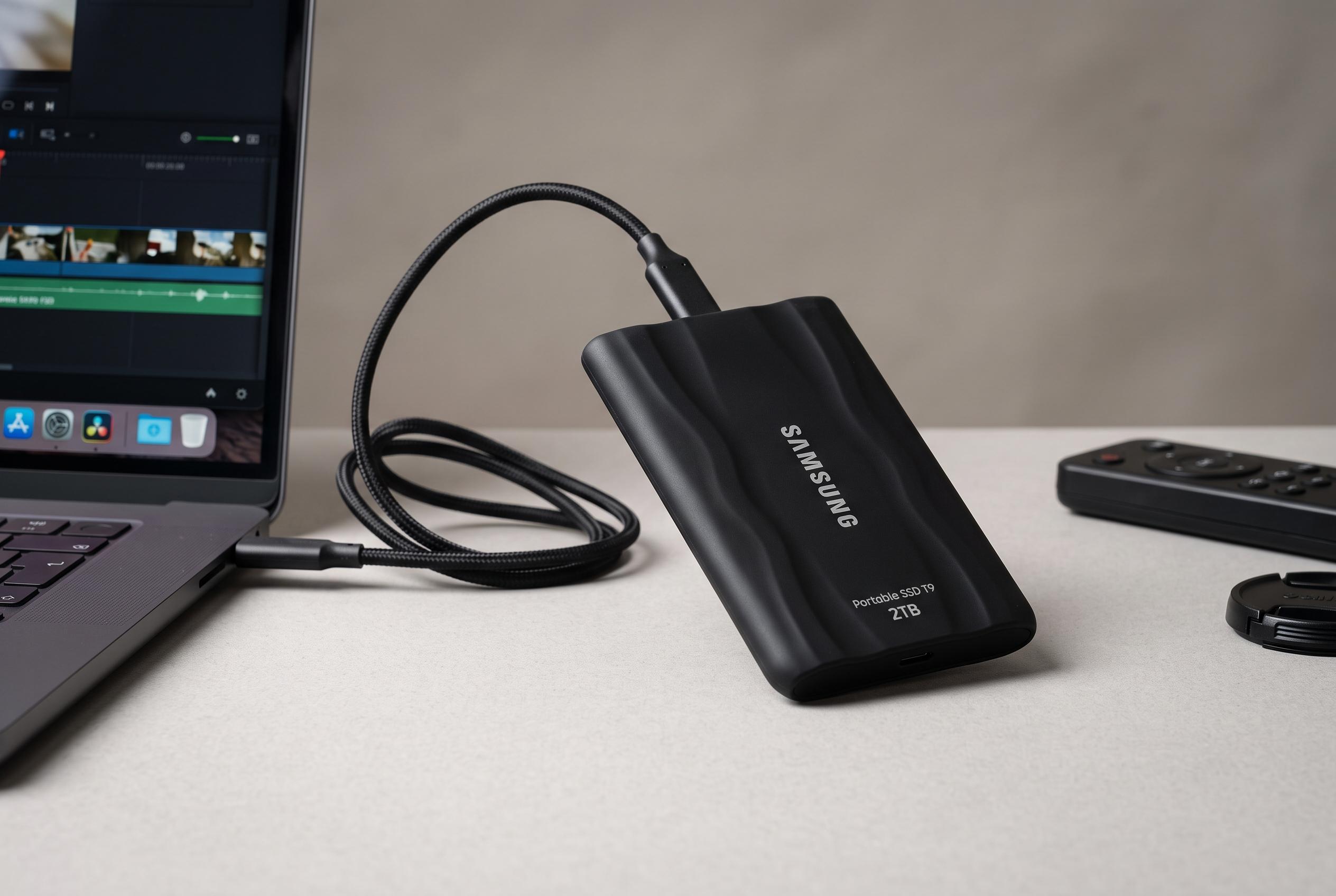

The Samsung T9 remains the preferred choice for editors needing reliable speed and durability, while the market also offers balanced options like the SanDisk Extreme and rugged Samsung T7 Shield, highlighting a shift towards durability and workflow-specific features.
The Samsung T9 remains the strongest all-round choice for editors who need a portable SSD that can keep pace with demanding video work. According to the article’s testing, it delivered the highest USB-based speeds in the roundup and held those speeds well during long transfers, which matters more in practice than a short burst peak. TechRadar’s review also points to the drive’s resilient casing, support for up to 4TB and the trade-off of a higher price and larger footprint than some rivals.
For creators who want a more balanced option, the SanDisk Extreme 2TB stands out as the most practical value pick. Tom’s Hardware described the latest Extreme model as a substantial step up from the original, with stronger performance and hardware-accelerated full-disk encryption, while Macworld highlighted its rugged build, competitive pricing and broad compatibility through USB-C and a USB-A adaptor. The drive is not built for Thunderbolt speeds, but for most 4K workflows it offers the right mix of capacity, portability and durability.
Durability is a recurring theme across the better-known creator drives, and it is one reason the Samsung T7 Shield keeps its place in professional kits. The article’s own field testing found it especially useful for location work where dust, moisture and knocks are real risks, and that is consistent with broader reviews that praise the Extreme family’s rugged design and security features. For editors who travel frequently, that kind of protection can be more valuable than a small increase in headline speed.
The article is also right to stress that interface choice matters as much as raw throughput. USB 3.2 Gen 2 is enough for most 4K editing, but Thunderbolt-class drives such as the OWC Express 1M2 are in a different performance bracket altogether. That extra headroom is useful for 6K and 8K work, although it comes with higher cost and, in some cases, more complicated setup. The practical lesson is simple: buy for your current workflow, not for a benchmark number you are unlikely to use.
What ties the whole comparison together is the point the article makes about backup discipline. No single SSD should be treated as the only copy of important footage. The most sensible setup is still a fast working drive, a separate backup SSD and a third copy on another medium or offsite. In that context, the best portable SSD is not just the fastest one, but the one that fits reliably into a wider storage strategy and can survive repeated daily use.
Disclaimer: This content is intended for informational purposes only. Readers are advised to exercise their own judgement, conduct due diligence, or consult a qualified expert before acting on any information provided.