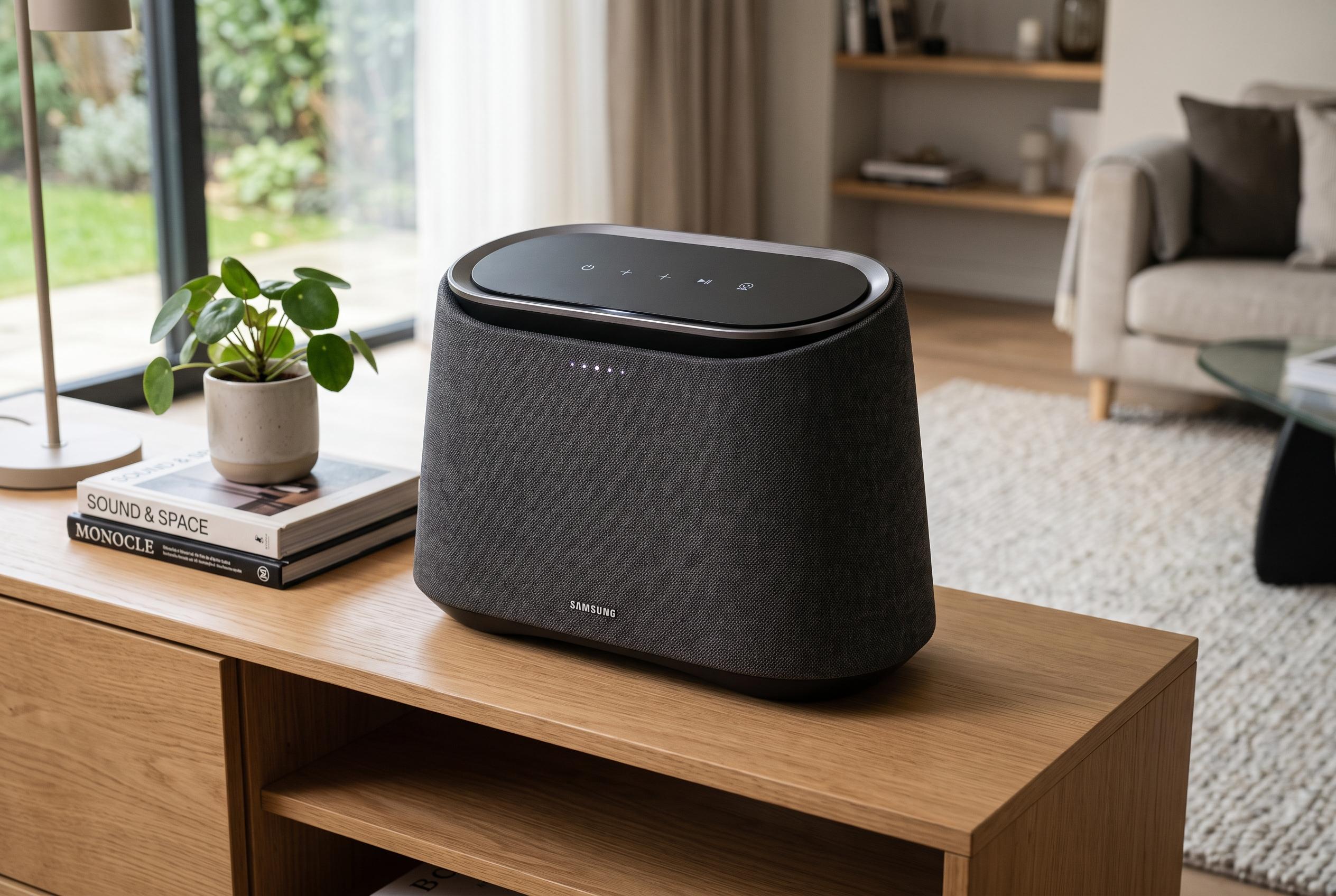

Samsung’s Music Studio 7 emerges as a versatile, high-end wireless speaker blending Dolby Atmos, HDMI eARC, and spatial audio innovation, targeting both home cinema and music enthusiasts seeking premium sound in a single device.
Samsung’s Music Studio 7 is a rare example of a wireless speaker that is trying to be both a serious hi-fi product and a practical living-room device. Available in black or white, it combines HDMI eARC, optical input, Wi-Fi streaming, Bluetooth, AirPlay 2, Google Cast, Spotify Connect, Tidal Connect and Roon support with Dolby Atmos playback and Samsung’s own room-correction tools. What Hi-Fi’s review suggests the concept is especially convincing when used with a TV, either as a single unit or, more effectively, as a stereo pair.
The hardware is unusual for the category. Samsung has hidden the drivers behind a minimalist front panel, while adding upward- and side-firing units for spatial effects. What Hi-Fi found that the design is not just decorative: it is built around Samsung’s Immersive Waveguide system and the pattern-control approach the company says helps direct sound more precisely. Samsung has also tied the speaker to its Eclipsa Audio format, an open spatial-audio standard developed with Google, which points to the Studio 7 being aimed at future as well as current content.
That technical ambition is matched by a strong feature set. Samsung’s SpaceFit Sound Pro is designed to measure the room and adjust output accordingly, while Active Voice Amplifier Pro is intended to improve speech intelligibility. Other reviews have echoed that this makes the Studio 7 versatile in mixed-use homes, with Techlicious describing it as quick to set up and flexible enough to work on its own or alongside other Samsung audio gear. T3 also notes the appeal of the top-panel controls and the speaker’s solid build.
Sound quality appears to depend heavily on how the Studio 7 is used. What Hi-Fi found streaming playback competent but not fully convincing until the speakers were connected through HDMI and fed high-quality material. In that configuration, the pair produced a far broader, more assured soundstage, with stronger low-end extension and better integration between channels. The publication said the room-correction system made a clear difference once it had had time to settle, adding warmth and filling in mid-bass that was otherwise missing.
Other testers have reached similar conclusions about the tuning, while also pointing to some limits. TechSpot praised the clarity and immersive presentation but warned that the speaker is physically large and can sound splashy at the top end. Netzwelt found the bass unusually deep and clean, even suggesting that a separate subwoofer may be unnecessary, while also noting that the system does not fully replicate the enveloping effect of speakers placed behind the listener. T3, meanwhile, said the bass can become excessive on more delicate material, especially if placement is poor.
Taken together, the Music Studio 7 looks like an ambitious attempt to move Samsung further into the premium speaker market without abandoning the company’s TV ecosystem. The strongest results come when it is treated less like a casual Bluetooth speaker and more like a compact home-cinema and music system. For buyers who want spatial audio, HDMI connectivity and broad streaming support in one enclosure, it appears to offer a compelling, if room-sensitive, package.
Disclaimer: This content is intended for informational purposes only. Readers are advised to exercise their own judgement, conduct due diligence, or consult a qualified expert before acting on any information provided.