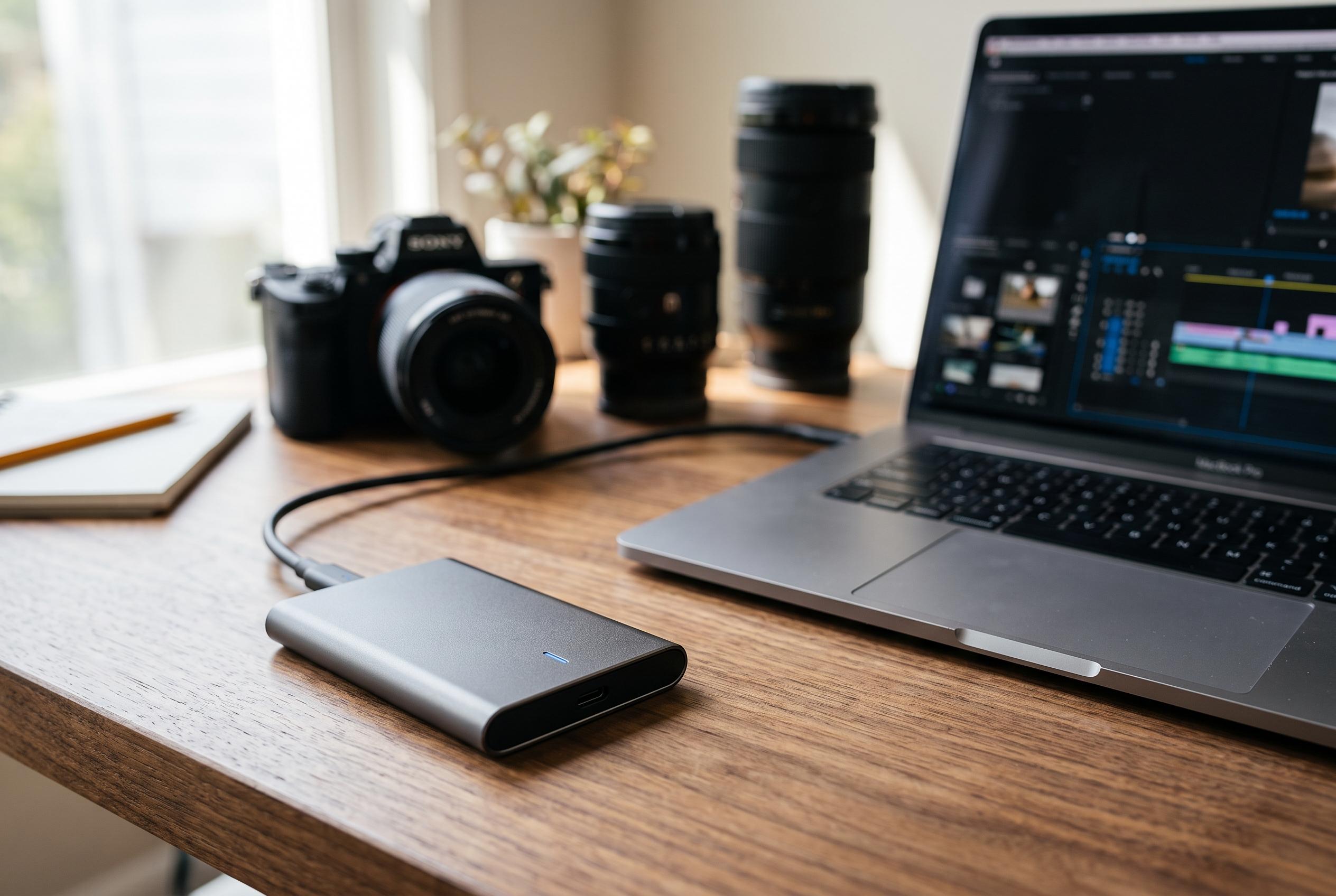

Samsung unveils its new P7 portable SSD, boasting up to 4,000MB/s speeds and a high-end price, positioning it as a premium solution for creators and frequent travellers seeking fast, durable external storage.
Samsung’s new P7 portable SSD has arrived with a clearer specification sheet than some of the first launch coverage suggested. While early reports in the first days after Gamescom did not list a full performance figure for the cheaper model, Samsung’s live product pages now describe the P7 as a USB4 Gen 3×2 drive rated for up to 4,000MB/s read and 3,800MB/s write speeds. At the same time, launch availability appears narrower than the headline 1TB-to-8TB range implies: ComputerBase reported that the first retail wave begins with 1TB and 2TB models, with larger versions to follow later. (digitalcameraworld.com)
That makes the P7 more ambitious, and more expensive, than the “everyday” label might suggest. GamesRadar+ said Samsung set US list prices at $289.99 for 1TB, $549.99 for 2TB, $1,149.99 for 4TB and $2,289.99 for 8TB. Digital Camera World published corresponding UK prices of £246.79, £493.49, £986.99 and £1,952.29. Those figures put the P7 below the flagship P9 in Samsung’s new P Series, but still firmly in premium territory for portable storage. Hermitage Akihabara, citing Samsung’s launch material, carried the same US pricing structure and said global sales were due to start on 31 August 2026. (gamesradar.com)
On paper, the technical package is strong. ComputerBase reported that both the P7 and P9 use USB4 Gen 3×2 at 40Gbps, support AES 256-bit hardware encryption, work with Samsung Magician software and carry a five-year limited warranty. It also listed the P7 at 90 x 65 x 8.3mm and 98g. That means Samsung is not simply selling extra headline speed; it is also moving its portable range on to a newer interface after arriving relatively late to USB4 external SSDs compared with some rivals. ThinkComputers added that Samsung is pitching the broader P Series as roughly a doubling of throughput over the older T9 generation, whose quoted ceiling is 2,000MB/s. (computerbase.de)
Compatibility is one of Samsung’s main selling points, but there is an important caveat. Launch coverage from Shane the Gamer said the P7 is aimed at consoles, PCs, laptops, phones and cameras, while Samsung’s product listings now extend that to tablets, smart TVs and newer Macs. Those pages also say the drive is backwards compatible with USB 3.2 Gen 2×2 and earlier USB devices, which should help with adoption, but top speeds depend on the host port and workload rather than the drive alone. Shane the Gamer explicitly warned that the 4,000MB/s figure remains a manufacturer claim until independent testing appears, and that a fast external SSD only performs at full pace when the connected system actually supports USB4. (shanethegamer.com)
Samsung is also leaning hard on ruggedness for mobile work. ThinkComputers said the P7 adds 2-metre drop-tested durability, and Hermitage Akihabara reported that the model had also passed vibration and shock tests. That matters because Samsung is pitching the drive not just for backups, but for moving large game libraries, media projects and high-resolution footage between devices and locations. The emphasis suggests the company sees the P7 less as a simple successor to older pocket SSDs and more as a carry-everywhere working drive for creators and frequent travellers. (thinkcomputers.org)
There is, however, some blurring in the launch message. Samsung’s own US newsroom presentation tied 12K direct recording and the “world’s first 8TB USB4” language most closely to the flagship P9 and to the broader P Series. Several third-party reports, including GamesRadar+, ThinkComputers and Shane the Gamer, likewise attached that “first” claim to the P9 rather than the P7. By contrast, Samsung’s current P7 product pages describe direct recording support more generally on compatible devices, including selected phones, but do not frame the P7 as the lead 12K product. The practical distinction is clear enough: the P9 is the performance-led model, while the P7 is the lower-priced version intended to bring much of the same interface upgrade to a wider audience. “With fast file storage and backup, the P Series is designed to provide professionals and everyday users alike with the performance they need to work efficiently across a wide range of applications,” Tommy Kwon, a Samsung vice-president, said in the company’s launch statement. (news.samsung.com)
As of Monday, 7 September 2026, the picture is therefore more complete than it was at launch, but not fully settled. Samsung’s official material points to a September 2026 global rollout, ComputerBase says Europe starts with the 1TB and 2TB versions before higher capacities arrive in the following months, GamesRadar+ reported that US retailers had not yet begun listing stock when it wrote, and Shane the Gamer said pricing for Australia and New Zealand was still unavailable. For buyers, the appeal is straightforward: USB4, smaller transfer windows and capacities reaching 8TB. The harder question is whether those gains justify pricing that pushes the top P7 model well past the cost of many full desktop PCs. (news.samsung.com)
Disclaimer: This content is intended for informational purposes only. Readers are advised to exercise their own judgement, conduct due diligence, or consult a qualified expert before acting on any information provided.