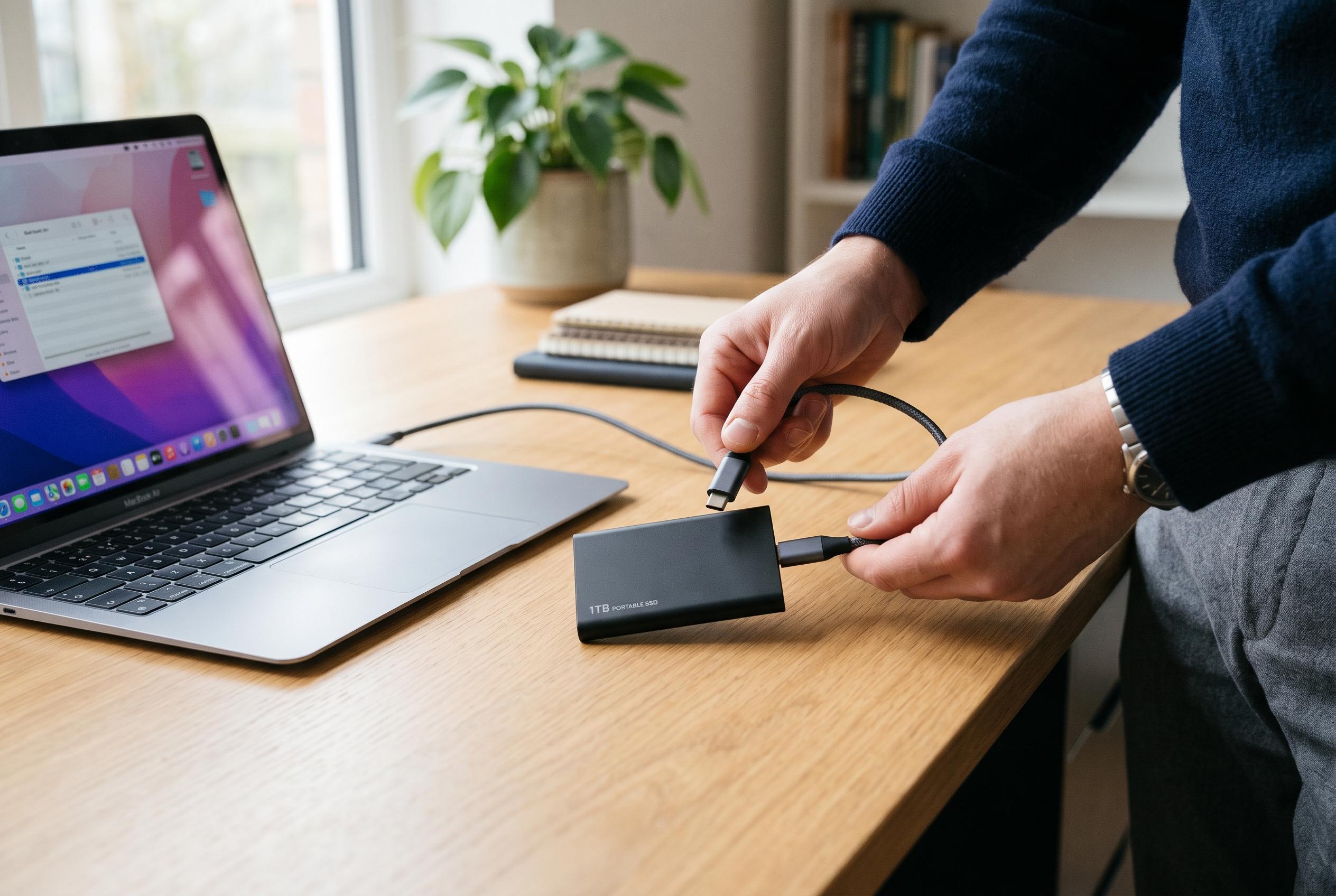

Samsung’s P9 and P7 signal that USB4 is moving into mainstream premium storage, but buyers will need the right ports and workloads to benefit from the extra speed.
Samsung’s Portable SSD P9 has shifted the portable storage conversation towards USB4, rather than simply faster branding. According to Samsung’s Gamescom 2026 announcement, the drive reaches up to 4,000MB/s read and 3,800MB/s write, with capacities from 1TB to 8TB, making it the company’s first 8TB USB4 portable SSD. That matters because the P9 is no longer a niche flagship: it is a clear signal that the highest end of the consumer portable SSD market is moving beyond the long-dominant 2,000MB/s class.
The practical question for buyers is whether that extra headroom is actually useful. For anyone transferring large photo libraries, 4K or 12K video files, or working directly from external storage, the answer is increasingly yes, provided the computer has a USB4 or Thunderbolt port. If the host machine tops out at USB 3.2 Gen 2×2, however, the benefits of a USB4 drive are largely wasted. In that case, a drive such as Samsung’s older T9 still makes sense, because it already matches the ceiling of that interface class.
The LaCie Rugged SSD4 sits in the same performance bracket as the P9 but takes a different route to value. Reviews from PCWorld and Tom’s Hardware both describe USB4 performance of up to 4,000MB/s read and 3,800MB/s write, along with an IP54 dust and water rating and resistance to drops of up to 3 metres. That combination makes it more suitable for field use than a bare desktop-style portable SSD, especially for photographers and video crews carrying drives in bags, cases and camera kits.
Capacity and price positioning are the other side of the decision. Samsung’s P9 is available in 1TB, 2TB, 4TB and 8TB versions, while the LaCie Rugged SSD4 comes in 1TB, 2TB and 4TB sizes. The P9 therefore fills the top-end capacity gap in this comparison, while the LaCie drive focuses on durability and sustained professional use. Samsung’s announcement also frames the P9 as a workflow device for tasks such as 12K video recording, which is a reminder that the market is now segmenting by actual production need rather than by a single speed figure alone.
Samsung’s P7 complicates the picture further. Announced alongside the P9, it also uses USB4 and is pitched as a lower-cost alternative for everyday devices. Samsung Mobile reported that the P7 is designed for broad compatibility across computers, smartphones, consoles and cameras, while maintaining the same 1TB to 8TB capacity ladder. That leaves Samsung with a clear three-tier structure: the T9 for 2,000MB/s USB 3.2 systems, the P7 for cheaper USB4 access, and the P9 for buyers who want the full flagship specification.
For most readers, the choice comes down to port matching rather than raw benchmark chasing. A USB4 drive cannot outperform the connection it is attached to, and many laptops still hide one fast port among several slower USB-C sockets. If the machine has USB4 or Thunderbolt and the workload involves frequent large transfers, the P9 is the cleanest performance choice. If the drive will spend its life in a camera bag or out in the field, the Rugged SSD4 is the more resilient option. If the computer cannot use USB4 speeds at all, the smarter purchase is still a strong USB 3.2 Gen 2×2 model rather than paying for unused bandwidth.
The broader market trend is clear enough: portable SSD buyers are being asked to choose between interface headroom, durability and price more carefully than before. The arrival of Samsung’s P9 and P7 shows that USB4 is moving from early adoption to mainstream premium territory, while LaCie continues to target professionals who want protection as much as speed. For anyone shopping in 2026, the right drive is now less about the fastest number on the box and more about whether the computer, the cable and the workload can actually use it.
Disclaimer: This content is intended for informational purposes only. Readers are advised to exercise their own judgement, conduct due diligence, or consult a qualified expert before acting on any information provided.