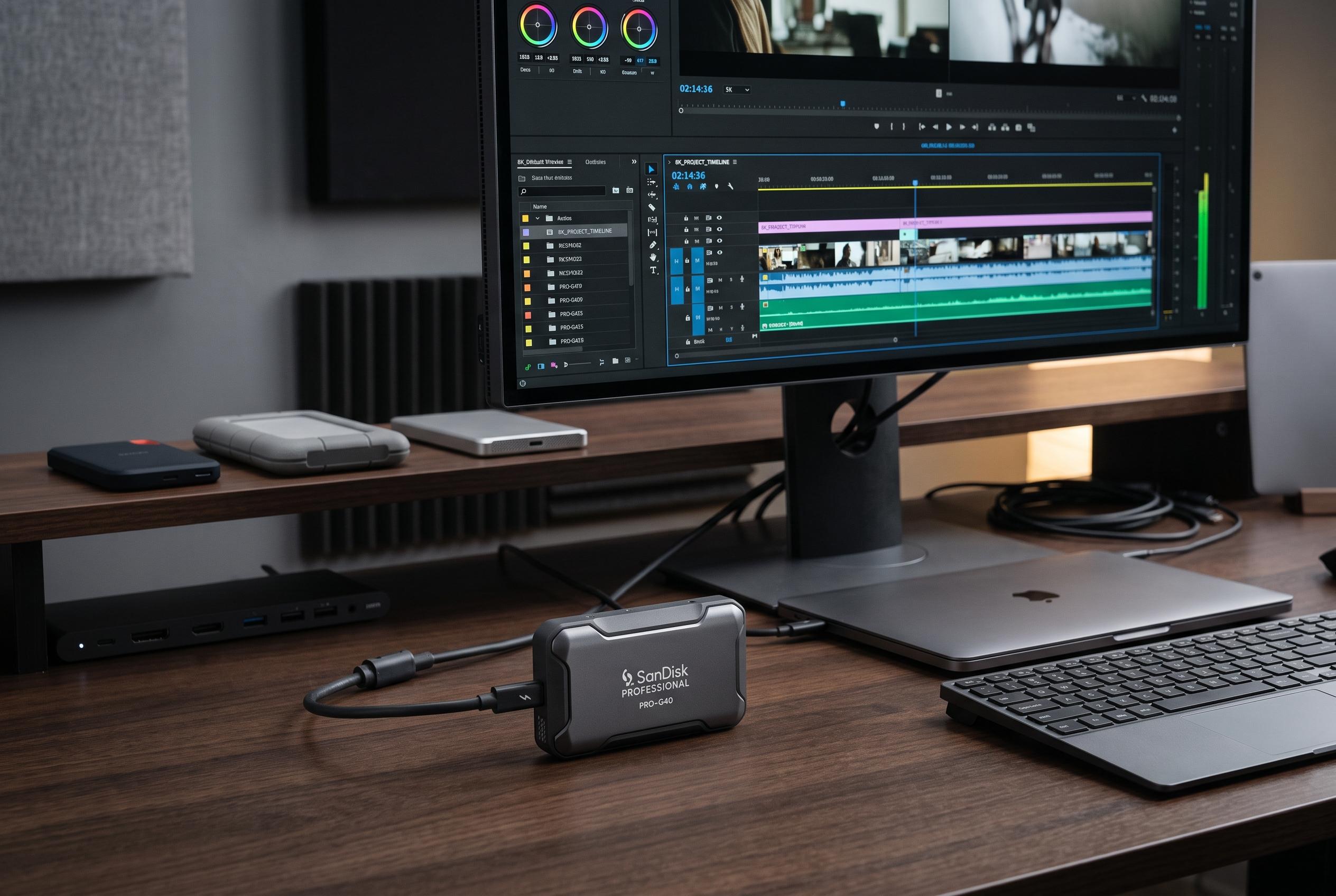

In the demanding realm of 8K video editing, the SanDisk Professional PRO-G40 stands out as the top choice for speed and reliability, while the Samsung T9 offers a balanced solution for most filmmakers, and budget options like the Crucial X10 Pro meet essential needs without breaking the bank.
For editors working in 8K, storage is not a background purchase but part of the workflow itself. The wrong drive can slow ingest, break playback and force constant offloads in the middle of a shoot. In the source article, the SanDisk Professional PRO-G40 is presented as the strongest all-round choice for this class of work, with the toughest case and the fastest sustained performance of the group. Independent reviews from TechRadar, Tom’s Hardware and Tech Advisor broadly support that view, noting its dual Thunderbolt and USB support, strong sustained writes and unusually rugged IP68-rated build.
What makes the PRO-G40 stand out is not peak speed alone but consistency under load. The drive is described as reaching around 3,000MB/s over Thunderbolt 3 in the source material, while TechRadar records up to 2,700MB/s and Tom’s Hardware praises its class-leading sustained write performance. That matters more for 8K than headline burst figures, because long edits, multi-layer timelines and cache-heavy grading sessions punish drives that throttle early.
The Samsung T9 sits in the middle of the market and looks like the most practical option for many filmmakers. The source article positions the 2TB model as the best value pick, while TechRadar notes that the T9 uses USB 3.2 Gen 2×2 and is available up to 4TB. That combination gives it enough speed for single-stream 8K work and enough capacity for smaller productions, without pushing buyers into the cost of a Thunderbolt-focused enclosure.
For crews that need a more affordable entry point, the Crucial X10 Pro is presented as the budget option. It is lighter than most rivals and, according to the source article, still reaches about 2,100MB/s read speeds, which is enough for basic 8K playback and shuttle use. Digital Camera World’s wider 2026 video-editing guide also underlines that portable SSDs such as the Samsung T7, PNY RP60 and SanDisk Pro-G40 remain the kinds of drives video professionals should consider, depending on speed and budget.
The article also makes a clear distinction between speed drives and field drives. The Samsung T7 Shield is presented as the rugged choice for location work, where dust, rain and drops matter as much as transfer rates. SanDisk’s Extreme PRO occupies a similar role, with hardware encryption and a forged aluminium body aimed at professionals who want security and durability alongside respectable performance. For travel shoots and documentary work, those traits can matter more than an extra few hundred megabytes per second.
Capacity remains the decisive constraint. The source article argues that 2TB is the minimum sensible starting point for 8K work, while 4TB is the safer practical target for longer shoots or projects that generate large caches and backups. That is a fair conclusion: 8K media fills space quickly, and the cost of constant drive swapping is usually greater than the cost of buying more storage at the start.
Taken together, the evidence points to a simple hierarchy. The PRO-G40 is the best premium choice for demanding 8K editing, the Samsung T9 is the most balanced option for most filmmakers, and the Crucial X10 Pro is the sensible low-cost entry point. For crews working outside the studio, the T7 Shield and SanDisk Extreme PRO add the physical resilience that fast but fragile drives often lack. In other words, the right SSD for 8K is the one that matches both the size of the project and the conditions of the shoot.
Disclaimer: This content is intended for informational purposes only. Readers are advised to exercise their own judgement, conduct due diligence, or consult a qualified expert before acting on any information provided.