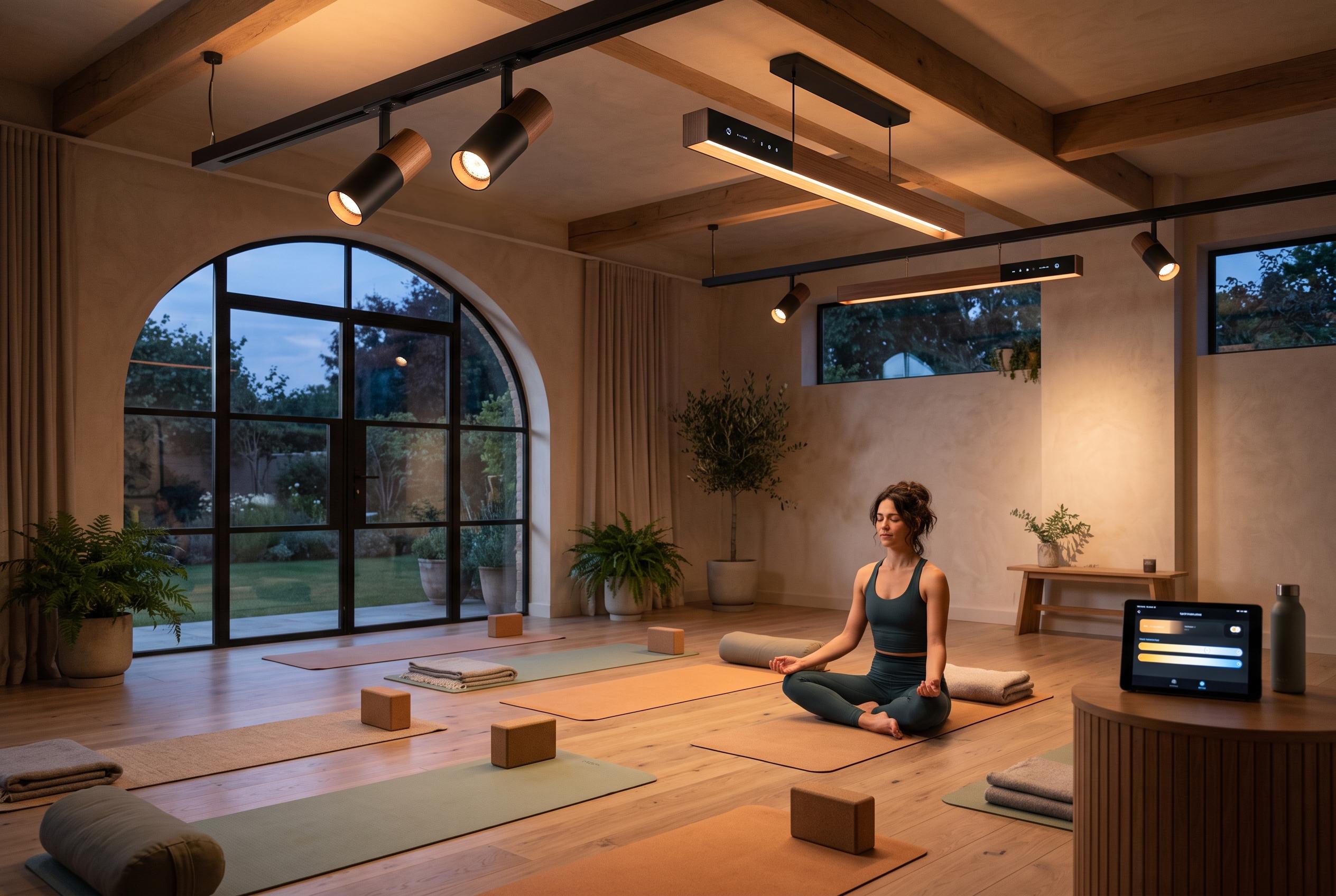

Innovative smart lighting solutions are increasingly shaping yoga spaces, offering instructors and practitioners the flexibility to create energising or calming atmospheres through adjustable, intuitive controls that support diverse practice needs.
Smart lighting has become a practical part of yoga-room design rather than a novelty. For instructors, studio owners and home practitioners, the main value is control: the same space can move from energising movement to restorative calm without changing fixtures. The strongest options are those that combine dimming, tunable white light, simple app or voice control, and a low-profile look that supports focus rather than distraction.
That approach fits the way yoga spaces are commonly lit. Lighting specialists advising on yoga-room design generally recommend soft ambient light, as much natural light as possible, and fixtures that can be dimmed to suit the class. Some also suggest layering light rather than relying on one source, so a studio can use brighter illumination for setup and cleaning, then shift to lower levels for meditation or slower flows. In practice, that means ceiling lights, floor lamps and accent pieces each have a role.
Among the more flexible products are smart floor lamps and table lamps that can act as scene-setting pieces. The Lepro TB1, for example, is designed around colour effects, music synchronisation and app-based scene creation, which suits warm-up areas or relaxation corners more than general room lighting. SwitchBot’s RGBICWW floor lamp takes a similar approach but adds Matter support, tunable white light and broader smart-home compatibility, making it easier to integrate into mixed-use spaces. These products are useful when atmosphere matters as much as illumination.
For spaces that need cleaner, more even coverage, ceiling-mounted options are usually the better fit. Recessed or flush-mount smart fixtures can provide adjustable white light as well as colour scenes, which is helpful in studios that switch between yoga, Pilates and general exercise classes. A ceiling panel with remote and app control is especially practical where staff need quick adjustments between sessions. That matters because studio lighting should be easy to change, not something that slows down turnover between classes.
Directional lighting has a narrower purpose, but it can still be valuable. A mirror-mounted or adjustable light is better for instructor demonstrations, posture checks and targeted visibility than for whole-room ambience. In a similar way, decorative neon-style signs and candle warmer lamps are best treated as accent pieces. They can define a reception area, meditation nook or brand wall, but they should not be mistaken for primary studio lighting.
The technical details matter as much as the style. Lighting guides for yoga studios often distinguish between active practice zones and quieter meditation areas, with brighter output needed where movement is involved and much softer light preferred where the goal is stillness. That is why dimming range, colour temperature and zoning are more important than decorative effects alone. A good setup should let operators move from warm white for calm sessions to cooler light for cleaning or preparation, while preserving a comfortable visual environment.
For buyers, the simplest rule is to think in layers. Use one fixture for the room’s main light, another for mood or corner lighting, and a decorative piece only if the studio needs visual identity. The best smart lighting for a yoga studio is not the most dramatic; it is the one that supports comfort, control and consistency across different kinds of practice.
Disclaimer: This content is intended for informational purposes only. Readers are advised to exercise their own judgement, conduct due diligence, or consult a qualified expert before acting on any information provided.