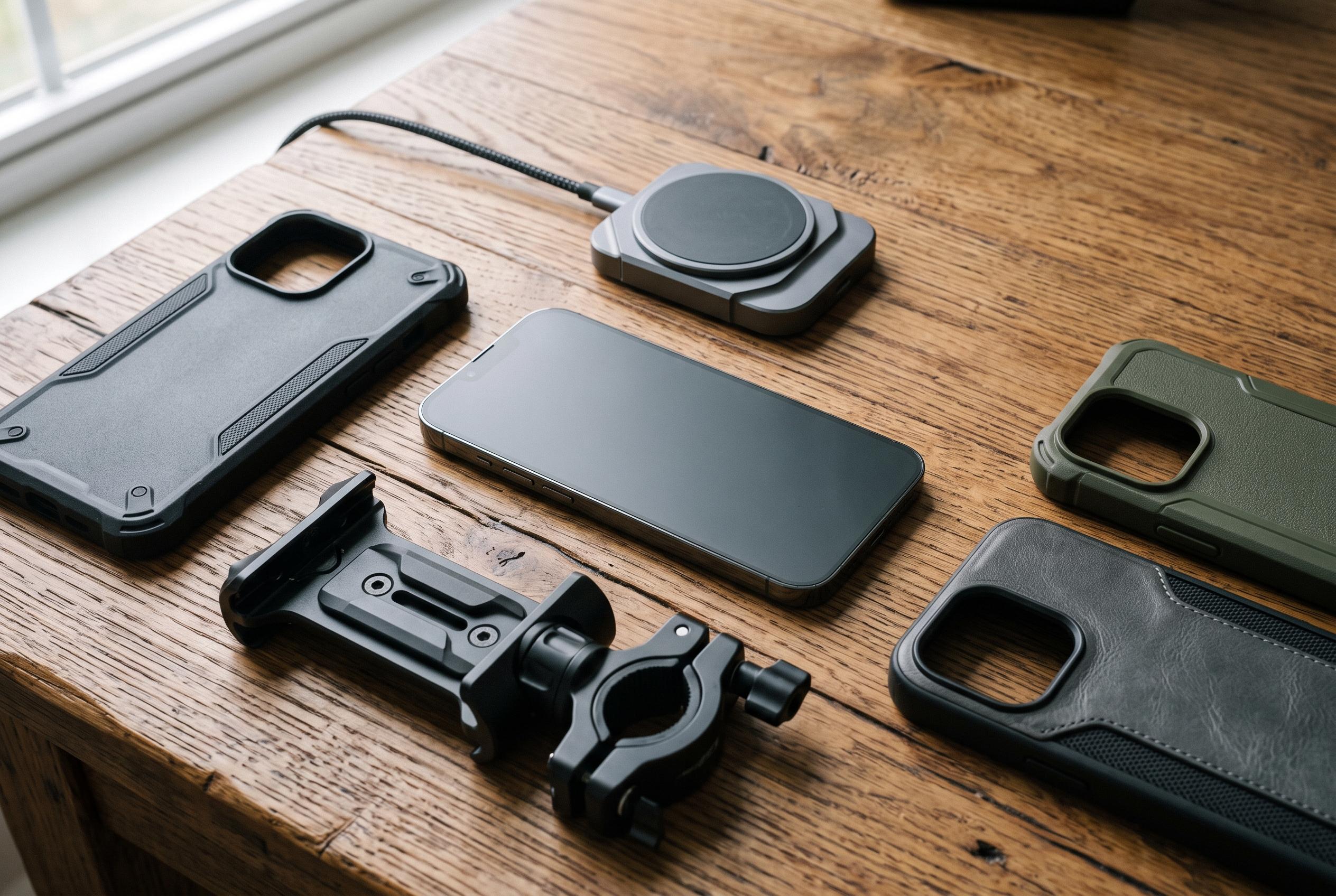

A shift in smartphone accessory buying emphasises system integration and durability over style, with innovative cases, chargers, and mounts setting new standards for everyday users.
Smartphone accessory buying has shifted from simple add-ons to a matter of system design. The best choices now balance protection, charging speed, convenience and compatibility, rather than style alone. For most buyers, the sensible order is clear: start with a case and screen protection, then move to cables, power banks, audio and in-car mounts. That approach reduces the risk of wasted spend and avoids accessories that look useful but fail in daily use.
Cases remain the most important first purchase. A modern case should fit exactly, allow access to ports and buttons, and support wireless charging where relevant. Tom’s Guide recently highlighted the Xtrem Inno iPhone 17 Pro case for its integrated e-ink display, which can show custom images or icons without needing its own battery. Green Lion makes a similar Smart E-Ink Case for the iPhone 17 Pro and Pro Max, using passive NFC to power display updates and keeping MagSafe charging available. These products show how cases are now doing more than absorbing shocks, but their model-specific compatibility means buyers must check device support carefully before ordering.
Screen protection still matters, even as handset glass improves. For televisions, Tom’s Guide’s recent 75-inch buying guide underlines a wider point: display size, brightness and glare handling all shape the viewing experience, and the same logic applies to phone screens. A good protector should preserve clarity, resist scratches and fingerprints, and not interfere with touch sensitivity. Anti-glare coatings and blue light filtering may also help for long viewing sessions, although they can slightly alter brightness or colour balance. Poorly made films that bubble, peel or reduce sensitivity are rarely worth the savings.
Charging cables are another area where quality pays off. Anker’s Prime USB-C to USB-C cable is built for high-wattage charging, with support for up to 240W and claimed durability beyond 300,000 bends. That kind of specification matters because many current phones, tablets and laptops now rely on USB-C for both power and data. Buyers should check the charging standard their device supports, confirm the connector type, and choose a length suited to home, office or travel use. A strong cable reduces wear, lowers the risk of intermittent charging and is more likely to survive repeated folding and packing.
Power banks need a different kind of judgement. Capacity is important, but so are output, recharge speed and portability. Anker’s Prime Power Bank, with a 26,250mAh battery and 300W total output, is aimed at users who need to charge more than one device and do so quickly. That makes it useful for commuters, travellers and professionals carrying a phone plus laptop or tablet. The trade-off is size and weight. Smaller packs are easier to carry, but they often deliver fewer full charges and slower top-ups.
Wireless earbuds have become one of the most visible upgrades in everyday mobile use. Sennheiser’s Momentum True Wireless 5 is positioned as a premium option, with high-fidelity sound, up to 40 hours of battery life with the case and IP54 dust and splash resistance. The lesson for buyers is that comfort and seal matter as much as codec support or noise cancellation. Earbuds that fit badly can sound thin, leak audio and become painful over longer sessions. Those choosing between budget and premium models should weigh battery life, call quality and app support alongside sound signature.
Car mounts are often overlooked until they fail. Vanmass’s mount is built around strong suction and wide surface compatibility, which is useful if a driver wants a stable hold on a dashboard, windscreen or vent. The real test for any mount is not only grip, but ease of use under motion: one-handed placement, adjustable viewing angles and predictable removal all matter. For road safety, the mount should keep the phone visible without encouraging the driver to fumble or look away for too long. In that sense, the best mount is the one that disappears into the background once fitted.
The practical way to shop is to prioritise. Start with protection and charging, because those items affect both daily convenience and device lifespan. Then add audio and in-car accessories according to how the phone is used most often. For buyers considering premium accessories such as e-ink cases or high-output power banks, the deciding factors should be compatibility, not novelty. When chosen carefully, accessories should make the phone more durable, more useful and easier to live with.
Disclaimer: This content is intended for informational purposes only. Readers are advised to exercise their own judgement, conduct due diligence, or consult a qualified expert before acting on any information provided.