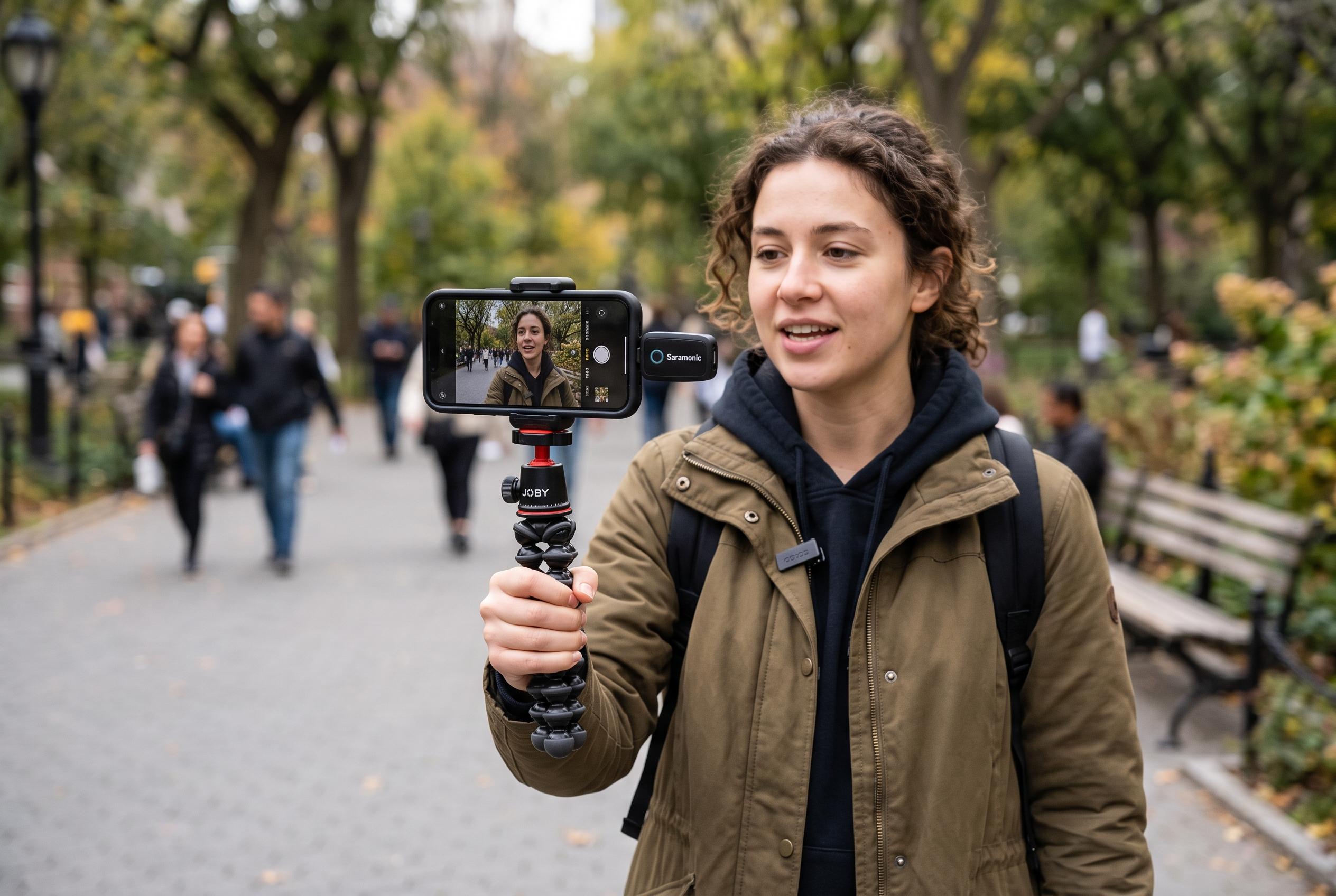

Sony’s 24g USB-C microphone is designed to give vloggers and mobile filmmakers directional, immersive sound without a full recording rig.
Sony has added a compact spatial-audio microphone for smartphones to its pro-audio line-up, pitching the ECM-AX10 at vloggers, mobile filmmakers and other creators who want to capture more directional sound without carrying a full recording rig. According to Sony’s announcement, it is the first smartphone microphone to receive Eclipsa Audio certification, which is intended to support immersive video production for YouTube. The company has set the price at $249.99, while RedShark reported that pre-sales are already under way.
The ECM-AX10 uses a spherical microphone module with four omnidirectional capsules, a design Sony says helps recreate a stronger sense of space, direction and distance than a conventional smartphone mic. It connects directly to compatible handsets through USB-C and weighs about 24 g, so it is unlikely to add much bulk to a compact mobile setup. Sony’s product listing also says the microphone includes measures to reduce unwanted wind and background noise, which should make it more practical for outdoor recording and run-and-gun shooting.
Sony has built three recording modes into the device. Ambisonics is aimed at spatial audio production and works with Sony’s Spatial Audio Video Tool app for publishing content in Eclipsa Audio on YouTube. Binaural mode uses Sony’s own spatial-audio processing, the same broad approach that underpins its 360 Reality Audio ecosystem, and is intended for listening through headphones when Eclipsa Audio is not supported. Stereo mode provides a more familiar output for standard video work and everyday social content. Sony says the related app also lets users record, review, make basic edits and export spatial-audio clips from a smartphone, which brings more of the workflow on device.
Compatibility remains an important consideration. Sony says it has tested the ECM-AX10 with a range of smartphones, including devices from Xperia, Galaxy, Google Pixel, Oppo, Xiaomi and the iPhone 15 to 17 Pro Max families, although it warns that recording quality can vary depending on handset performance and that support may change over time. That broader device list suggests Sony is trying to position the microphone as a cross-platform accessory rather than a niche add-on for its own phones alone. In Japan, Sony says the microphone is scheduled for release on 23 October 2026, and the company’s Japanese product page lists accessories including a windscreen, USB cable, shoe-mount holder and spacer sheet.
Disclaimer: This content is intended for informational purposes only. Readers are advised to exercise their own judgement, conduct due diligence, or consult a qualified expert before acting on any information provided.