
A detailed analysis of a failed Anker A8730 cable uncovers that many USB-C-to-HDMI ‘cables’ are actually active adapters with embedded conversion circuitry, challenging the perception of plug-and-play simplicity.
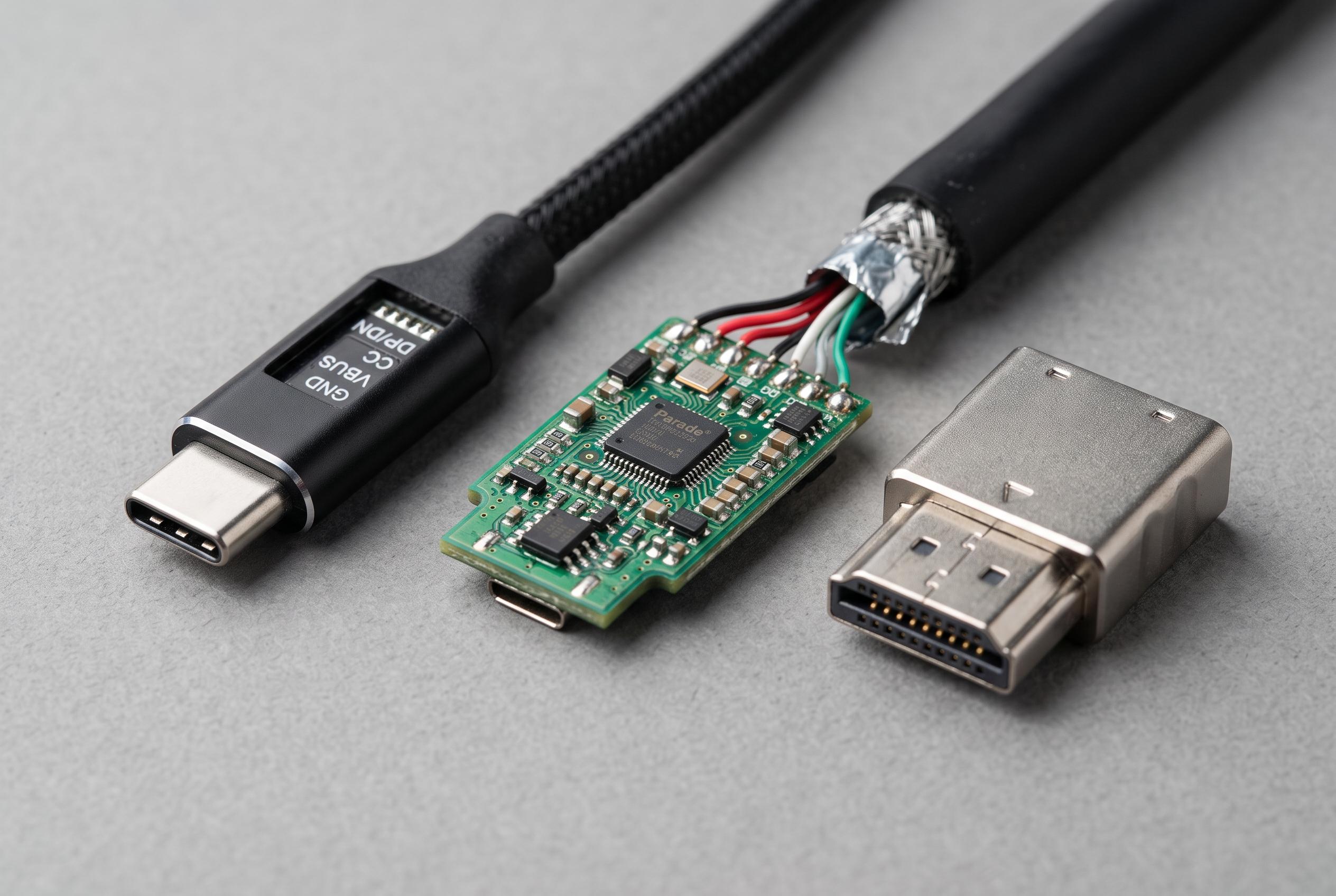
A teardown of a failed Anker A8730 has turned a routine desktop fault into a useful reminder that many USB-C-to-HDMI “cables” are not passive leads at all. Inside the enlarged HDMI end, EDN found an active DisplayPort-to-HDMI conversion board, and comparable products sold by Delock, StarTech and SIIG list the same Via Labs VL100 and Parade PS176 chipset pairing. In practical terms, that means a product sold as a simple display lead is closer to a miniature video adaptor.
That distinction matters because the failure first looked like software. In the EDN test setup, a 2018 Mac mini was driving one Dell 4K panel from its built-in HDMI port and a second through the Anker lead on Thunderbolt 3. After one macOS update the second screen vanished, then briefly returned when the cable was moved to another port, only to fail again and later refuse to work on a Windows-on-Arm development kit as well. Anker’s own FAQ presents the A8730 as a plug-and-play product for the A8176 and A8730 family, says no software or drivers are needed, and states that a 2018 iPad Pro can be connected directly to a television’s HDMI input. That official simplicity helps explain why the host computer, rather than the lead itself, was the first suspect.
The underlying transport is less simple than the packaging suggests. SIIG says DisplayPort Alt Mode over USB-C is required “for this cable to function properly”, and StarTech makes the same point in its datasheet by noting that the USB-C port must support DisplayPort over USB-C rather than merely providing a Type-C socket. Delock’s adaptor sheet extends that compatibility across macOS 10.12 and later, Windows 7 through 11, Linux kernel 4.3 and newer, Chrome OS, Android 6.0 and later, and the 2018 iPad Pro. The common thread is that these products rely on video lanes being repurposed over USB-C, not on generic USB data alone.
That is also why the EDN dissection is technically credible beyond one damaged sample. Delock identifies the VL100 and PS176 as the controller pair in its own USB-C-to-HDMI adaptor with charging, while StarTech uses the same two chips in a 3m 4K cable and notes that the “adapter chip is built into HDMI connector”. SIIG lists the identical VL100+PS176 combination in its hardware table. Three separate vendors describing the same architecture strongly suggest a standard design pattern for this class of accessory.
Parade’s documentation shows what the larger of those two chips is doing. The PS176 is described as a DisplayPort-to-HDMI 2.0 converter for cable adaptors, monitors and other protocol-conversion uses. It accepts DisplayPort 1.1a, 1.2a, 1.3 and 1.4 inputs, and can deliver up to 4096 x 2160 at 60Hz with 24-bit colour and 4:4:4 sampling from a four-lane HBR2 link. Parade also says the part includes an on-chip microprocessor with internal SPI ROM that can be field-updated, plus I2C support for system control and external EDID functions, alongside HDCP 1.4 and 2.3 and up to eight channels of LPCM audio at 192kHz. That specification makes it reasonable to infer that when one of these leads starts failing, the symptoms can resemble a display-identification or handshake problem rather than a dead piece of wire.
The rest of the market reinforces the same point. SIIG advertises 7.1-channel LPCM audio, no driver installation and no external power adaptor. BCI Imaging’s listing for a similar C2G cable says the form factor removes the need for a separate adaptor and lead, while still promising 4K output, plug-and-play use and compatibility with the iPad Pro, MacBook, MacBook Air, MacBook Pro and Microsoft’s Surface line. These are consumer-friendly claims, but they describe an active conversion device hidden inside a cable-shaped enclosure.
That hidden complexity may also help explain why diagnosis can go wrong. StarTech specifies an operating range of 0C to 45C for its version, while SIIG quotes 32F to 140F for the adaptor body, and both vendors place the critical electronics in a very small housing at the display end. The EDN teardown did not isolate a single failed component, so any claim about the exact fault would go too far. Even so, once voltage regulation, clock generation, firmware storage, HDCP handling and EDID exchange are packed into a sealed shell, a years-old 4K60 lead has more potential failure points than buyers usually assume.
The broader lesson is practical rather than philosophical. When a USB-C display connection breaks after an operating-system update, the neat story is to blame the software build or the host port. This case points in the other direction: the simplest explanation may be that the “cable” is really a compact converter and has started to fail. Official material from Anker, Parade, Delock, StarTech, SIIG and BCI all supports the same conclusion that USB-C-to-HDMI accessories sold as effortless, driverless add-ons are small pieces of display hardware in their own right.
Disclaimer: This content is intended for informational purposes only. Readers are advised to exercise their own judgement, conduct due diligence, or consult a qualified expert before acting on any information provided.