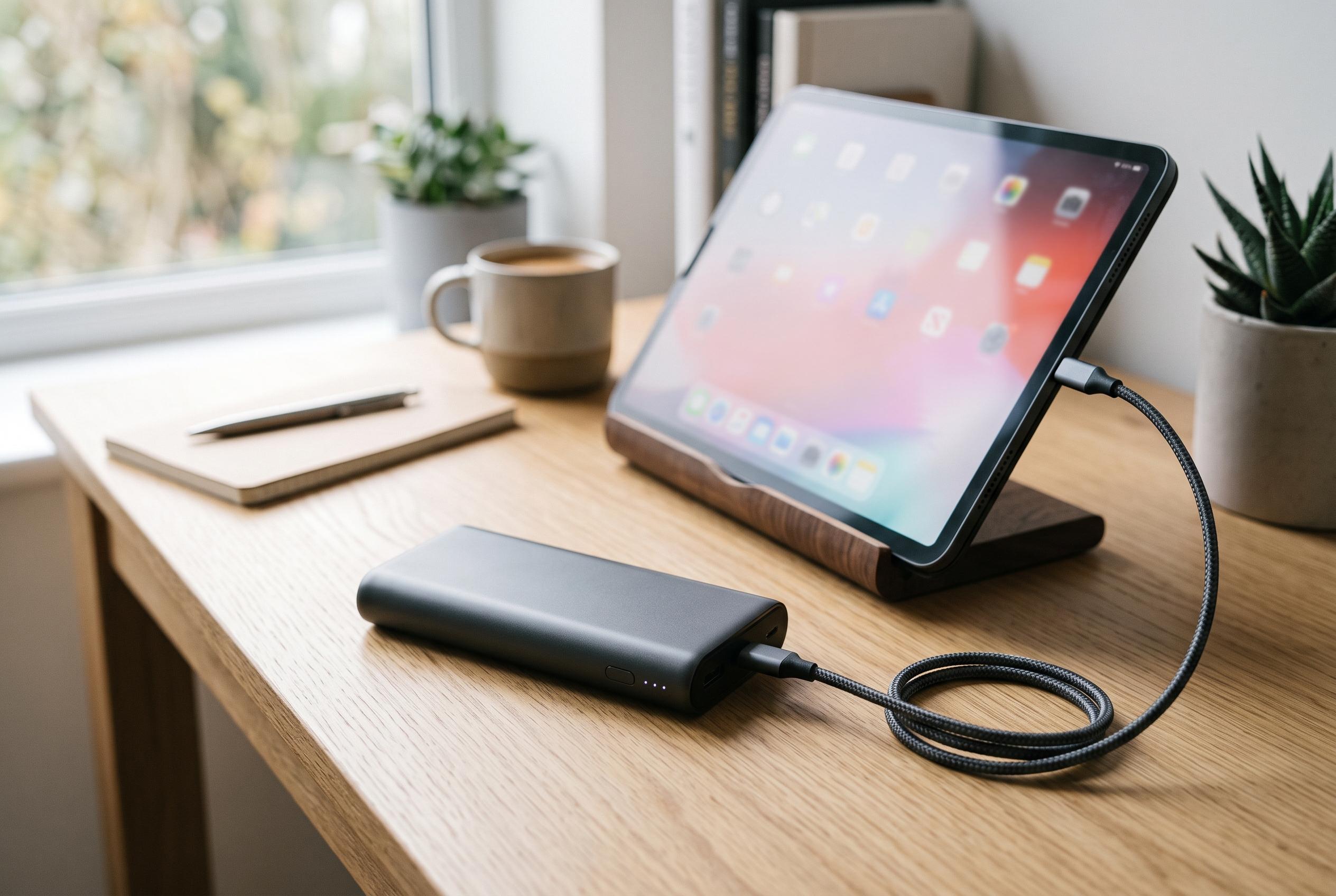

Five 20,000mAh-plus power banks take different approaches to portability, charging power and cable convenience , with UGREEN offering the strongest all-round balance.
An iPad does not need a 100W power bank to keep going, but that does not mean a high-output pack is wasted. In practice, the better purchase is the one that matches your bag, your cable needs and the number of devices you want to charge at once. The strongest candidates in the current US market all start at 20,000mAh, but they serve very different kinds of travellers and desk setups.
Anker’s Laptop Power Bank 25K is the most ambitious option here. The company says it carries 25,000mAh of capacity, includes two built-in USB-C cables, offers three USB-C ports plus a USB-A port, and can reach a combined 165W when two USB-C connections are used together. It is also the heaviest pack in this group at 595g, or 21 ounces, and its 90Wh rating keeps it within common airline rules for spare batteries. That makes it a sensible choice for people who want one battery to cover an iPad, a laptop and smaller accessories without carrying separate chargers and loose leads. The trade-off is obvious: this is a backpack power bank, not a slim daily carry item.
UGREEN’s Nexode 20,000mAh 130W model is the most balanced all-rounder. According to UGREEN, it combines a 100W USB-C port, a second USB-C port rated at 30W, and a USB-A port rated at 22.5W, all in a vertical body that saves desk space. The company also says the pack uses automotive-grade batteries and retains more than 80% of its capacity after 1,000 cycles. For most people, that makes it the clearest compromise between weight, output and everyday usefulness: enough power for an iPad and phone, with real headroom for an occasional laptop charge when needed.
Baseus takes a different approach with the Blade H1. The company describes it as a flat, square 20,000mAh pack measuring 13.4 by 13.4cm and 1.8cm thick, with two USB-C ports, two USB-A ports, a 100W maximum output and a display. Its appeal is practical rather than dramatic. A power bank shaped like a slab lies more neatly beside a tablet or laptop in a sleeve, instead of forming a single thick lump at the bottom of a bag. At about 451g, it is not light, but it is easier to organise than a more bulbous pack if you care about packing geometry.
Belkin’s BoostCharge 20K 30W is the simplest iPad-first option in the group. Belkin says it includes an integrated USB-C cable, another USB-C port and a USB-A port, with up to 30W total output shared across three connected devices. That lower ceiling makes it less appealing for laptop users, but it also makes the product easier to understand than a more complex high-wattage pack with detailed power-sharing rules. For anyone whose main need is to recharge an iPad and a phone without thinking too hard about port allocation, that simplicity is the point.
INIU’s P62-E1 sits between compactness and flexibility. The company lists a 20,000mAh battery, a 65W maximum single-port output, three ports, and a short detachable USB-C cable that also functions as a carrying loop. It is also the cheapest of the five models considered here. That combination makes it a good fit for users who want a smaller 20K pack than the Anker, but still want enough output to be useful with a compatible laptop as well as an iPad and phone. Its display shows remaining charge rather than relying on a row of LEDs, which is a small but useful improvement in day-to-day use.
For iPad owners, the more important question is not headline wattage but compatibility and behaviour. USB-C devices negotiate the power they draw, so a larger power bank does not force an iPad to charge faster than the tablet allows. What higher output really buys is versatility: the ability to charge a laptop, top up a phone and keep headphones alive from the same battery. Buyers should also check the cable rating, because not every USB-C lead can carry the maximum output a power bank advertises. On the travel side, airline and FAA rules generally require spare lithium batteries to stay in carry-on baggage, with 100Wh a common threshold for uncomplicated transport.
In practical terms, the UGREEN Nexode 20K 130W is the most rounded choice for most people. The Anker 25K makes sense if you value built-in cables and want to power several devices from one brick. The Baseus Blade H1 suits flat storage in a sleeve. The Belkin is the cleaner iPad-and-phone option. The INIU offers a compact 20K alternative with a replaceable cable. The right answer depends less on raw wattage than on how the pack will actually sit in your bag and which devices it must support.
Disclaimer: This content is intended for informational purposes only. Readers are advised to exercise their own judgement, conduct due diligence, or consult a qualified expert before acting on any information provided.