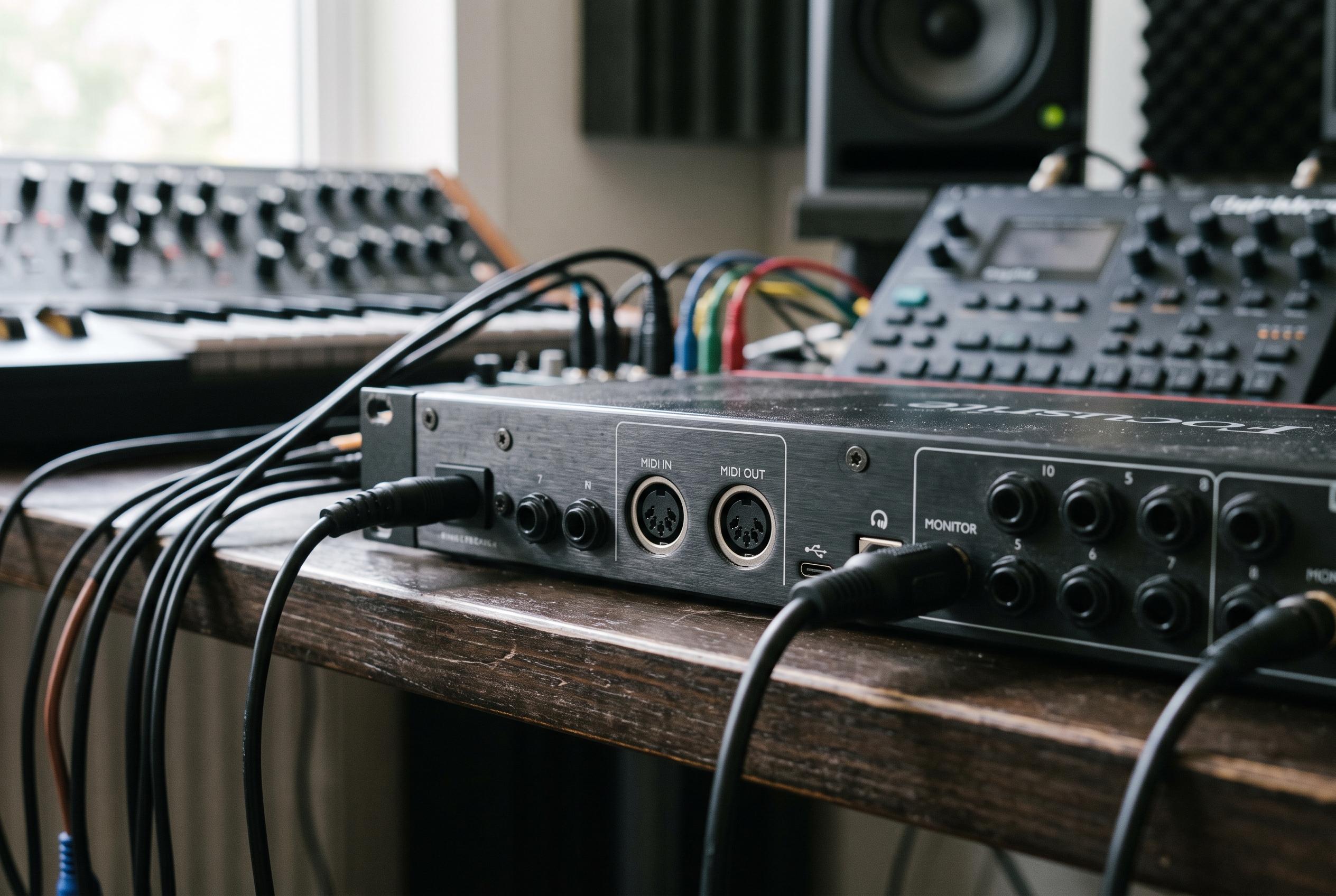

For musicians connecting synthesizers, drum machines or older controllers, genuine five-pin MIDI sockets matter more than headline sample rates. Here are the interfaces that offer them, and the compromises buyers should expect.
The strongest choice for musicians who need both clean recording and traditional MIDI connectivity is the Arturia MiniFuse 2. Arturia says the compact interface provides two combo inputs for microphones, instruments and line-level sources, along with 48V phantom power and a standard five-pin MIDI input and output. That combination makes it especially useful for small studios built around a computer, a microphone and hardware such as synthesizers or drum machines. The bundled software and USB-C connection add to its appeal for beginners and mobile setups.
For users who want a little more routing flexibility, the Mackie Onyx Producer 2-2 remains a sensible alternative. According to Mackie’s retail listing, it is a bus-powered 2-in/2-out interface with two Onyx preamps, 48V phantom power and MIDI I/O, wrapped in an all-metal chassis. Moog Audio’s product information also highlights 24-bit/192kHz conversion and broad DAW compatibility on Mac and Windows. That makes it a practical pick for solo recording sessions where durability and straightforward operation matter as much as MIDI integration.
The broader field separates neatly into two camps: compact two-channel interfaces and larger four-input models. The lead article’s shortlist places the Behringer U-PHORIA UMC404HD in the latter category, with four mic preamps, four outputs and dedicated MIDI connections for users who may record several sources at once. By contrast, the Focusrite Scarlett 2i2 4th Gen is positioned for simpler vocal-and-instrument setups, but the supplied specifications do not clearly identify MIDI ports, so it is better suited to buyers who do not need hardware MIDI sockets.
That distinction matters because MIDI support is not interchangeable with USB connectivity. A number of interfaces in the roundup, including the Focusrite Scarlett Solo 4th Gen and M-Audio M-Track Duo, are useful entry-level recording tools, but the supplied specifications do not list standard five-pin MIDI ports. For buyers connecting external keyboards, grooveboxes or older controllers, that omission is important. In practice, the right purchase depends less on headline sample rates than on whether the interface offers the exact connections a studio actually uses.
Taken together, the most sensible buying approach is to match the interface to the shape of the setup. A two-channel model with MIDI ports is usually enough for a solo musician, producer or content creator working with one microphone and one hardware instrument. A four-input interface is better when multiple microphones or several MIDI devices must be connected at the same time. The best value is usually found in clear monitoring, solid preamps, bus power where portability matters, and genuine five-pin MIDI sockets rather than vague claims of digital compatibility.
Disclaimer: This content is intended for informational purposes only. Readers are advised to exercise their own judgement, conduct due diligence, or consult a qualified expert before acting on any information provided.