
UGREEN’s new MagFlow range introduces active liquid cooling in power banks and chargers, promising faster, cooler wireless charging as demand for higher wattage increases amid thermal challenges.
UGREEN has brought an unusually elaborate cooling system to a category that normally hides its compromises behind plastic shells and marketing claims. Its new MagFlow range, unveiled around IFA 2026 in Berlin and at the company’s Smart Living launch event at Gillette Stadium in Foxborough on 3 September, is led by a 10,000mAh magnetic power bank that uses a micro-pump to circulate coolant inside the pack. The products are already on sale, with UGREEN pitching them as a way to make 25W Qi2 charging faster without the familiar rise in surface heat.
That focus on heat is not incidental. In launch material distributed through PR Newswire, UGREEN argued that the jump from 15W wireless charging to 25W raises power by nearly 70%, bringing a corresponding increase in thermal load. The company said heat build-up can cause throttling, slower charging and long-term harm to battery health. Club386, reporting from the IFA show floor, added the practical engineering point behind that message: once temperatures climb, charging performance tends to fall away, while sustained heat is one of the conditions that speeds up lithium-ion degradation.
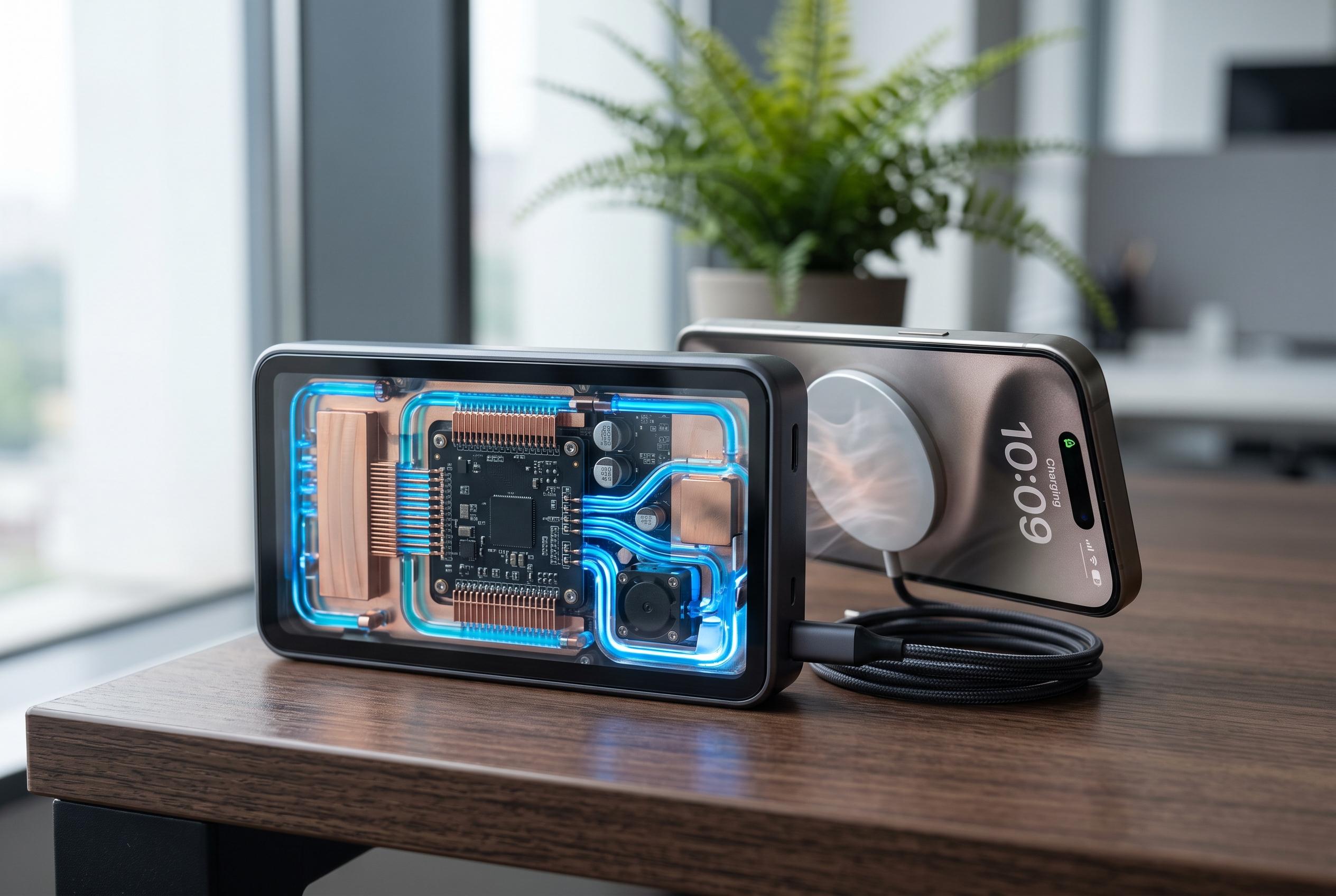
The MagFlow Pro power bank is the most technically ambitious part of the line-up. Android Authority and 9to5Toys both drew attention to the visible CryoPulse coolant loop behind a transparent panel, turning the thermal system into a feature users can actually see working. Notebookcheck reported that the pack also includes a built-in USB-C cable, 45W wired output and support for PD, QC, PPS, AFC, FCP and SCP charging standards. Club386 said there is a second USB-C port as well, allowing the unit to charge three devices simultaneously: one over Qi2 and two over USB-C. It also said the pack is built around two 5,000mAh cells. Notebookcheck listed the dimensions at 108.45 x 70.6 x 16.2mm and the weight at about 229.9g, which suggests UGREEN has added cooling hardware without turning the product into an obviously bulky travel battery.
UGREEN’s own performance claims are substantial. According to the PR Newswire release, the company says the power bank can hold peak iPhone 17 Pro Max temperature up to 10C below a 48C industry reference while still taking that phone to 50% in about 40 minutes over Qi2. The company also says it uses high-density ATL cells with Dymondcell 2.0 protection and a built-in display showing charging power, battery level, cycle count and cooling status. That combination is why several reports treated the product as more than a cosmetic experiment: unlike typical magnetic packs that rely on passive heat spreading, this one actively moves liquid through the body of the battery while charging.
The desktop version, sold as the MagFlow Pro 3-in-1 stand, uses a different cooling method but makes a similar promise. Android Central and UGREEN’s launch release said it combines a thermoelectric cooling module with an ultra-quiet 15dB fan while charging an iPhone, Apple Watch and AirPods together. UGREEN says the charger can bring the centre of its magnetic charging surface down to about 51.8F and take an iPhone 17 Pro Max to 50% in 26 minutes. However, Club386’s report from Berlin cited a markedly different figure, saying the same stand reached 20% in 26 minutes. That discrepancy does not prove either account wrong, but it does show how sensitive launch-day charging numbers are to the exact test method, handset state and ambient conditions.
The smaller MagFlow 2-in-1 foldable charger is a more straightforward accessory, but it still fills an important place in the range. PR Newswire said it folds down to 60 x 72 x 27mm, while Android Central framed it as the bedside or travel option rather than the technological showpiece. Android Authority added one useful specification absent from some of the broader launch summaries: it can deliver 25W to a phone and 5W to AirPods at the same time. Pricing around this model also varied early on. Android Central gave it a US price of about $59, while Android Authority said it had already appeared on Amazon at roughly $43. UGREEN’s European list price was £43.99 or €49.99.
The flagship power bank shows how much of a premium UGREEN thinks buyers will accept for thermal management. Most US launch coverage placed it at $149.99 through UGREEN’s own shop and Amazon, while Notebookcheck reported a 20% introductory offer taking it to $119.99. Club386 gave local pricing of £109.99 and €119.99. The 3-in-1 stand was listed at £119.99 or €139.99 in Europe, and at around $159 in US launch coverage. Those regional and promotional differences help explain why the early reporting does not line up perfectly on price, particularly around the foldable charger.
What UGREEN is really testing here is whether active cooling can become a normal selling point in premium wireless charging rather than a gimmick borrowed from enthusiast PCs. The accessories market is already crowded with magnetic packs and stands that charge more slowly and cost much less. UGREEN is arguing that as 25W Qi2 charging becomes more common, the bottleneck will not be magnetic alignment or battery size so much as temperature control. If independent testing bears out even part of the company’s claims, the most important detail in this launch may not be the transparent coolant window, but the broader suggestion that wireless chargers are starting to need the same level of thermal design attention as the phones they serve.
Disclaimer: This content is intended for informational purposes only. Readers are advised to exercise their own judgement, conduct due diligence, or consult a qualified expert before acting on any information provided.