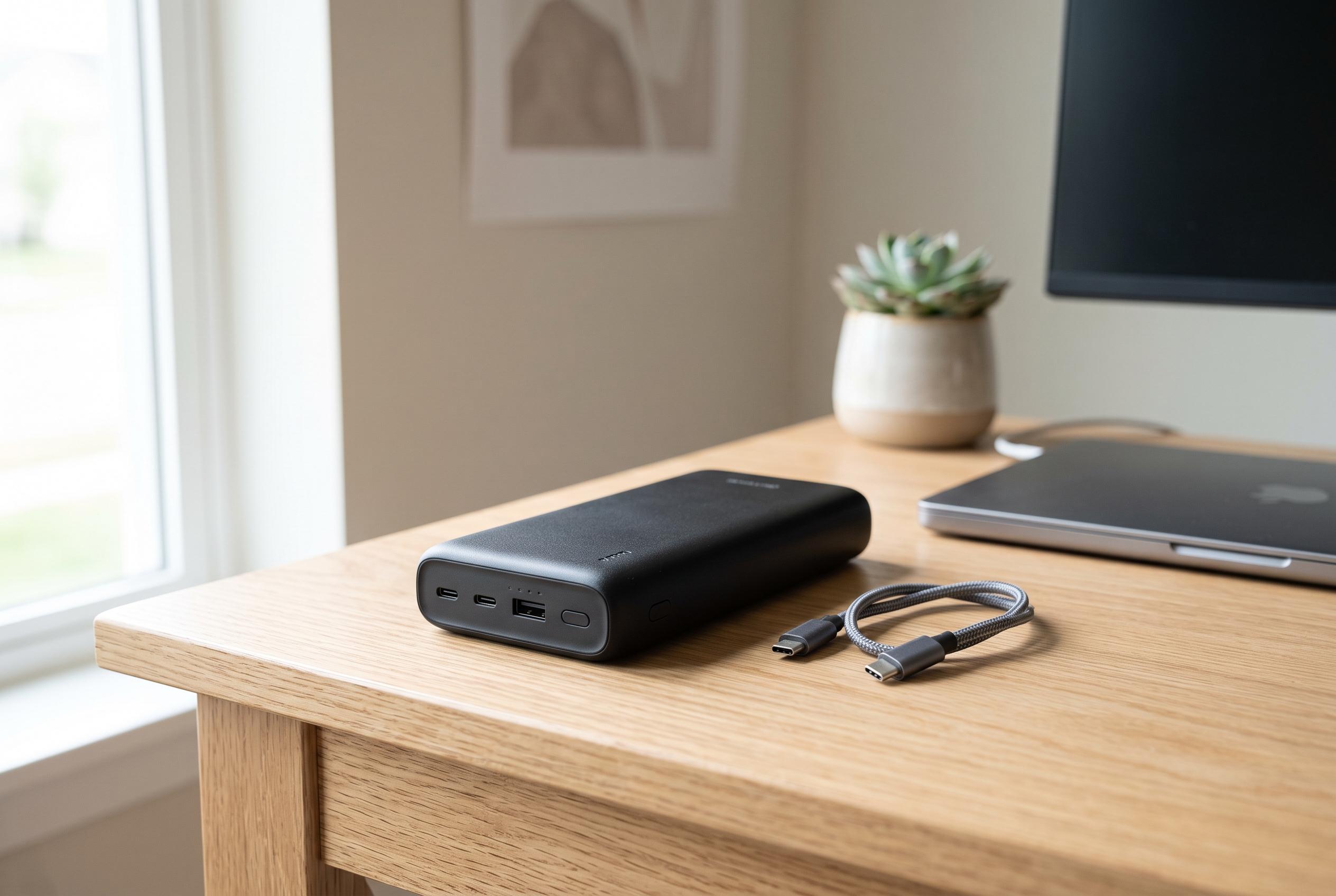

Ugreen’s 20,000mAh Nexode power bank is marketed with varying wattage, pricing, and features across Europe, leading to consumer uncertainty about its true capabilities and value.
A Ugreen power bank being promoted in France as a 55W bargain comes with a more complicated set of numbers than the sale copy suggests. In a French deal post dated Saturday 5 September 2026, Frandroid said Amazon had cut the 20,000mAh Nexode model to €63.99 and that the offer was due to end on Sunday 6 September 2026. Yet other coverage of what appears to be the same device has attached very different benchmarks to it: Clubic previously cited €34.49 from €45.99, while launch reports from Notebookcheck and iXBT placed European pricing at about £40 in the UK and from €69.99 or €70 in the eurozone. Ugreen’s own catalogue adds to the uncertainty by naming the product as a 45W power bank on one page while marketing it elsewhere around a 55W claim.
What is consistent is the basic hardware. Across retail and launch write-ups, the Nexode pack is described as a 20,000mAh battery with an integrated USB-C cable, an extra USB-C port and a USB-A port, allowing three devices to be charged at once. Notebookcheck said the model appeared on Amazon in the UK, Germany and France in August, while Clubic positioned it as an all-in-one travel accessory for users carrying an iPhone 16 or 17, a Galaxy S25, an iPad or even a MacBook Air. The cable is a selling point because it removes the need to carry a spare lead, but it is also short: Clubic put it at about 17.8cm, and Notebookcheck described it as a built-in 7-inch cable.
The headline charging figure also needs qualification. Ugreen’s March 2026 launch material for the smaller Nexode Pro 10,000mAh model said normal single-port fast charging reached 45W, and only rose to 55W with compatible Xiaomi devices. The company’s official product page for the 20,000mAh unit uses the same logic, promising “55W Ultra-Fast Charging” but linking that to Xiaomi’s proprietary mode and listing PD 45W for an iPhone 17 Pro or Galaxy S25. Notebookcheck and iXBT both said suitable laptops could charge at up to 45W, not 55W. Clubic added a practical warning that the advertised output is not maintained in the same way when several devices are attached, because total power has to be shared, and that 55W is not enough to sustain a laptop under heavy load.
The display is where this battery tries to distinguish itself from cheaper power banks. According to iXBT and Notebookcheck, it shows remaining charge, current output, battery temperature and charge-cycle count, giving users a clearer view of battery wear over time. Ugreen’s official product page says the screen also shows charging speed in watts and fast-charging status, while its battery-management system can log abnormal conditions and issue high or low temperature alerts. That is materially more informative than the simple percentage displays common on low-cost packs, even if Clubic noted that this is still not the per-port TFT readout found on some dearer models.
Even the physical specifications vary depending on where the device is listed. Clubic described a body measuring 15.2 x 7.1 x 3.0cm and weighing 470g, whereas Notebookcheck and iXBT both gave 116.5 x 71 x 30mm and 389g. Ugreen’s own English-language product page lists 380g. Those are not trivial gaps for a product sold on portability. Clubic also said the pack carries CE and CCC certifications, but its conclusion was measured: compact enough to travel with, heavy enough that buyers should not mistake it for a pocket-light backup battery.
The broader branding helps explain why Ugreen is pushing this format so hard. In March, the company used PR Newswire to launch the Nexode Pro line as equipment for people moving between desks, trains and flights, describing the range as being built for frequent travellers and mobile professionals. ANTARA, republishing that announcement later in March, echoed the same pitch and said the smart-display model was intended for commuting, business travel and daily use. That launch release concerned a smaller 10,000mAh variant rather than the 20,000mAh pack now being promoted in France, but it shows a consistent strategy: integrated cable, visible charging data and just enough output for phones, tablets and light laptop top-ups away from a wall socket.
For shoppers, the real lesson is not the nominal discount but the need to read past the headline wattage. This Nexode model appears to offer a useful combination of 20,000mAh capacity, three-device charging, pass-through charging and unusually detailed battery telemetry. At the same time, several important details are inconsistent across publishers and seller pages, including list price, launch price, weight and even whether the product should be understood primarily as a 45W or 55W charger. The safest interpretation is that it is a mid-power portable battery whose top speed depends on the device attached, especially if that device is a compatible Xiaomi handset, and whose value depends heavily on which of the widely varying advertised prices a buyer actually pays.
Disclaimer: This content is intended for informational purposes only. Readers are advised to exercise their own judgement, conduct due diligence, or consult a qualified expert before acting on any information provided.