
USB4 is often mistaken for a uniform high-speed standard, but in reality, its performance varies widely. Buyers should look for clear speed and power ratings rather than relying solely on the USB4 logo or connector shape.
USB4 is widely treated as a shorthand for a fast USB-C connection, but that reading is too broad. In practice, the USB-C connector tells you the physical shape of the port or cable, not the communication standard behind it. The USB Implementers Forum says USB4 is a protocol built on existing USB-C cabling, with support for multiple data and display modes, but that still leaves wide variation in what a given port, cable or accessory can actually do.
That variation matters because USB4 is not a single fixed performance tier. Industry explanations from Tech Advisor and Tom’s Hardware note that USB4 devices may support anything from 20Gbps to 40Gbps, while the newer USB4 Version 2.0 spec raises the ceiling to 80Gbps. Charging support also varies, and the USB logo alone does not guarantee anything close to the most capable USB-C hardware on the market. In other words, a USB4 label can describe products with very different real-world behaviour.
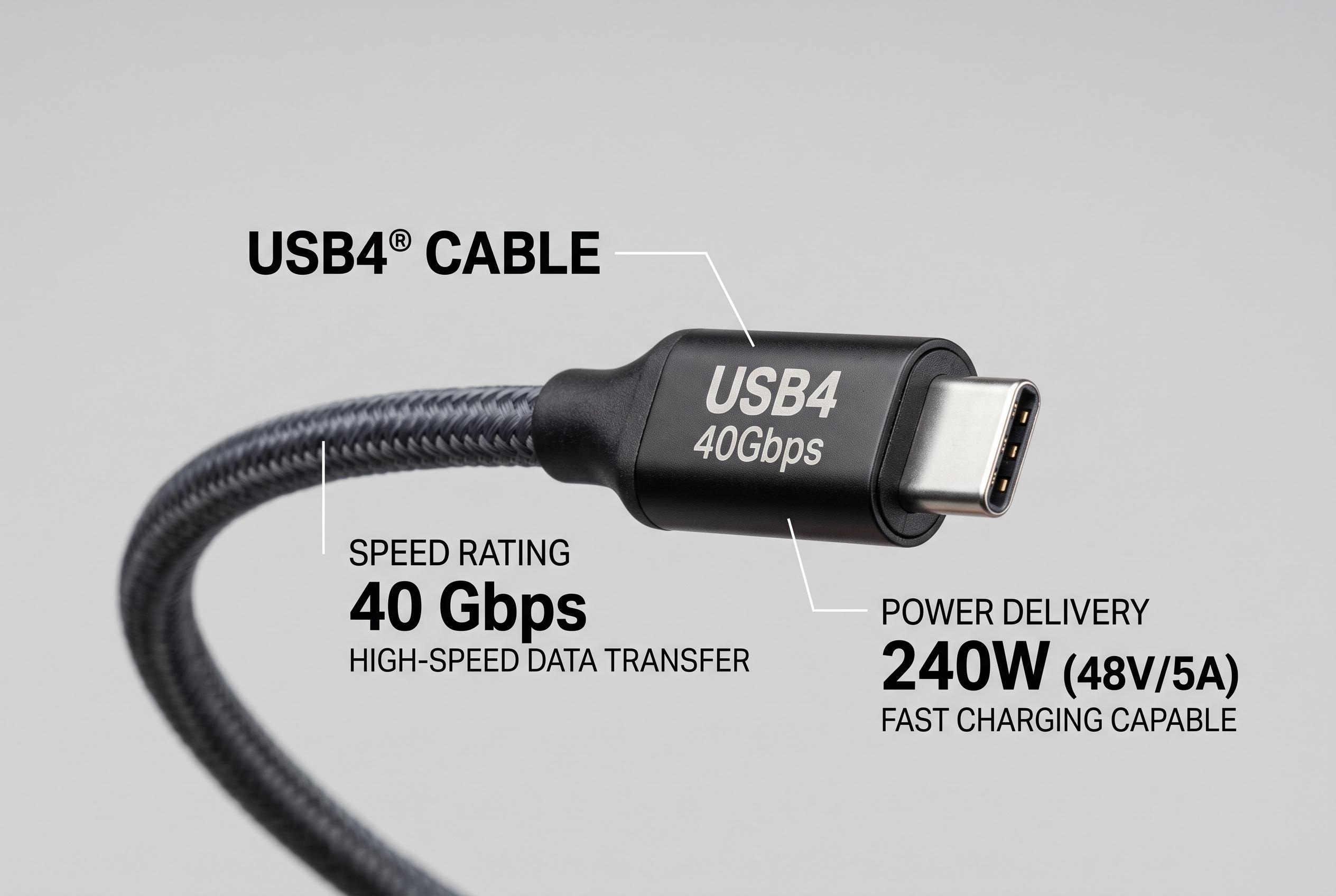
This is why the better buying signal is the speed and power rating printed on the cable or packaging. The USB industry has moved towards labels that spell out both data rate and charging capacity directly, such as 20Gbps with 100W or 40Gbps with 240W. Those markings are more useful than the generic USB4 name because they tell users what the accessory is designed to deliver. For older or non-compliant cables, that information may be absent altogether, which makes identification harder and raises the risk of buying under-specced hardware.
Thunderbolt remains the clearest example of why the distinction matters. Intel says Thunderbolt 5 guarantees 80Gbps bidirectional bandwidth, can reach 120Gbps in Bandwidth Boost mode, supports up to 240W charging and is designed for multiple high-resolution displays. By contrast, USB4’s minimum requirements are far more modest, which means a USB4 badge does not automatically imply premium performance. For buyers, the practical lesson is simple: check the rated data speed, charging wattage and supported display features, not just the connector shape or the USB4 logo.
Disclaimer: This content is intended for informational purposes only. Readers are advised to exercise their own judgement, conduct due diligence, or consult a qualified expert before acting on any information provided.