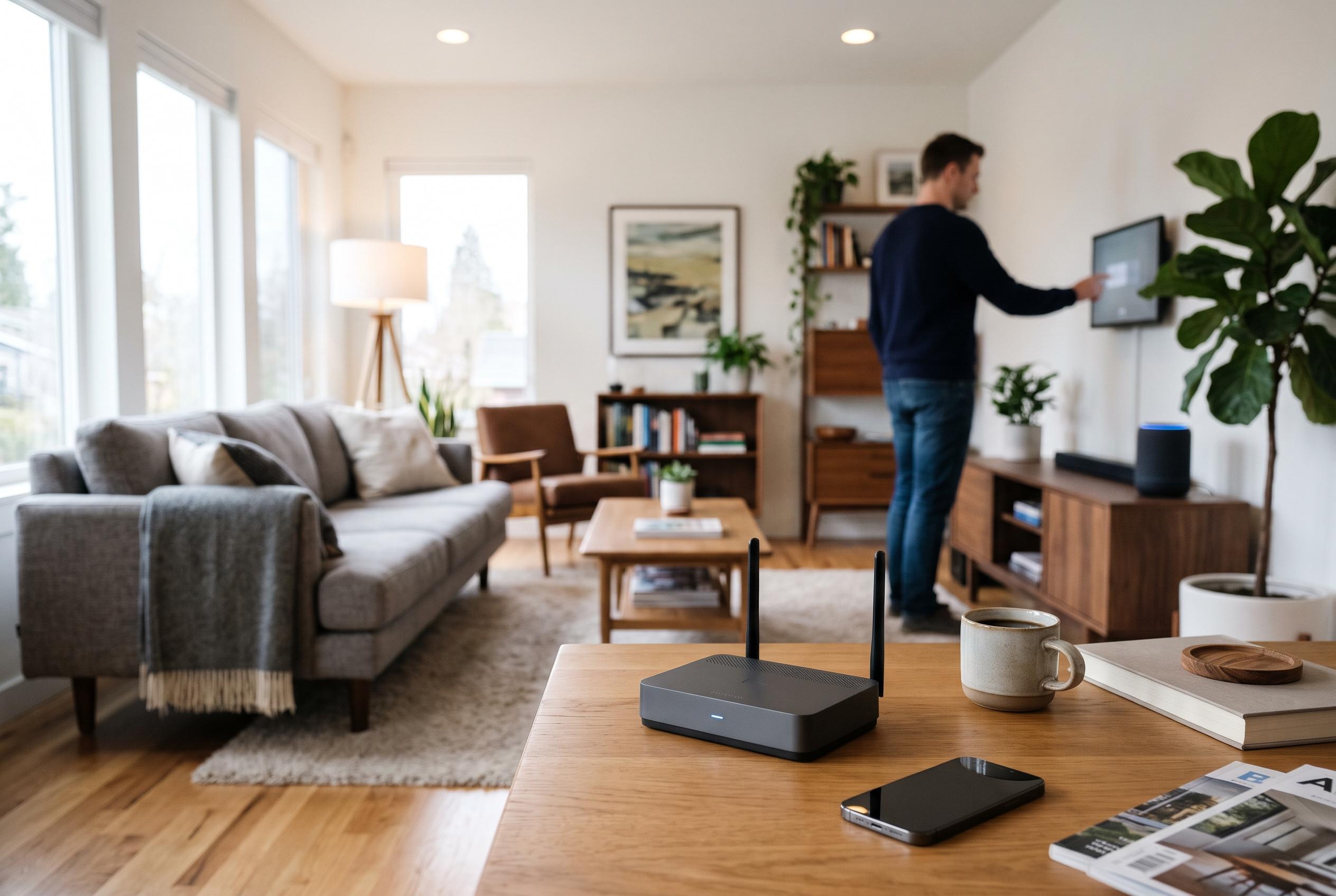

From SwitchBot’s all-in-one Hub 2 to wired ESP32 proxies, the right Bluetooth gateway depends on ecosystem compatibility, privacy and how far your signal needs to travel.
Bluetooth low-energy devices are attractive because they are inexpensive, small and often last for months on a battery. Their main weakness is range. On their own, they usually need a nearby phone or controller to stay useful. A Bluetooth gateway solves that problem by listening to nearby devices and passing their data on to Wi-Fi or Ethernet, which makes remote alerts, automations, logging and voice control possible. For households with mixed equipment, the choice usually comes down to two broad models: branded hubs for one ecosystem, or Home Assistant proxies that can work across multiple brands.
That distinction matters. Brand hubs are usually the easiest option, but they tend to support only the maker’s own devices. A SwitchBot hub will not normally relay a Govee sensor, and a Govee gateway will not act as a universal Bluetooth bridge. Home Assistant Bluetooth proxies are more flexible because they can read many brands passively, although active connections such as locks and some switches place tighter limits on each proxy. Placement is also critical, because Bluetooth range drops quickly through walls and floors. In larger homes, one gateway is often not enough.
For most buyers, the most complete all-round option is SwitchBot’s Hub 2. It combines a Bluetooth bridge, an infrared remote and a built-in temperature and humidity sensor, which makes it more than a simple relay box. SwitchBot says it can expose supported devices to Matter controllers as well, extending its use beyond the company’s own app. The trade-off is that it remains largely tied to the SwitchBot ecosystem and depends heavily on cloud services for remote access. For people already invested in SwitchBot locks, curtains, buttons or sensors, though, it is the most polished single-box answer.
Shelly takes a different approach. The Shelly BLU Gateway is a compact USB-A dongle that can be placed near Shelly’s BLE buttons, motion sensors, contact sensors and climate devices. The appeal is not just size but control. Shelly supports both cloud and local operation, and its products are widely used with Home Assistant. That makes it a stronger fit for privacy-conscious users and for homes that may need to continue working when internet access is unavailable. Shelly also offers an unusual hidden option: some of its Gen3 relays can function as BLU gateways, allowing a wall-mounted switch or relay to double as a Bluetooth bridge without an extra box.
Govee’s gateways are aimed more narrowly at its own sensor range. The company sells bundles that pair a gateway with temperature and humidity sensors, and its fridge-monitoring kits are designed to warn when cold storage moves out of safe limits. The model-based compatibility is important, because not every Govee sensor works with every gateway. SensorPush follows a similar pattern. Its G1 Wi-Fi gateway adds remote monitoring and alerts to SensorPush’s BLE sensors and includes cloud storage without a recurring fee, although the listing highlighted in the guide is a renewed unit rather than new stock. Tuya sits at the other end of the spectrum: its multi-mode gateway brings both Zigbee and Bluetooth mesh devices into the Smart Life app, making it a practical choice for households already committed to that ecosystem.
Home Assistant users have a broader set of options. A small ESP32 board running ESPHome can act as a Bluetooth proxy, and the guide’s preferred low-cost choice is the M5Stack ATOM Lite. It is tiny, inexpensive and easy to flash from a browser, which makes it practical to scatter around a house to expand coverage. For better reliability, especially where active Bluetooth connections are involved, an Ethernet-connected proxy is the stronger design. The guide points to an ESP32-S3 PoE board for that role, because moving networking off the 2.4 GHz radio leaves the Bluetooth side freer to scan. If the Home Assistant server itself is already close to the devices, a USB adapter such as TP-Link’s UB500 Plus can be the simplest route, although it only serves one location.
The central lesson is that Bluetooth gateways are not interchangeable. The best choice depends on whether the home is built around one vendor, a mixed set of devices or a Home Assistant installation that needs coverage across several rooms. That is why the guide separates convenience hubs from local-control gateways and from DIY proxies. Brand hubs remain the easiest way to bring one ecosystem online. Home Assistant proxies remain the most adaptable. And for users who want better privacy, wider compatibility or more reliable coverage, the wired proxy approach is often the more future-proof option.
Disclaimer: This content is intended for informational purposes only. Readers are advised to exercise their own judgement, conduct due diligence, or consult a qualified expert before acting on any information provided.