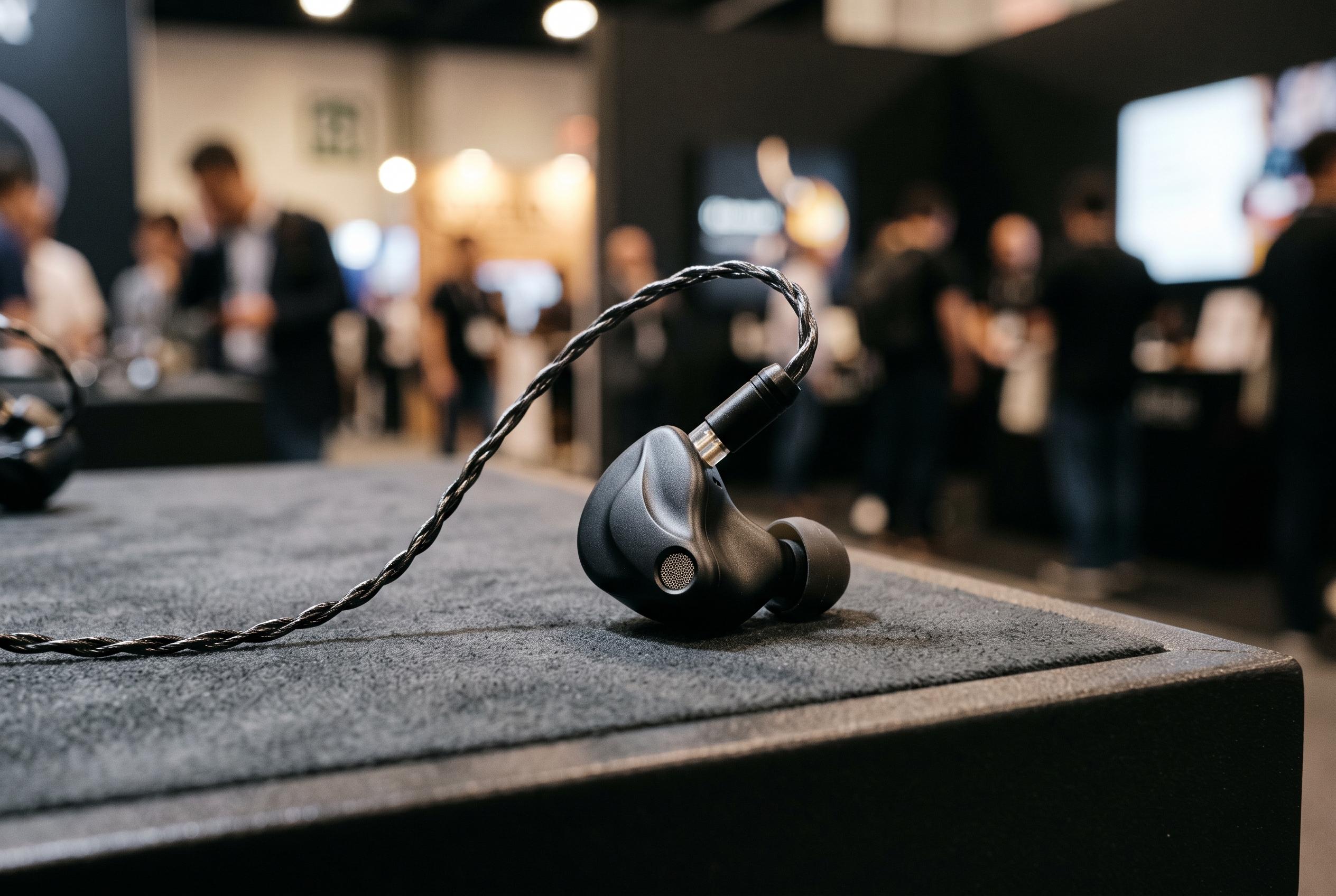

The CanJam SoCal 2026 event highlighted a decisive shift in the personal audio industry, where wired in-ear monitors are evolving into a key battleground of innovation, design, and audiophile credibility, redefining high-end portable sound experience.
CanJam SoCal 2026 made clear that wired in-ear monitors are no longer a specialist sideline within personal audio but one of its busiest development fronts. Over the weekend of 29-30 August at the Irvine Marriott in Orange County, the show floor was packed enough for Headphone Guru to call it “the largest show they have hosted yet”, while The Verge described booths and side rooms filled with a couple of thousand enthusiasts. The result was not simply more product. It was a sharper argument about what now matters in high-end portable audio: tuning, fit and coherence, rather than raw driver count alone.
That argument played out inside a much broader event. HomeTheaterHiFi’s rolling report ranged from Audio-Technica’s HPA-KG NARU, priced at $108,000 for the amplifier alone, to the new ADX7000 headphones, which its reviewer found notably light and crisp sounding. The same report highlighted ZMF’s new Tessidera planar headphones as “warm yet detailed” and marked the return of Earmen, with founder Milomir Trosic showing the L-Amp MKII portable tube DAC, amplifier and preamplifier. TWICE, meanwhile, reported that iFi Audio used booths E6-E7 to show the iDSD Phantom, the new iDSD GR 2 with revised DAC architecture and touchscreen controls, and early previews of the iCAN Phantom 1.5 and UP Play Max ahead of their 14 September launch.
At the most expensive end, Campfire Audio used the show for the first US public demonstration of its Chimera after earlier appearances in Singapore and London, according to The Absolute Sound. The company described it as its most ambitious in-ear monitor so far: a nine-driver quad-brid design combining a shell-mounted bone-conduction unit, a True Glass dynamic driver, balanced armatures and four electrostatic supertweeters in a PVD magnesium shell with a carbon fibre-brass damascus faceplate. The Verge’s account suggested the engineering ambition came with practical compromises, describing the shells as physically large but the sound as one of the most detailed and enjoyable listens of the event. That broadly supports the sense that summit-priced IEMs are now as much industrial design statements as listening tools.
Yet the show also showed how divided impressions can be once the listening starts. Bloom Audio, which said all of its listening was done through an iBasso DX270 and mostly with KBEAR 4540 Coffee eartips, treated 64 Audio’s $3,999 Ocean as one of the weekend’s “must-listens”. Its writer said 64 Audio staff framed the model as a “revolution of the U12t”, praised its sibilance control and bass texture, and pointed to the usefulness of its modules and filters, including a -2dB option to trim low-end weight. That enthusiasm was not universal. Another show report judged Ocean highly capable and unusually tunable, but still stopped short of preferring it to 64 Audio’s less expensive Volur. For a flagship presented as a step-change, that is an important distinction.
Some of the most persuasive products sat far lower down the price ladder. Bloom Audio called Ice Lab’s $399 Lumira “entirely different” from much of the crowded field around it and said it was built as a playground for source swapping and cable rolling. The same report praised its detail retrieval and control over energetic upper frequencies, even while warning that the tuning could become too contrast-heavy at louder levels. Elsewhere on the floor, more affordable wired models and mid-priced hybrids appeared to attract as much curiosity as ultra-flagships. That reinforces the broader impression from the weekend: buyers no longer need to cross into four-figure pricing to hear something genuinely distinctive.
Noble Audio’s stand offered a similarly broad picture of where the market is moving. Headphone Guru said the company was making “huge waves” with four launches spanning wireless and wired listening: the $199 Osprey true wireless earphones, the $899 FoKus ARTEMIS hybrid wireless headphone, the $325 Vanguard wired IEM and the $699 Iris. That range matters because it shows manufacturers no longer treating wired IEMs as separate from the rest of their portable line-ups. They are part of a wider ecosystem in which true wireless, premium headphones and traditional wired monitors sit side by side, often sharing design language and brand ambition even when their audiences differ.
The conditions in which these products were heard also help explain why opinions varied so sharply. The Verge noted that many exhibitors used tablets running Qobuz at their listening stations, while quieter rooms off the main hall were better suited to serious evaluation than the crowded ballroom. Bloom Audio went further than most in disclosing front-end and eartip choices, a useful reminder that source, seal and insertion depth remain unusually important with IEMs, especially on bone-conduction, electrostatic and hybrid designs. HomeTheaterHiFi’s multi-reviewer format, with Eric Hieger and Lory Hawley adding material over time, underlined another reality of CanJam reporting: these are snapshots taken under imperfect conditions, not lab tests.
Even so, the shape of the market was hard to miss. CanJam, as The Verge noted, exists partly because mainstream headphones have become “good but boring now”; the Irvine show offered the opposite, from esoteric flagships to portable DACs and sub-$1,000 experiments that felt more daring than safe. The practical lesson from CanJam SoCal 2026 is that personal audio is not converging on one ideal form. It is splitting into several: luxury statement pieces, serious mid-tier wired monitors, and supporting portable electronics designed to make all of them more usable. In that environment, the winning products were not necessarily the ones with the longest specifications sheet, but the ones that balanced technical ambition with believable tuning and real-world usability.
Disclaimer: This content is intended for informational purposes only. Readers are advised to exercise their own judgement, conduct due diligence, or consult a qualified expert before acting on any information provided.