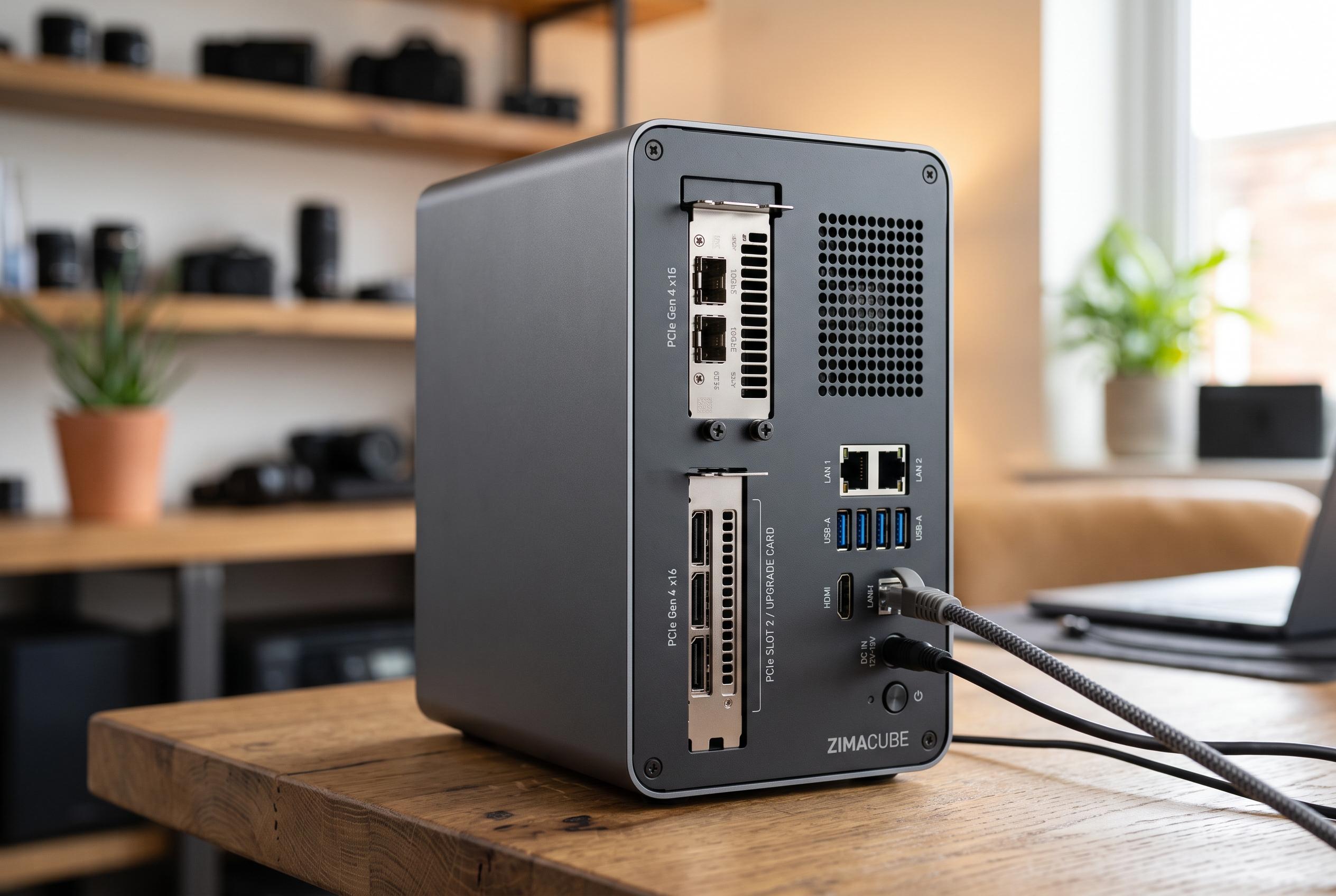

The ZimaCube 2 stands out from typical NAS devices thanks to dual PCIe slots that enable future upgrades including network and graphics cards, transforming the compact server into a versatile platform for growing needs.
What makes the ZimaCube 2 more intriguing than a typical six-bay NAS is not the storage on the front, but the pair of PCIe slots hidden inside. According to XDA Developers, those connectors give the compact server room to evolve well beyond its original role, turning it into something that can absorb new demands over time rather than locking the owner into one use case from day one.
That flexibility matters because the standard model is no longer a niche prototype but a retail product aimed at users who want a polished home server with headroom to grow. NAS Compares said the non-Pro version sells for $799 and ships with ZimaOS, six SATA bays, four M.2 NVMe slots, dual 2.5GbE networking and USB4-class connectivity, making it a more serious all-round platform than the first ZimaCube.
The expansion slots are the key difference. XDA noted that the primary slot is a full-length connector running at PCIe 4.0 x4, while the second is a physical x8 slot limited to PCIe 3.0 x2. That means the board can accept cards such as network adapters, storage controllers and some low-profile graphics cards, but buyers need to watch electrical bandwidth rather than assuming desktop-class capability from the slot size alone.
That distinction is especially important for networking upgrades. The ZimaCube 2 already includes dual 2.5GbE ports, which is plenty for many homes, but reviewers at Phoronix and TechRadar both pointed out that PCIe gives users an upgrade path to 10GbE or even more complex multi-port network setups later on. For many small-office or homelab owners, that kind of future-proofing may be more valuable than paying extra up front for hardware they do not yet need.
The same logic applies to graphics. TechRadar said the machine can be configured for GPU use, and IceWhale’s own material describes the slots as suitable for low-profile cards, Plex transcoding and even virtualisation projects. But there are practical limits: XDA stressed that the chassis has no auxiliary GPU power connector, so only modest, slot-powered cards make sense. That makes the ZimaCube 2 more adaptable than a conventional NAS, but not a substitute for a full desktop workstation.
Recent modding experiments underline just how far the platform can be pushed. Tom’s Hardware reported on an unusual build that turned a ZimaCube 2 into a gaming machine by hanging an RTX 5060 off the side and repurposing a drive bay for a 750W power supply, producing dramatic performance gains over the integrated graphics. It was an extreme and impractical example, but it reinforced the larger point: the ZimaCube 2 is not just a storage box, it is a compact server with enough spare capacity to become something else if the owner wants it to.
For many buyers, that may be the real appeal. Six drive bays and four M.2 slots already make the machine useful as a straightforward NAS, but the PCIe expansion turns it into a platform rather than a finished appliance. If the job changes in a year or two, the hardware can change with it.
Disclaimer: This content is intended for informational purposes only. Readers are advised to exercise their own judgement, conduct due diligence, or consult a qualified expert before acting on any information provided.