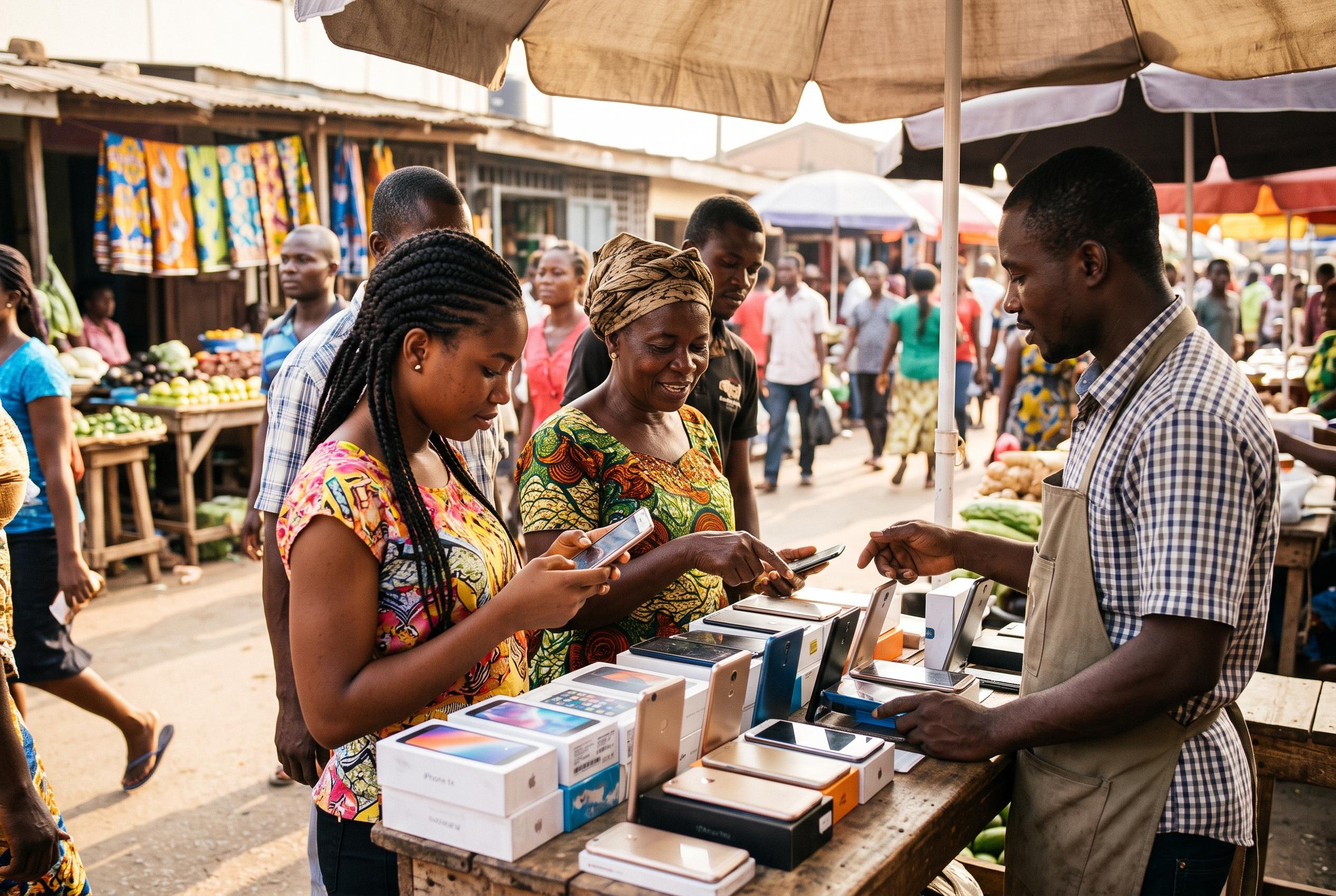

The African smartphone industry is experiencing its first significant contraction in three years, driven by rising prices and component shortages, prompting vendors to explore innovative financing solutions to sustain growth.
Africa’s smartphone market is moving out of the ultra-cheap era faster than many buyers can follow. Omdia now expects shipments across the continent to fall 26 per cent in 2026 after a 7 per cent year-on-year drop in the second quarter, the first annual contraction in three years and the break in what MyBroadband described as a 12-quarter growth run. The hardest-hit part of the market was the sub-$100 bracket, where volumes slumped 34 per cent, or nearly 3 million handsets, signalling that the traditional first-phone segment is under acute pressure.
That change is being driven as much by component economics as by household budgets. Connecting Africa, citing Omdia, said the global memory shortage linked to AI data-centre demand has pushed memory to nearly 60 per cent of the bill of materials for phones priced below $400 and to more than 64 per cent for models under $99. It also said an entry-level smartphone can absorb as much as 73 per cent of a low-income adult’s monthly income in sub-Saharan Africa. “We’re witnessing a forced upward shift in the African market,” Manish Pravinkumar, principal analyst at Omdia, said. “Vendors can no longer profitably manufacture $75 smartphones, while consumers who need connectivity are increasingly having to stretch their budgets towards $200-plus devices”.
The regional picture is uneven. South Africa expanded 17 per cent in the quarter, helped by stronger purchasing power and continued migration to 5G handsets, while Nigeria shrank 11 per cent as shoppers delayed upgrades. Egypt endured a 26 per cent fall after manufacturers raised prices mid-quarter; Cyprus Mail and ITWeb said the Mobile Division of the Federation of Egyptian Chambers of Commerce had put the rise in local production input costs since January at 50 per cent. Those increases disrupted established retail channels and encouraged some buyers to wait longer before replacing devices. Kenya, where demand remains concentrated below $150, recorded a 15 per cent decline.
Rising prices are also redrawing the supplier league table. Average selling prices climbed by $41 year on year to $202, reversing the discounting seen a year earlier. MyBroadband reported that Samsung lifted African shipments from 3.4 million to 3.9 million units, taking its share from 18 per cent to 22 per cent, while Honor rose from about 800,000 units to 900,000 and edged its share up from 4 per cent to 5 per cent. Transsion, whose Tecno, Infinix and iTel brands dominate the low end, still accounted for 47 per cent of smartphones sold, but its shipments fell 14 per cent as the cheapest price tier weakened. Xiaomi and Oppo were down 30 per cent and 25 per cent respectively as they protected margins rather than chase unprofitable entry-level volume.
South Africa offers a view of how vendors may respond. MyBroadband said financing and rental schemes such as Pep’s FoneYam, PayJoy and MyFlex are already being used to widen access to pricier devices. These products rely on Samsung Knox, a remote management tool that lets financiers restrict some functions when payments are missed. The model is designed for customers who do not have the credit record needed for a conventional mobile contract, and it suggests that the next phase of African smartphone growth may depend less on cutting sticker prices than on spreading the cost over time.
ITWeb argued that the squeeze on African buyers is part of a wider industry correction rather than a stand-alone regional event. It cited IDC’s expectation that global smartphone shipments will fall 13.9 per cent in 2026 to 1.09 billion units, which the research house described as the sharpest annual decline on record. The same report also pointed to a warning from Counterpoint Research director Tarun Pathak in January that rising memory prices and supply constraints were already forcing forecast cuts and visible handset price increases. Africa’s entry-level problem is therefore also a test case for what happens when component inflation reaches markets where affordability margins were already thin.
For manufacturers, the immediate question is not whether demand for mobile connectivity exists, but how it can be financed without destroying profitability. Omdia expects device financing to become more important as upfront prices rise, with Transsion looking to deepen its existing credit capability and Xiaomi exploring partnerships that could move buyers into higher-value models. Honor’s concentration in South Africa and Samsung’s success in keeping stock of mass-market Galaxy models show that vendors with stronger distribution, working capital and financing tools are better placed to cope. The market is still large, but the route into it is changing: the companies that can bridge the gap between a $75 legacy expectation and a $200 reality are likely to define Africa’s smartphone business over the next year.
Disclaimer: This content is intended for informational purposes only. Readers are advised to exercise their own judgement, conduct due diligence, or consult a qualified expert before acting on any information provided.