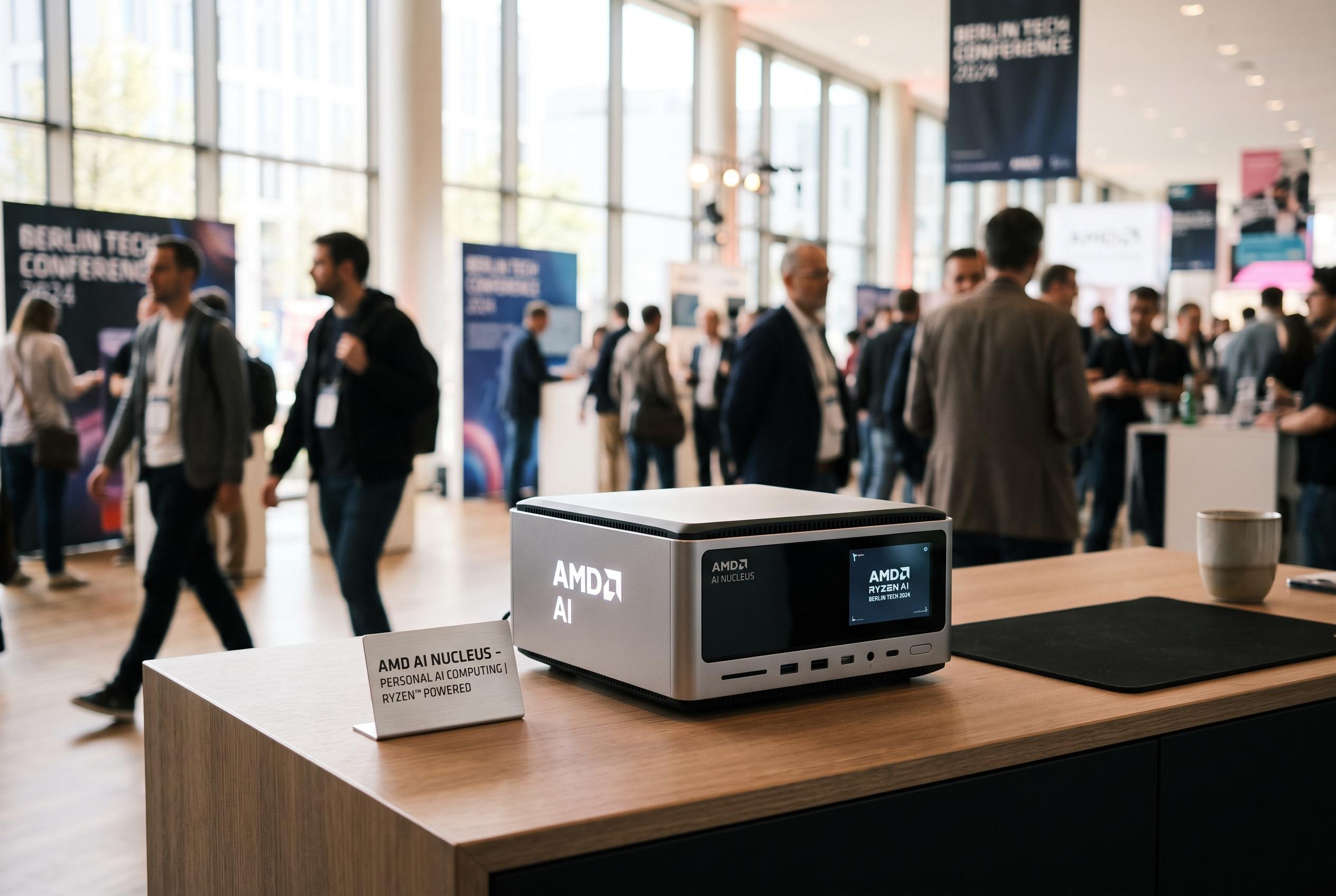

AMD is making a strategic comeback at IFA Berlin, emphasising personal AI and local inference capabilities over traditional gaming, signalling a major shift in its consumer technology vision.
AMD will return to IFA in Berlin this year and will take one of the trade fair’s most visible slots, delivering the opening keynote on September 4. The presentation will be led by Jack Huynh, the company’s senior vice president and general manager for computing and graphics, on the Innovation Stage at 11am. The title, “The Era of Personal AI: The Future of Imagination”, points to artificial intelligence rather than gaming, even though Huynh has played a central role in AMD’s console chip work. According to AMD’s announcement and the IFA preview, the company is using the appearance to frame its wider consumer strategy around AI-powered computing rather than a narrow product launch.
The planned message fits AMD’s recent product direction. At CES 2026, the company unveiled Ryzen AI 400 and PRO 400 Series processors with up to 60 NPU TOPS for Copilot+ PCs, alongside Ryzen AI Max+ parts for thinner notebooks, workstations and compact systems. It also introduced the Ryzen AI Halo mini-PC and said Ryzen 7 9850X3D would extend its gaming line-up. AMD paired those hardware launches with updated ROCm 7.2 software support and new AI features in Adrenalin Edition, underscoring a broader effort to tie together chips, software and developer tools.
Huynh has already hinted at what the company means by “personal AI”. In a post on X in late July, he described a future in which Ryzen AI systems on desks run local AI agents overnight, process users’ data and turn to the cloud only when needed. That framing suggests AMD wants to present AI as a local computing layer, not just a remote service, and to position its PCs as machines that can handle more inference and automation on-device.
The return to IFA also fits AMD’s wider 2026 event schedule. In July, the company staged its “Advancing AI 2026” event in San Francisco, where it said its end-to-end stack spans silicon, software and infrastructure. At CES, it highlighted everything from client chips to rack-scale data centre systems, including Helios and Instinct roadmap updates, while also outlining a $150 million commitment to expand AI access in classrooms and communities. Taken together, the appearances show AMD leaning hard into an “AI everywhere” message, with gaming remaining important but no longer the sole centrepiece of its public pitch.
Disclaimer: This content is intended for informational purposes only. Readers are advised to exercise their own judgement, conduct due diligence, or consult a qualified expert before acting on any information provided.