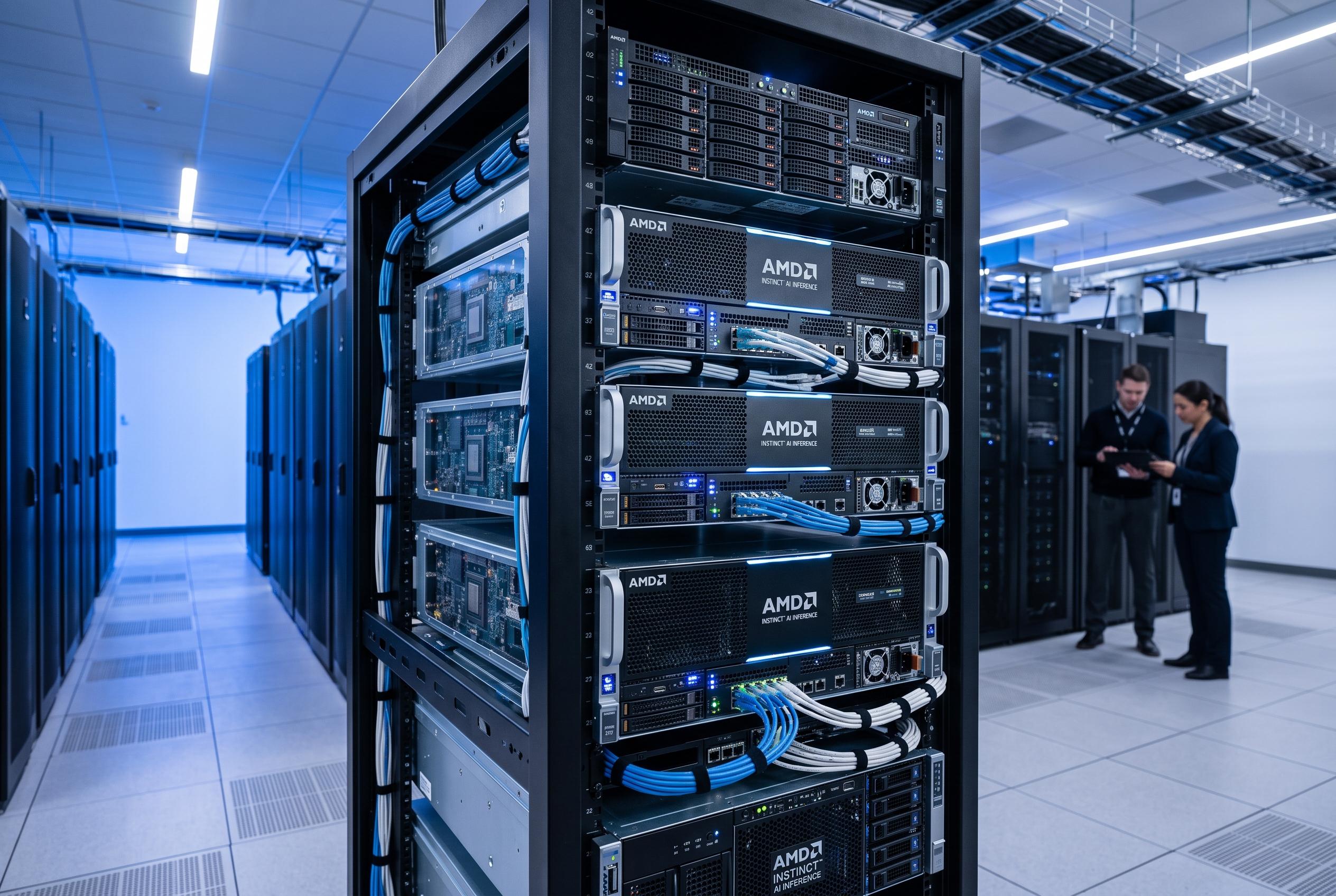

AMD has announced the acquisition of Toronto-based startup Taalas, marking a significant move to bolsters its AI inference chip portfolio with specialised, hardware-embedded AI models designed for efficiency and low latency.
AMD has agreed to buy Toronto-based startup Taalas in a move that deepens its push into AI inference chips, the part of the market focused on running models after training rather than building them. The company said the deal, announced on August 6, will bring Taalas’s specialist engineering team and its model-to-silicon technology into AMD’s Artificial Intelligence Group. Financial terms were not disclosed and the transaction still needs regulatory approval and other closing conditions.
Taalas, founded in 2023, has built processors designed to embed an AI model directly into hardware. The aim is to reduce the costly back-and-forth movement of model data between memory and compute units, a major constraint in large language model inference. AMD said the startup’s HC1 demonstrator runs Meta’s Llama 3.1 8B model and is made using TSMC’s 6-nanometre process. Taalas says the chip can produce about 17,000 tokens a second for one user, although those figures are company benchmarks rather than independent measurements.
The attraction for AMD is clear: inference increasingly rewards efficiency, low latency and lower power use once a model has stabilised. That contrasts with training, where flexibility matters more because models and techniques change constantly. According to AMD, Taalas’s design uses hard-wired mask-ROM fabric together with SRAM for functions such as key-value caching, model adaptation and fine-tuning, while a later platform is built around 4-bit floating-point formats and denser model support.
The architecture also comes with limits. Unlike GPUs, which can run many models through software changes, Taalas’s chips are closely tied to the model they were built for. The startup says it has tried to shorten the turnaround by changing only a small number of metal layers when porting a design to a new model, with a goal of turning model weights into deployable hardware in about two months.
AMD is presenting the acquisition as part of a broader systems strategy rather than a replacement for its existing accelerators. The company has been expanding its Instinct line and Helios rack-scale platform, while its MI455X accelerator is designed with 432GB of HBM4 memory and theoretical bandwidth of 23.3 terabytes per second. The addition of Taalas suggests AMD wants both paths: bigger memory systems for conventional accelerators and specialised silicon for workloads that are better served by fixed-function inference hardware.
The deal also reunites AMD with several people who know the company well. Taalas chief executive Ljubisa Bajic previously worked on AMD CPU-GPU designs before later founding Tenstorrent, while co-founders Lejla Bajic and Drago Ignjatovic also held engineering roles at AMD. The acquisition follows AMD’s July 2024 plan to buy Finnish AI startup Silo AI and its August 2024 agreement to acquire ZT Systems, underlining a steady build-out of AMD’s AI stack across software, systems and infrastructure.
Disclaimer: This content is intended for informational purposes only. Readers are advised to exercise their own judgement, conduct due diligence, or consult a qualified expert before acting on any information provided.