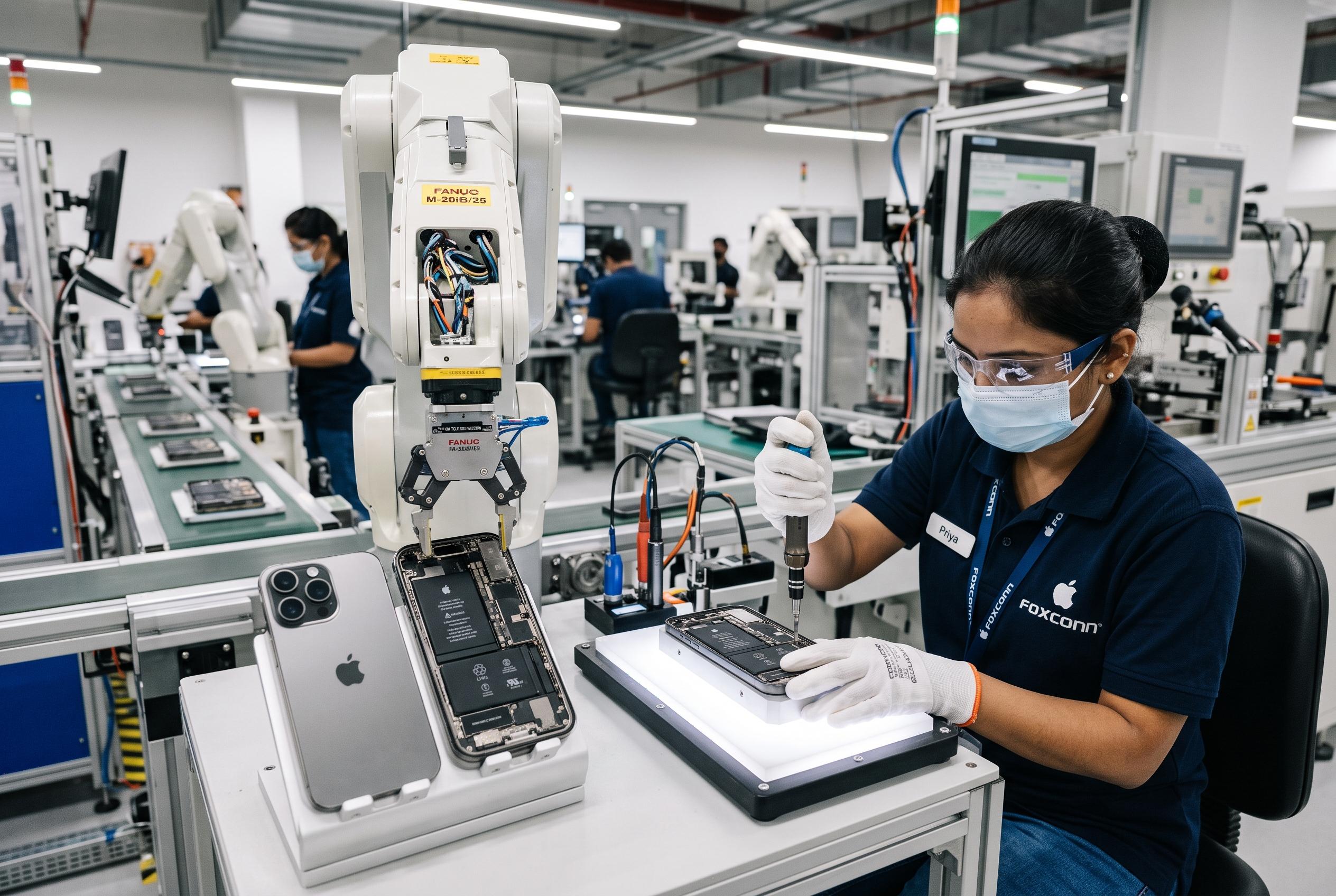

Apple is significantly expanding its manufacturing presence in India, now assembling all models of its flagship iPhones including Pro and Pro Max, signalling a strategic shift from China towards a more resilient and premium production base in India.
Apple’s push to make more iPhones in India has become one of the clearest signs yet that the company is reworking its production map away from China. Bloomberg reported in March that Apple assembled about 55 million iPhones in India in 2025, roughly a quarter of its total output, after a 53% increase in local production over the previous year. That marks a sharp rise from earlier stages of its India strategy, when the country was mainly used for lower-end models rather than the full range of flagship devices.
The shift is not only about volume. According to Bloomberg and other industry reports, Apple is now assembling all versions of its latest iPhone line in India, including the Pro and Pro Max models that are more technically demanding to produce. That suggests the company has moved beyond simple diversification and is trying to build a deeper manufacturing base capable of handling premium devices. It also reflects the commercial logic of India itself: a large domestic market, a growing export platform and government incentives designed to attract high-value electronics production.
At the same time, Apple’s expansion in India still faces practical limits. TechSpot reported that logistics remain weaker than in China and that component costs are still higher. Even so, the company has broadened its supply network, working with Foxconn, Tata Electronics and Pegatron across multiple facilities. Business Standard said Apple’s manufacturing footprint now spans eight Indian states and more than 40 suppliers, many of them small and mid-sized firms, while the company has also added production for accessories such as AirPods. That wider supplier web is important because it shows Apple is trying to localise more of the chain around final assembly.
For India, the gains are significant. The India Brand Equity Foundation said the country’s production-linked incentive scheme has helped draw large-scale investment from Tata and Foxconn, with both firms receiving substantial support. Industry estimates also suggest Apple’s India-made phones are increasingly feeding exports, not just local sales. The broader implication is that Apple is building a more resilient supply chain, but one that is still dependent on a complex mix of Chinese, Taiwanese and Indian operations. In practice, India is becoming less of an outpost and more of a core manufacturing hub, even if China remains central to the rest of Apple’s ecosystem.
Disclaimer: This content is intended for informational purposes only. Readers are advised to exercise their own judgement, conduct due diligence, or consult a qualified expert before acting on any information provided.