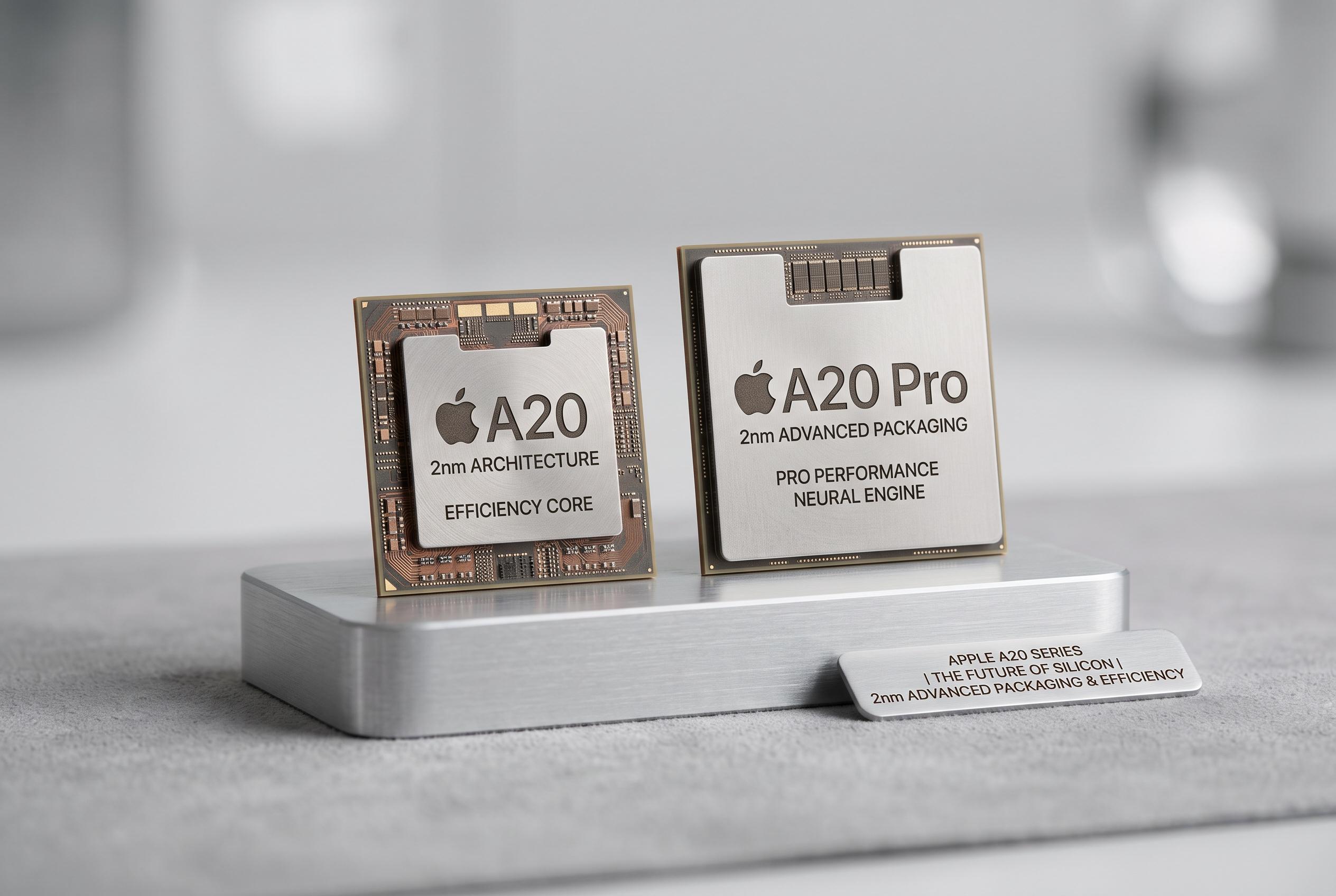

Apple’s upcoming iPhone processors, the A20 and A20 Pro, are set to leverage TSMC’s 2nm process, prioritising improved power efficiency and integrated packaging innovations to enhance battery life, heat management, and AI capabilities without dramatic speed increases.
Apple’s next iPhone chip is shaping up to be more about efficiency than raw speed. According to reporting from MacRumors and related analyst notes, the A20 and A20 Pro are expected to be Apple’s first iPhone processors built on TSMC’s 2nm process, a shift that should improve power use and sustained performance rather than transform everyday tasks.
The move matters because TSMC’s own figures for its N2 manufacturing process suggest either 10% to 15% better performance at the same power or 25% to 30% lower power at the same performance. Analysts including Ming-Chi Kuo have tied those gains to the iPhone 18 generation, while Jeff Pu has also pointed to the same 2nm transition for Apple’s next chips. In practice, that means Apple can choose between more speed, less heat or a blend of both, depending on how it configures the finished silicon.
Much of the attention is on packaging rather than the chip core itself. MacRumors says Apple is expected to use TSMC’s Wafer-Level Multi-Chip Module, or WMCM, which places RAM much closer to the processor, GPU and Neural Engine. That approach should shorten data paths, cut latency and improve memory bandwidth, which matters most for gaming, photography, video editing and on-device AI.
The likely split between standard and Pro models is also becoming clearer. The regular A20 is expected in the iPhone 18 and iPhone 18e, while the A20 Pro should appear in the iPhone 18 Pro, iPhone 18 Pro Max and Apple’s rumoured foldable, with the possibility that the iPhone Air 2 could use either chip depending on product positioning. Reports from the supply chain suggest the Pro version may pair the 2nm process with 12GB of RAM and stronger graphics and AI hardware, giving Apple a way to separate premium devices without relying only on camera or design changes.
For most buyers, the practical gains are likely to be subtle rather than dramatic. A faster chip may help with app loading, but the bigger benefits should show up in battery life, lower heat, smoother gaming, faster photo processing and more capable local AI features. That makes the A20 generation less of a headline-grabbing overhaul than a foundation for Apple’s next software features and higher-end hardware.
Disclaimer: This content is intended for informational purposes only. Readers are advised to exercise their own judgement, conduct due diligence, or consult a qualified expert before acting on any information provided.