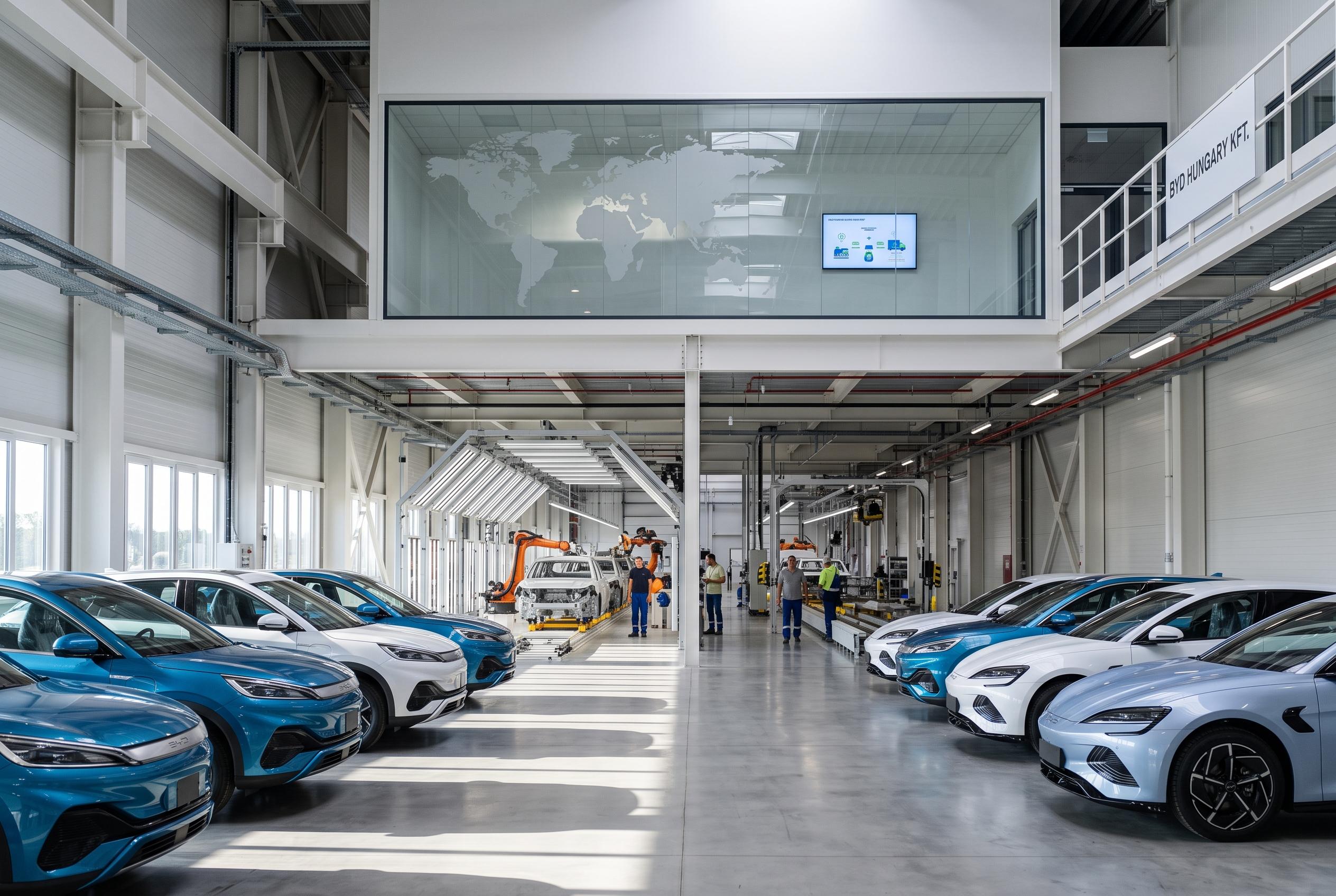

BYD advances its international strategy by prioritising Hungary for European manufacturing and expanding product offerings in the Philippines, highlighting shifts in global EV production and sales amid geopolitical and regulatory challenges.
BYD is pressing ahead on one side of its overseas expansion while slowing down on another, adding two new models in the Philippines as it leaves its planned factory in Turkey on ice and concentrates European production in Hungary.
In Manila, BYD Cars Philippines has opened sales for the Atto 2 compact crossover and a refreshed Seal 5 DM-i sedan. Local outlets reported that the rollout was tied to the second anniversary of the Sealion 6 plug-in hybrid, which the brand marked with a promotional event. The launch strengthens BYD’s position in a market where it is trying to compete across both lower-priced and more established compact segments.
Reservation materials circulated in the Philippines show the Atto 2 will be offered in three forms, including plug-in hybrid and battery-electric versions, while the Seal 5 DM-i will arrive in two plug-in hybrid trims. According to local automotive reports, the Atto 2’s DM-i versions use a 1.5-litre petrol engine with an electric motor, while the electric variant is expected to use a single-motor layout. The Seal 5 DM-i keeps BYD’s hybrid focus, with the facelifted model adopting styling cues from the brand’s newer Ocean series.
The company’s European strategy is now tilting decisively towards Hungary. BYD has confirmed that its planned $1 billion factory in Manisa, Turkey, has been paused indefinitely, with no production timetable currently in place. By contrast, the company is treating its Szeged site as its priority European passenger-car plant, with series production still targeted for the fourth quarter of 2026. That facility matters because vehicles built there should avoid the extra European Union tariffs applied to Chinese-made electric vehicles.
The Hungarian project has not been free of friction. Local authorities have scrutinised the site over work permits, social security records and contracts, and regulators have also fined the project over an environmental issue linked to earth removal on the premises. Even so, BYD is sticking with its timetable, underscoring how important a tariff-free European base has become as it reshapes its international footprint.
That shift comes as overseas sales take on more weight in the group’s overall business. Company data shows BYD sold about 969,000 vehicles outside China from January to July, equal to 43.5% of total group sales. July alone brought a record 179,841 overseas deliveries of passenger cars and pickups, more than double the level a year earlier. With domestic growth slowing, that export performance is increasingly central to the company’s case.
Investors have not yet fully rewarded the expansion. BYD shares were trading at €10.14 on Monday, still well below last year’s peak, even after a modest gain on the day. Attention now turns to the company’s unaudited half-year figures due later this month and the public debut of the new Da Han sedan at the Chengdu auto show, both of which will help show whether the overseas push is translating into stronger earnings.
Disclaimer: This content is intended for informational purposes only. Readers are advised to exercise their own judgement, conduct due diligence, or consult a qualified expert before acting on any information provided.