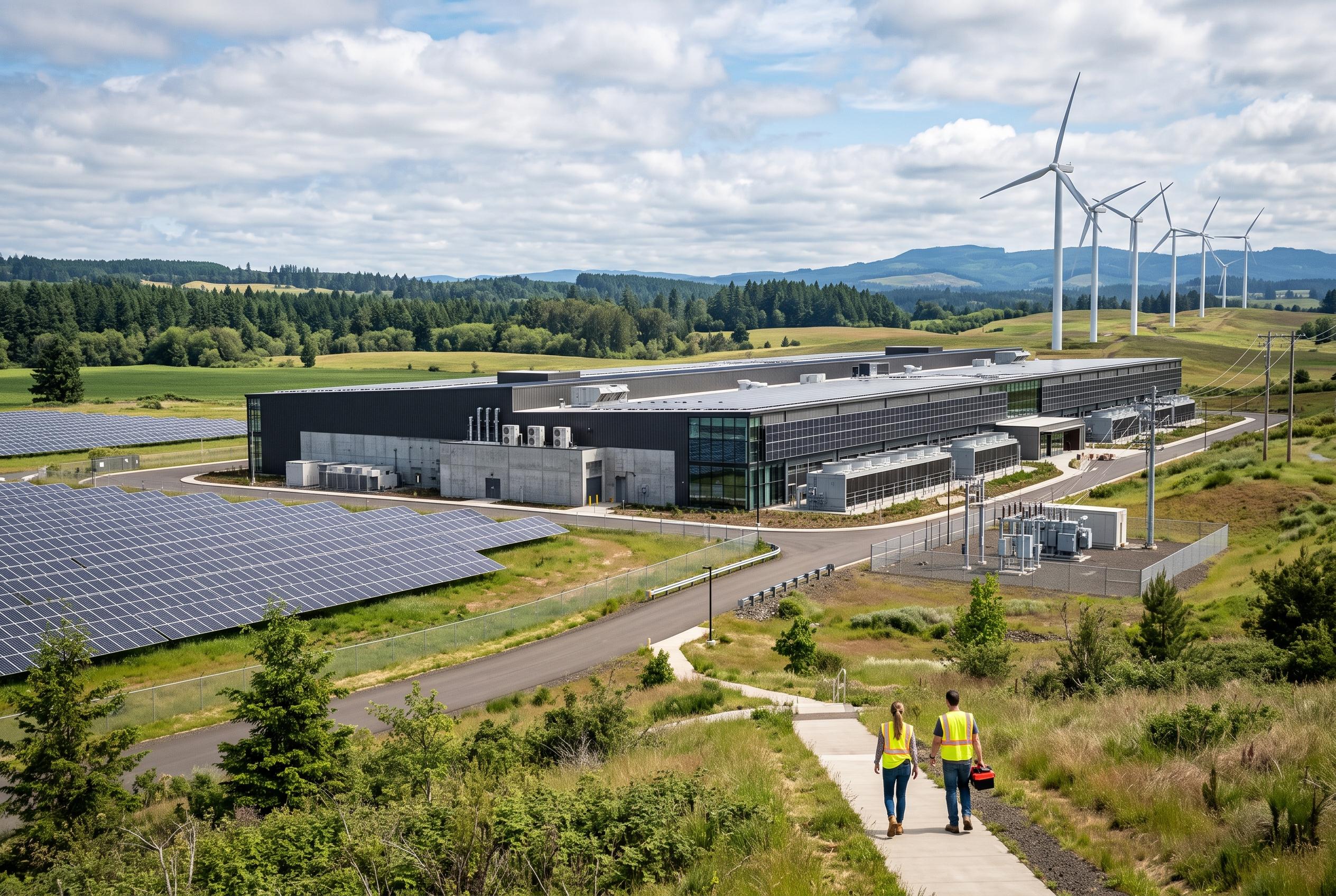

Ulanqab is becoming a major hub for China’s AI data-centre expansion, but abundant electricity and land cannot resolve shortages of advanced chips, network capacity and paying workloads.
China is racing to turn Inner Mongolia’s grasslands and farmland into a new kind of industrial base: a dense cluster of data centres built to feed the artificial intelligence boom. In Ulanqab, where the land is wide, the air is cold and renewable power is abundant, operators have moved quickly to convert former agricultural land into server campuses. Yet the broader contest with the United States is increasingly shaped not just by ambition, but by hard limits on chips, capital and demand. According to CNN, the city already has dozens of planned facilities, while the research directory at Epoch AI identifies VNET’s Bayin campus as one of the largest operational AI sites in the area, with plans for substantial further expansion.
The appeal of Ulanqab is straightforward. Its climate helps reduce cooling costs, and its wind and solar resources make it easier to market projects as green compute. Local residents quoted by CNN described a visible economic lift as construction workers arrived and spending increased, even as some businesses were disrupted by development. That pattern reflects a wider push across China to use cheaper energy and available land to offset weaknesses elsewhere in the AI stack. VNET’s Bayin site is described by Epoch AI as an operational AI data centre geared towards large-language-model workloads, with a major increase in capacity projected by 2027.
But the scale of the build-out should not be confused with an unconstrained advance. The New Talk report said Beijing is still constrained by the United States’ restrictions on high-end chip exports, which limit access to Nvidia and AMD accelerators that remain central to frontier AI systems. It also noted that China’s domestic chipmakers are trying to narrow the gap, but remain behind on performance and face tight production capacity. VNET’s own Bayin project illustrates the intensity of demand: Global Data Centers reports that its third phase was approved in February 2026, with ByteDance said to be behind the need for additional capacity, including space for server halls, generators and a research building.
That tension is driving a distinctly Chinese strategy: use electricity where advanced silicon is scarce. The New Talk article said China added more generating capacity between 2022 and 2025 than the total industrial power capacity available in the United States by the end of 2025, while research from the Centre for Research on Energy and Clean Air and Global Energy Monitor found that excess renewable electricity in the first half of 2026 alone was large enough to power Mexico for a year. In parallel, a report cited by Tom’s Hardware said Beijing is drafting a five-year plan worth about 2 trillion yuan to build a national AI data-centre grid, with at least 80% of the technology intended to come from domestic suppliers.
Even so, the economics remain uncertain. The New Talk report warned that many inland projects risk becoming underused “ghost data centres” if they are built to satisfy policy targets rather than actual customer demand. Distance from coastal demand centres also creates latency problems, which matters as AI development shifts from raw compute towards bandwidth and interconnect performance. Against that backdrop, companies such as Envision are trying to differentiate themselves. Data Centre Magazine reported that its Galaxy Campus in Ulanqab is designed to scale beyond 2 GW, with most of its power intended to come directly from its own wind farm and with waterless cooling methods. Whether such projects become durable infrastructure or simply another round of overbuilding will depend on whether China can match energy abundance with enough usable chips, network capacity and paying workloads.
Disclaimer: This content is intended for informational purposes only. Readers are advised to exercise their own judgement, conduct due diligence, or consult a qualified expert before acting on any information provided.