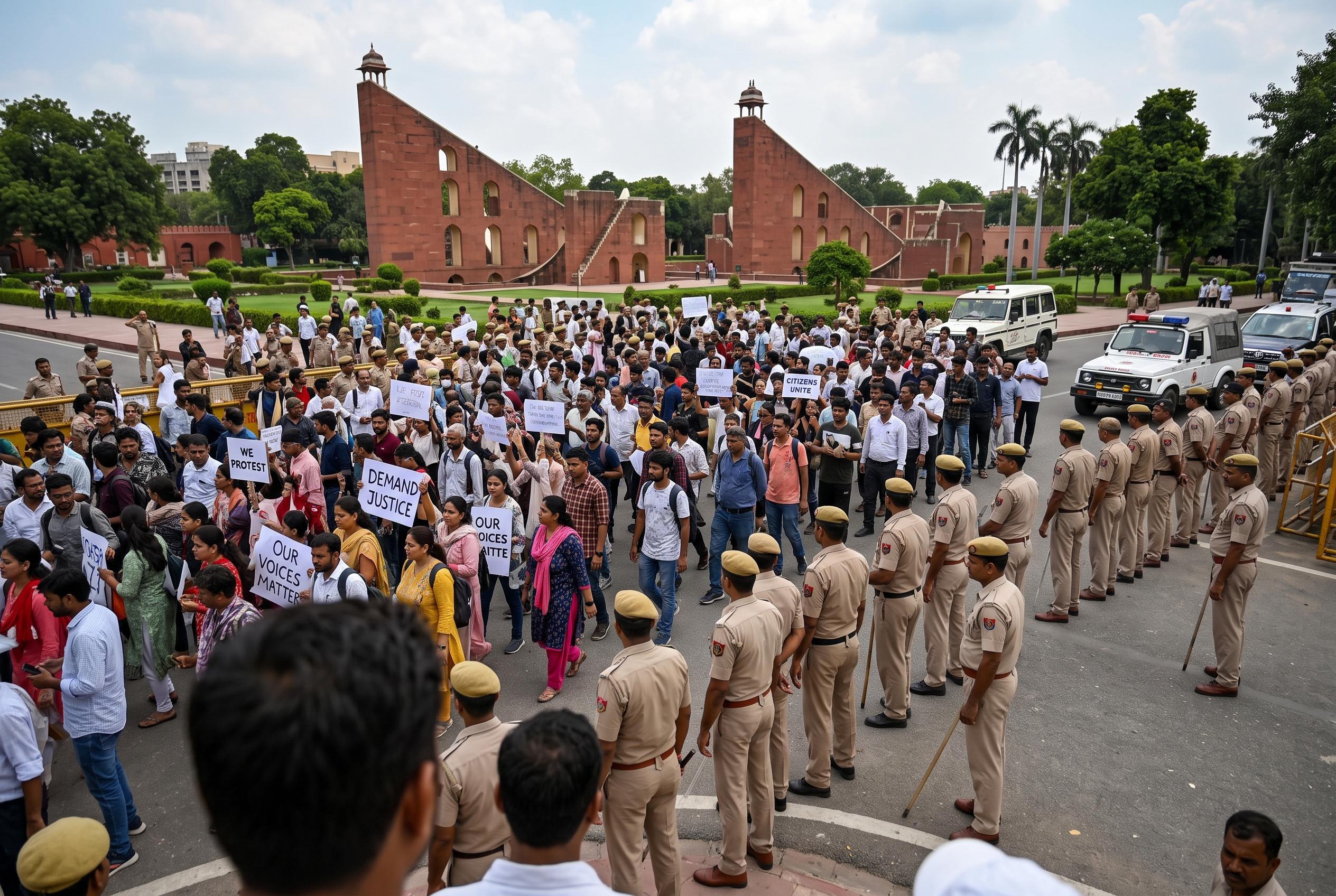

Delhi’s recent protests at Jantar Mantar have become a battleground for debates on police use of intrusive AI-driven surveillance tools, raising urgent questions about legality and privacy in a democratic society.
Delhi’s recent protests at Jantar Mantar have become a test case for how far police surveillance can go in a democratic public space. Reports from the site describe body-worn recording devices, AI-assisted facial recognition, mobile surveillance vans and other monitoring tools being used as demonstrators gathered there. The controversy has moved beyond the familiar question of whether police may record a protest at all, and towards a harder issue: whether technology is being used in ways that outstrip the legal basis for ordinary policing. According to reporting by India Legal Live and Brut, the technology appears to have been deployed alongside conventional crowd-control measures, but with a far more intrusive reach.
The Indian Express said Delhi Police deployed two surveillance vehicles near the protest site, including a larger mobile command unit watching live CCTV feeds and a smaller vehicle using AI-supported facial recognition to match faces against a police database. India Legal Live also reported the use of an Ikshana surveillance vehicle equipped with 360-degree cameras and AI-assisted facial recognition. Separately, visuals and protest accounts published by Business and Human Rights Resource Centre described officers wearing Meta smart glasses, which can combine recording functions with a low-visibility form of on-the-ground monitoring.
The legal challenge now unfolding in the Delhi High Court and, according to Webindia123, in a public interest petition before the Supreme Court, turns on privacy, free speech and peaceful assembly. The plea filed by Rajya Sabha MP A A Rahim reportedly names the Union of India, Delhi Police and the National Crime Records Bureau as respondents, and alleges that protesters, journalists and members of the public were subjected to continuous biometric surveillance from 20 June, using CCTV cameras, drones, body-worn cameras, a mobile command vehicle, AI-enabled smart glasses and fingerprint checks. Another petition, reported by Business and Human Rights Resource Centre, alleges that people were filmed while eating, resting and receiving medical attention.
The Centre has argued in the Delhi High Court that privacy in a public place is an “oxymoron”, and that videography at Jantar Mantar is a routine law-and-order practice. India Legal Live noted that this defence does not settle the constitutional issue. The distinction matters because a conventional camera records an event, whereas facial-recognition systems can convert an image into a biometric identifier, search databases and link an individual to other records. That shift raises questions about legality, necessity, proportionality and accountability that ordinary crowd videography does not.
The broader concern is the absence of a clear statutory framework for police use of facial recognition and related AI surveillance in India. India Legal Live said the Digital Personal Data Protection Act, 2023 offers a general data-protection framework, but also contains exemptions for law-enforcement and State processing. Critics argue that this leaves important gaps around retention, sharing, deletion and audit trails. For protest movements, the practical effect may be even more serious than the legal one: continuous monitoring can chill attendance, deter journalists and create a climate in which public dissent carries the risk of being stored, matched and reused later.
Disclaimer: This content is intended for informational purposes only. Readers are advised to exercise their own judgement, conduct due diligence, or consult a qualified expert before acting on any information provided.