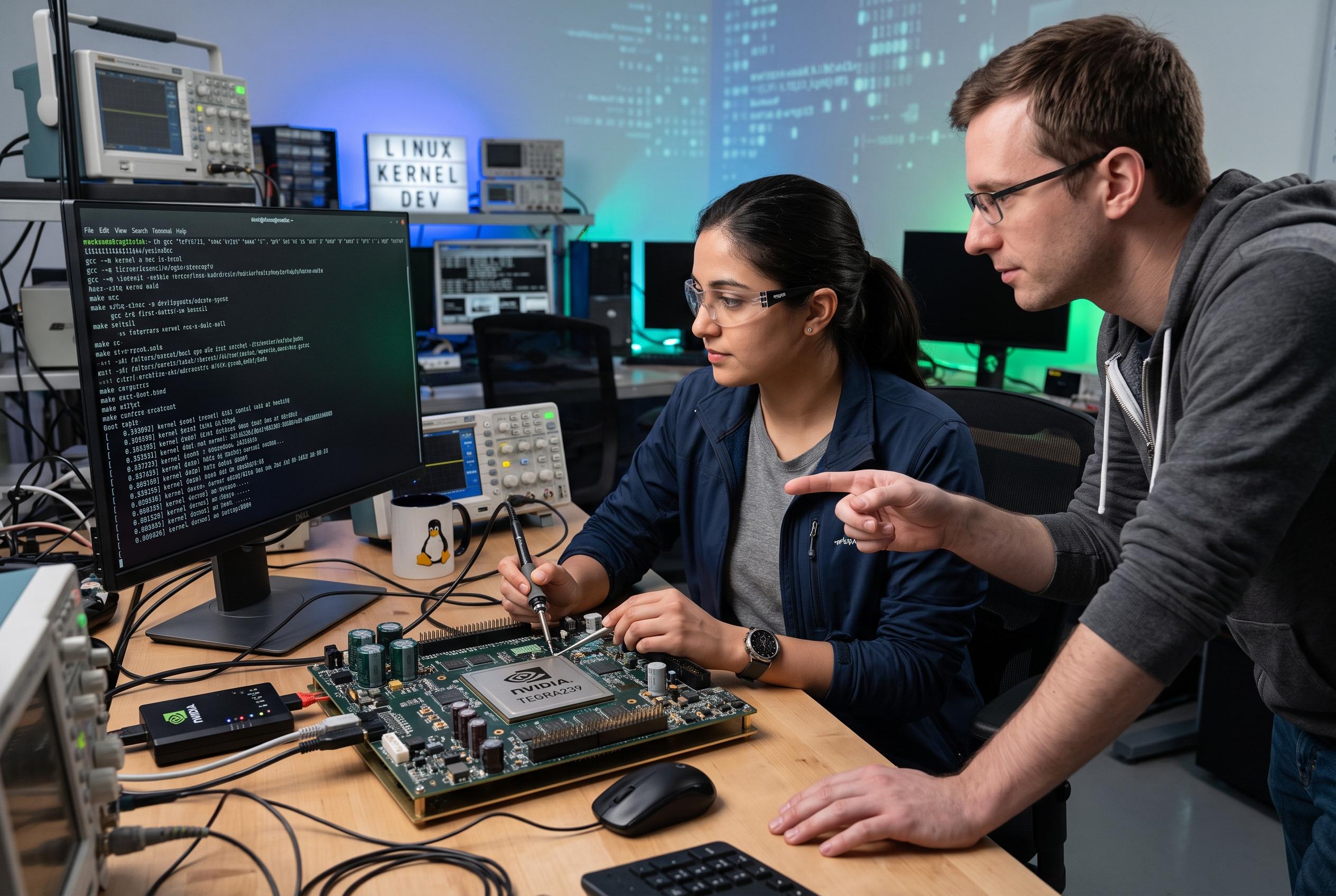

A Linux kernel patch submitted by NVIDIA in September 2022 revealed key details of the Tegra239 processor, which later became the core of Nintendo’s Switch 2, ahead of its official launch and teardown confirmation.
The first solid clue that Nintendo’s next console would use NVIDIA silicon did not come from a leak site. It came from a public Linux kernel patch submitted by NVIDIA engineer Sumit Gupta in September 2022. The patch named Tegra239 and described a CPU layout with eight cores in a single cluster, a detail that made the part look real rather than speculative.
That evidence, however, stopped well short of a full product reveal. It did not name Nintendo, did not identify a retail console and did not disclose clocks, memory, storage or launch timing. Later reporting in 2022 connected T239 to NVIDIA’s Tegra234, also known as Orin, and suggested a possible next-generation Nintendo platform, but that link remained inferential at the time.
The picture changed only after Nintendo formally unveiled Switch 2 and launched the machine on June 5, 2025. Nintendo’s own specifications describe a custom NVIDIA processor, a 7.9-inch 1080p HDR LCD, up to 120Hz output and 256GB of UFS storage. NVIDIA separately said the platform includes DLSS, ray tracing, dedicated Tensor and RT cores, G-SYNC support and 4K TV-mode output.
Post-launch hardware analysis then filled in the missing silicon details. TechSpot reported that a teardown confirmed Tegra T239 in retail units, alongside eight Arm Cortex-A78C CPU cores, an Ampere-based graphics block with 1,536 CUDA cores, 12GB of LPDDR5X memory and 256GB of UFS 3.1 storage. That matched the broad shape of the 2022 clue, even if it did not match every early estimate that circulated before release.
Those earlier estimates were the weakest part of the story. Some 2022 reports suggested 2,048 CUDA cores and roughly 4 TFLOPs, but later analysis reported a smaller GPU. That is not unusual in a battery-powered console, where final performance depends on clocks, thermal limits, memory bandwidth, software scheduling and game-specific optimisation, not just on headline core counts.
Taken together, the evidence shows that the T239 patch was a meaningful early signal, not a complete specification leak. It was accurate on the most important point: NVIDIA had a real Tegra239 design with an eight-core CPU cluster, and that design ultimately became the basis of Nintendo Switch 2. What it did not provide was the complete retail picture, which only emerged through Nintendo’s launch details and subsequent teardown work.
Disclaimer: This content is intended for informational purposes only. Readers are advised to exercise their own judgement, conduct due diligence, or consult a qualified expert before acting on any information provided.