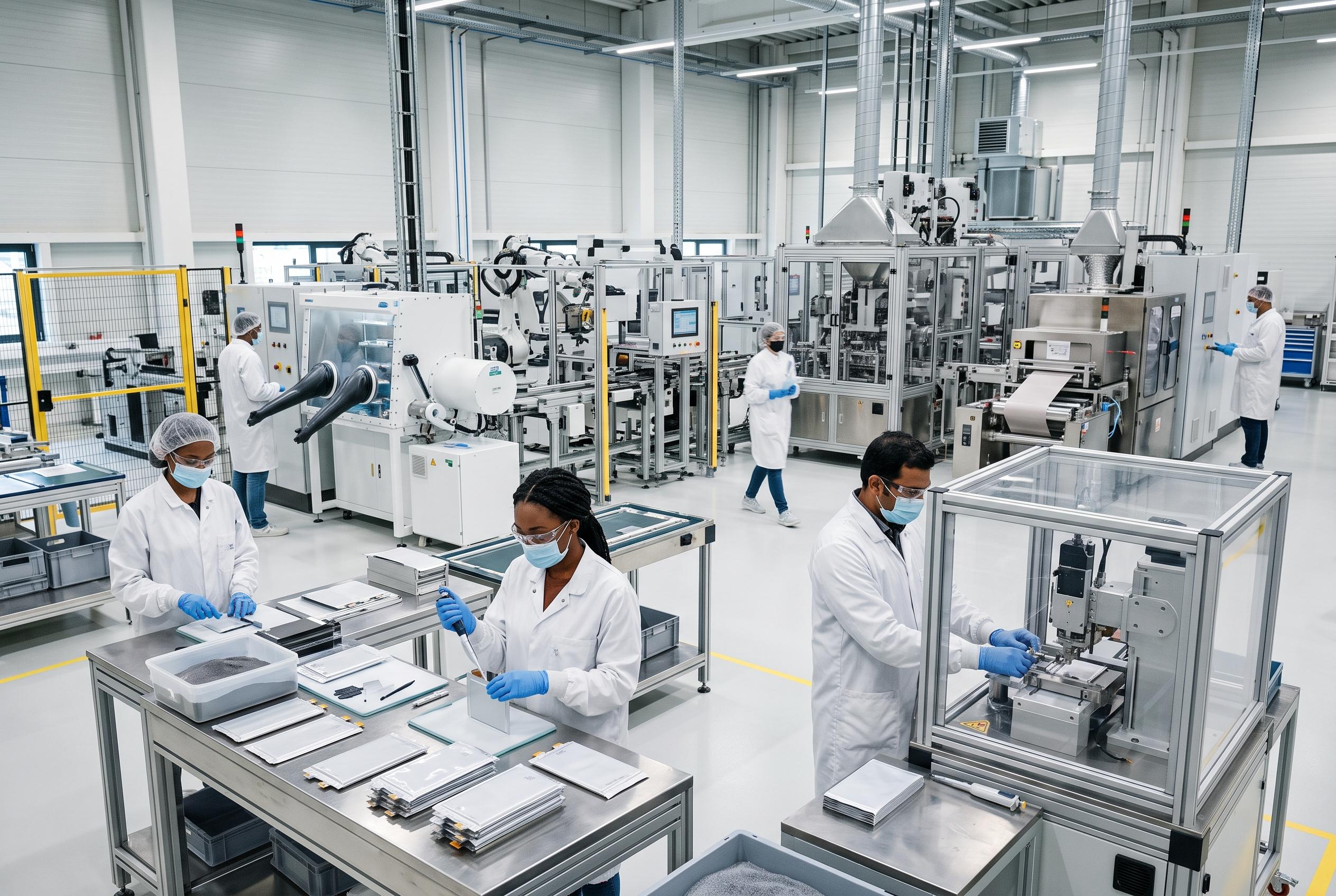

Dutch start-up LeydenJar is developing high-density silicon-anode batteries for drones and defence, but its new Eindhoven plant shows how difficult it remains for Europe to escape Chinese equipment and expertise.
Europe’s push to build a battery industry of its own is running into the same obstacle at several points in the value chain: dependence on Chinese machinery, materials and know-how. In the Netherlands, LeydenJar is trying to change that from an industrial estate in Eindhoven, where the start-up is fitting out a new production site for advanced battery components and eventually complete cells. The company’s silicon anode technology is designed to raise energy density by about 50% compared with conventional anodes, while also making batteries lighter, faster to charge and potentially less carbon-intensive to produce, according to LeydenJar’s own technical material.
That ambition matters well beyond consumer electronics. The Eindhoven plant is being prepared for batteries aimed first at drones and other specialist applications, including military uses, where European buyers are increasingly sensitive to supply-chain risk. LeydenJar says its anodes can be made with a plasma-based manufacturing process that is intended to be scalable and to cut emissions sharply versus established methods. The firm, founded in 2016 as a Dutch deep-tech company, says the technology can be fitted into existing battery formats and paired with standard cathodes and electrolytes.
But the company’s own expansion also illustrates Europe’s dilemma. LeydenJar is buying equipment from Germany, South Korea and China because, as its management argues, a fully Chinese-free production line is not realistic today. The firm says it will keep control over maintenance and adjustment itself, in part because defence customers would not accept outside technicians from China working on the line. Even so, chief growth officer Ewout Lubberman has acknowledged that the dependency is difficult to escape, saying European makers are still losing ground while Chinese manufacturers keep introducing newer generations of machinery.
That dependency is one reason the debate has broadened from batteries themselves to the machines that make them. According to the European Automobile Manufacturers’ Association, the EU still accounts for only a small share of global battery production and remains heavily reliant on imports across the supply chain. In practice, that means European vehicle makers and battery start-ups often rely on equipment and upstream processing that ultimately traces back to China, even when the final assembly happens in Europe. The result is a strategic vulnerability that Brussels, national governments and industry groups have been trying to address with subsidies, procurement rules and industrial policy.
The pressure is particularly visible in the automotive sector. European cell makers such as Automotive Cells Company, Verkor and PowerCo have all struggled to bring factories up to stable output, and industry reports have said many of the machines they use were sourced in China. The consequences can be immediate: Reuters reported in September that Stellantis paused production of some electric Peugeot models after battery supply problems at ACC. For LeydenJar and its backers, the lesson is that Europe cannot build battery autonomy by cell chemistry alone. It also needs its own machine builders, its own process expertise and, above all, the patience to industrialise technologies that are still far from mature.
Disclaimer: This content is intended for informational purposes only. Readers are advised to exercise their own judgement, conduct due diligence, or consult a qualified expert before acting on any information provided.