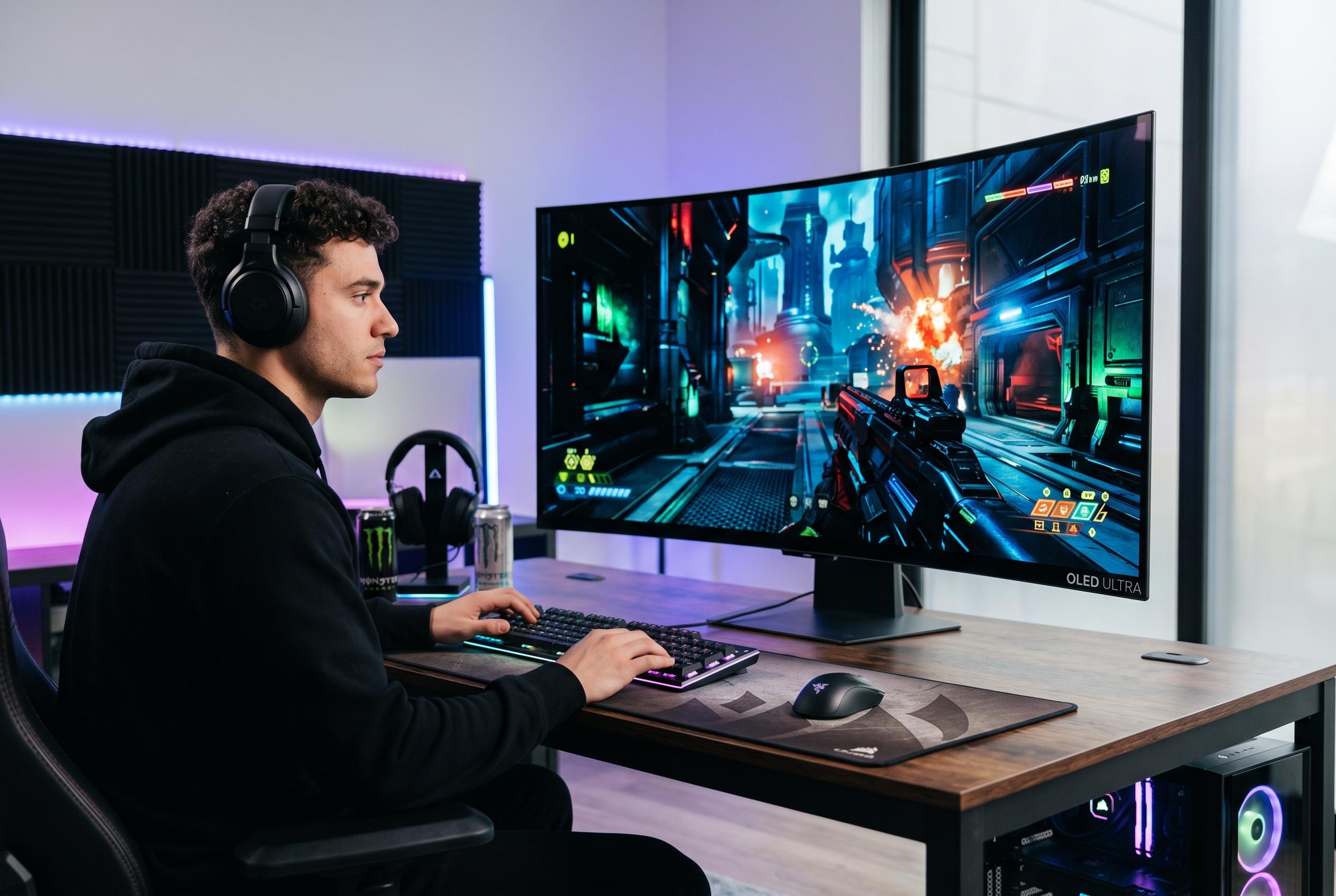

The gaming monitor market is experiencing rapid expansion as larger, OLED and Mini-LED screens become mainstream, driven by esports, streaming, and premium home setups, with projections reaching over $21 billion by 2032.
Large gaming monitors are moving from a niche enthusiast product into a broader premium category, according to market research cited by HTF Market Intelligence. The report says the segment is being lifted by demand for 32-inch and larger displays, along with faster refresh rates, higher resolutions and panel technologies such as OLED and Mini-LED. It projects the market to rise from $9.6 billion in 2025 to $21.2 billion by 2032, with a compound annual growth rate of 11.8%. This trend is being reinforced by esports, streaming and the growing preference for multi-purpose setups that can handle both play and productivity.
Other market studies point in the same direction, though with different estimates and timeframes. Emergen Research values the broader gaming monitor market at $12.63 billion in 2025 and forecasts a 9.9% revenue CAGR, while Future Market Report pegs the large-screen monitor market at $11.05 billion in 2025, rising to $21.14 billion by 2033. The variation reflects different definitions of the market, but the common message is clear: large displays are gaining share as buyers look for more immersive visuals and better performance. Curved formats, in particular, are also drawing attention, with one forecast putting that segment at $5.25 billion in 2025 and $11.50 billion by 2032.
Technology shifts are central to the market’s momentum. According to industry reports and recent product launches, OLED is becoming a stronger selling point for premium buyers, while Mini-LED is being positioned as a high-brightness alternative for users who want strong contrast without some of OLED’s trade-offs. LG’s UltraGear evo lineup, announced ahead of CES 2026, includes a 39-inch curved Tandem OLED model and a 52-inch 5K2K large-format display, showing how manufacturers are pushing beyond standard gaming sizes. Samsung has also expanded its Odyssey G7 range with 37-inch and 40-inch curved monitors, underlining the move towards larger, higher-resolution panels with gaming-focused refresh rates.
Shipment data suggests the technology cycle is already reshaping the market. Tom’s Hardware reported that OLED monitor sales surged 92% in 2025 to 2.735 million units globally, with ASUS leading shipments. That growth helps explain why premium gaming monitors are increasingly being marketed not just to esports players but also to content creators and buyers building high-end home setups. The appeal is straightforward: larger screens improve immersion, while high refresh rates and low response times reduce motion blur and input lag.
Even so, the segment faces practical limits. Premium pricing remains a barrier, as do desk space, the need for powerful graphics hardware and competition from large-screen gaming televisions. Analysts also note that the market moves quickly, which can make products feel outdated sooner than buyers expect. For now, though, the direction of travel is towards bigger, faster and more visually ambitious displays, with Asia-Pacific leading current demand and North America expected to be the fastest-growing region.
Disclaimer: This content is intended for informational purposes only. Readers are advised to exercise their own judgement, conduct due diligence, or consult a qualified expert before acting on any information provided.