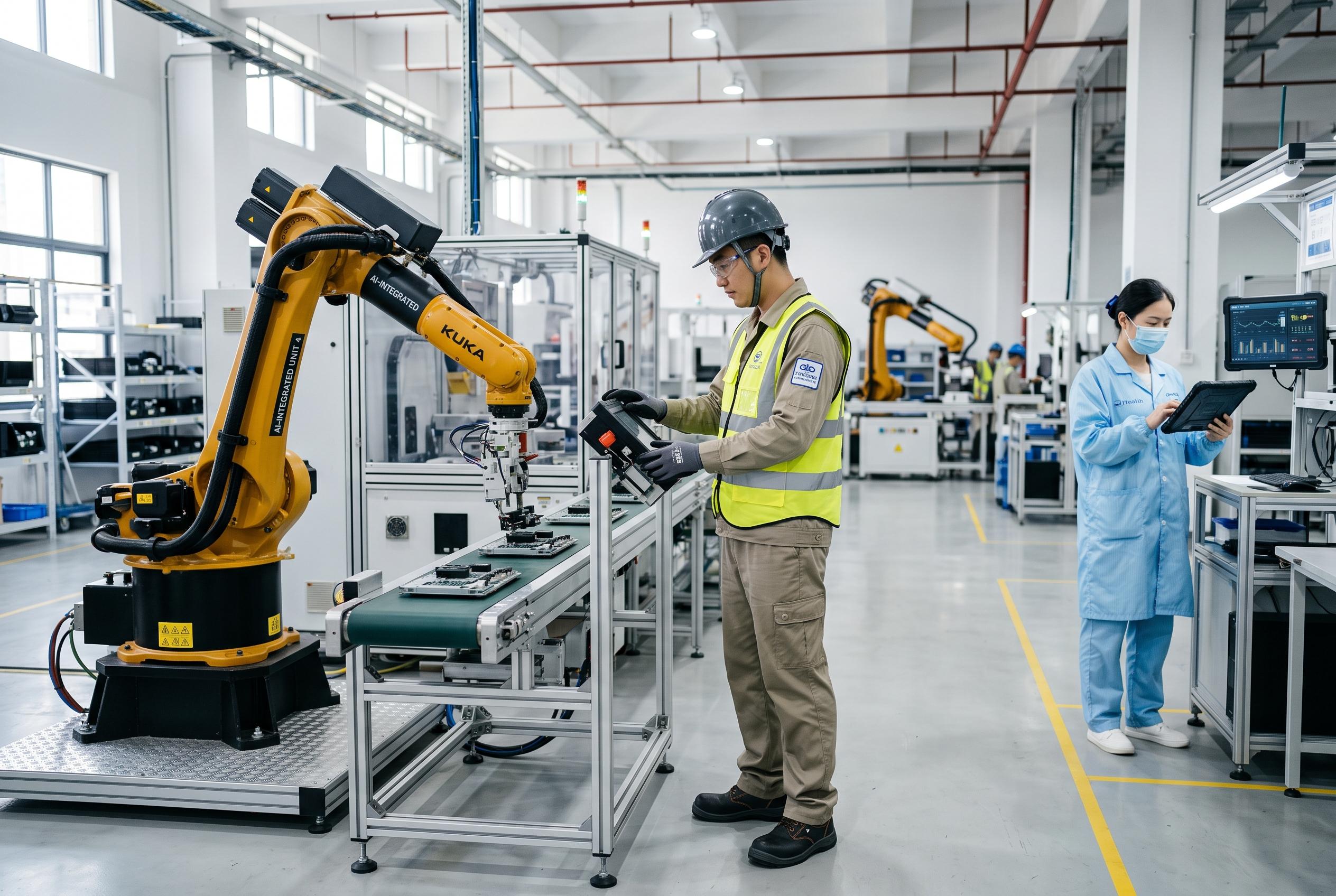

The Greater Bay Area is transitioning from AI research to practical industrial application, with Guangzhou and Dongguan leading the way in integrating AI into factories and hospitals amid a region rich in manufacturing expertise.
The Greater Bay Area is moving from AI experimentation towards industrial deployment, with southern China’s technology policy now focused less on model development alone and more on how artificial intelligence can be embedded into factories, hospitals and wider service systems.
In Guangzhou, the first AI Agent Industrial Park in Huangpu District has been unveiled as a clustered development zone for intelligent software and AI firms. Official material from the Guangzhou Development District says the site covers 128,000 square metres and is designed to support the full chain from research and testing to production and office operations. It also aims to attract at least 50 industrial software companies by the end of 2028 and build a 10 billion RMB software industry scale.
Dongguan is pursuing a more application-led model. The city has opened what it describes as its first joint laboratory for OpenHarmony-based smart medicine, a project backed by the National AI Application Pilot Base and Nanfang Hospital of Southern Medical University’s Dongguan Binhaiwan Central Hospital. According to the Greater Bay Area news portal, the laboratory is intended to develop intelligent ward systems, medical-device terminals, pharmaceutical traceability tools and hospital management applications that can be standardised and replicated elsewhere.
The emphasis on practical deployment is also visible in Huangpu’s wider industrial planning. In February, construction began on the Guangdong-Hong Kong-Macao Greater Bay Area International Intelligent Inspection Industrial Park, which is expected to provide testing, certification and laboratory services for emerging industries, including the low-altitude economy. Separate local government material also shows that Huangpu has approved a JD.com-backed AI manufacturing park, due for completion in 2029, underlining the district’s push to link AI with robotics and advanced manufacturing.
This approach reflects the region’s existing industrial strengths. Guangzhou, Dongguan and the broader Pearl River Delta already sit within one of the world’s most concentrated manufacturing ecosystems, making the area better placed than many rivals to turn AI into productivity gains rather than stop at software innovation. That strategy also matches Beijing’s broader preference for coupling digital tools with the real economy, particularly in manufacturing quality, efficiency and energy use.
Shenzhen remains the technology engine of the region, but its role is increasingly to supply research, chips, robotics and software that neighbouring cities can test and scale. Hong Kong and Macau sit alongside that system in more specialised functions: finance, legal services, international research and market access in Hong Kong, and tourism, smart services and diversification efforts in Macau.
The result is a more segmented regional model. Guangzhou is building industrial AI infrastructure, Dongguan is applying AI in production and healthcare, and the wider Greater Bay Area is trying to turn artificial intelligence into a practical industrial tool rather than a standalone sector. The challenge now is not only technical capacity, but skills, data governance, cybersecurity and supply-chain resilience.
Disclaimer: This content is intended for informational purposes only. Readers are advised to exercise their own judgement, conduct due diligence, or consult a qualified expert before acting on any information provided.