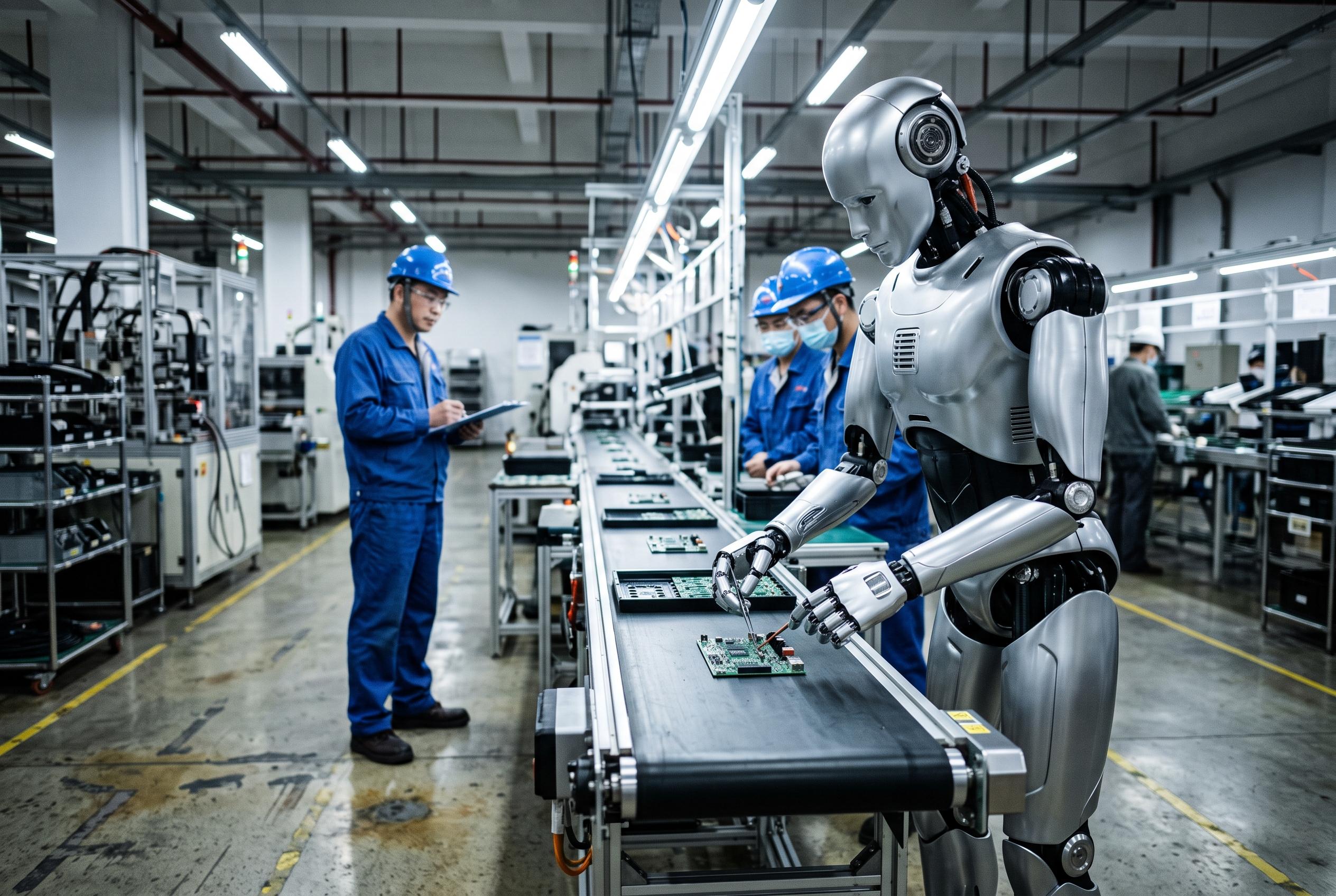

As humanoid robots transition from labs to factories worldwide, Chinese manufacturers dominate installations, while Western firms like Tesla and Boston Dynamics push for broader deployment amid technological challenges.
Humanoid robots are moving beyond controlled laboratory settings and into factories, warehouses and other structured workplaces. The latest wave of machines is built to interpret natural language, identify objects and execute physical tasks with more autonomy than earlier generations. Yet the market is still uneven: according to figures covered by the South China Morning Post, Chinese manufacturers accounted for more than four-fifths of humanoid robot installations worldwide in 2025.
Among the best-known American developers, Figure AI is positioning itself as a general-purpose platform rather than a narrowly industrial one. The company says its Figure 03 robot is driven by Helix, an embodied AI system that translates visual input and spoken instructions into action. Figure has also used an active BMW production line to demonstrate the machine, signalling a move away from staged demonstrations towards live operations.
China’s AgiBot has emerged quickly as one of the most aggressive producers in the sector. Its range spans full-size humanoids, service robots, quadrupeds and open platforms for researchers. The company says its strategy is built on mass production and open development, while market data cited by the South China Morning Post placed it at 30.4% of global installations in 2025. Unitree Robotics, better known first for its quadrupeds, has also pushed hard into humanoids with the H1 and G1. Its low-cost G1 model, starting at about $13,500, has helped make advanced robotics more accessible to universities and AI labs, while the company captured 26.4% of worldwide humanoid installations last year.
Tesla is taking a different route with Optimus, aiming at a general-purpose robot that can handle repetitive, risky and physically demanding work. The project draws on the company’s experience in vision systems, batteries, motors and autonomous driving software. But the commercial case remains early. Elon Musk has said the first production ramp will be slow, and the robot has yet to reach meaningful deployment at scale.
UBTech Robotics, based in Shenzhen, is focusing more tightly on industrial tasks. Its Walker series is being developed for automotive production, materials handling, inspection, sorting, logistics and repetitive assembly. The Walker S2 can replace its own battery, which reduces dependence on human intervention. UBTech said it shipped 1,079 full-size humanoids in 2025, although Reuters reported that many humanoids remain too slow and error-prone for broad industrial use.
In the United States, Apptronik and Boston Dynamics are also pushing towards practical deployment. Apptronik’s Apollo, which traces its origins to NASA’s Valkyrie work, is designed for warehouse and factory jobs including moving parts, inspecting products and tending machines. The company has signed agreements with Mercedes-Benz and GXO and has partnered with Google DeepMind. Boston Dynamics, meanwhile, is turning Atlas from a research showcase into a manufacturing robot, with Hyundai planning production use. Both firms are backed by deep engineering experience, but the core challenge remains the same: today’s humanoids still struggle to match people in unpredictable environments, while specialised industrial robots remain faster, cheaper and more reliable for many structured tasks.
Disclaimer: This content is intended for informational purposes only. Readers are advised to exercise their own judgement, conduct due diligence, or consult a qualified expert before acting on any information provided.