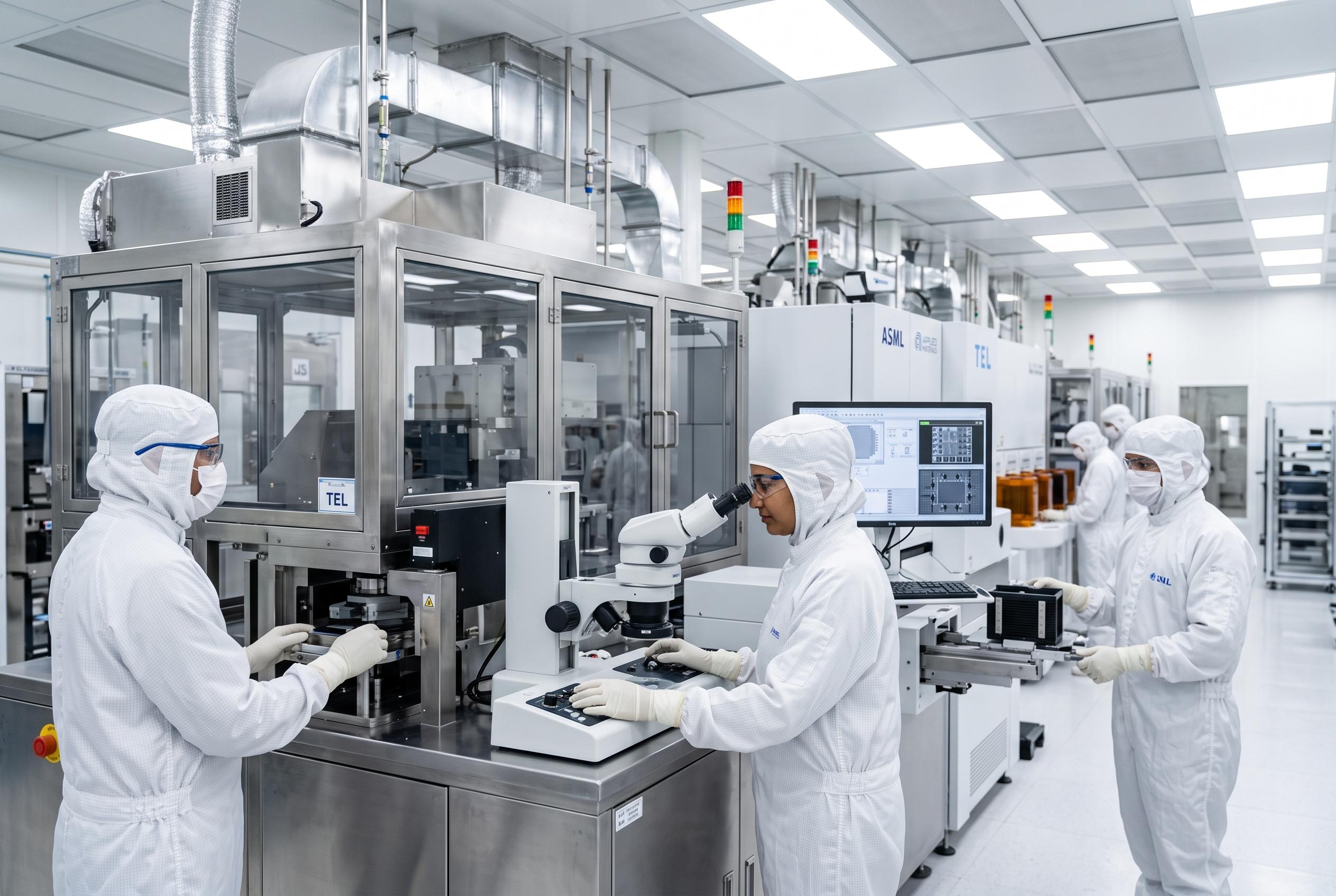

India’s move from policy to production, focused initially on assembly, is positioning the country as a significant player in global electronics manufacturing, with potential to expand into full chip fabrication.
India’s semiconductor strategy is moving from policy design to industrial execution, and the timing reflects a larger shift in global electronics manufacturing. The country has already become a major base for iPhone assembly, with government-backed incentives helping Apple and its suppliers diversify beyond China. According to recent reporting, Apple has shipped nearly $50 billion worth of iPhones from India since fiscal 2022, underlining how quickly the country has moved into a more important role in consumer electronics manufacturing.
The government now wants a similar outcome in chips, but the challenge is harder. Semiconductor production is split between design, wafer fabrication and packaging, and India is concentrating first on outsourced semiconductor assembly and test, known as OSAT, and assembly, test, marking and packaging, or ATMP. These are lower-barrier activities than building a full fab, but they are also labour-intensive and lower-margin. That makes them a practical entry point for a country trying to build scale quickly. The latest phase of support adds about ₹1.27 trillion to the earlier incentive programme, while the first wave of projects is already moving into production.
Industry data helps explain why New Delhi is pushing so hard. The Indian Electronics and Semiconductors Association said only 9% of India’s semiconductor requirement was sourced locally in 2021, when the domestic market was valued at $27 billion. Other estimates put the market at $36 billion in 2023 and rising towards $60 billion by 2028, with smartphones accounting for a large share of demand. TechCrunch reported in July that the government has also expanded support for smartphone manufacturing, reinforcing the broader effort to pull more of the electronics supply chain into India. The global backdrop is also favourable: the Semiconductor Industry Association has said worldwide chip sales are on track to exceed $1 trillion in 2026, driven in part by demand for AI hardware, memory and networking equipment.
For India, the immediate opportunity lies in packaging rather than leading-edge chip fabrication. Mature-node chips, generally those at 28-nanometres and above, are used in cars, appliances, telecoms and industrial equipment, and they account for the bulk of global chip volumes. China remains dominant in this segment, with lower costs built on scale and a broad industrial base. India’s first batch of OSAT and ATMP facilities, however, is already drawing bookings from overseas customers seeking supply-chain diversification. Companies including Kaynes Semicon and Suchi Semicon say their capacity is largely committed, with clients in the US, Europe and Japan looking for an alternative to China.
The next test is whether India can move from packaging into manufacturing at a meaningful scale. Tata Electronics is building the country’s first silicon fab, a far more capital-intensive project than OSAT, and the government wants more fabs and compound semiconductor plants to follow. That is a longer-term bet, with a much slower payback, but it is central to India’s ambition to become a top-tier chip hub by 2032. For now, the country is trying to prove something more modest but still significant: that it can become a reliable, cost-competitive node in global semiconductor supply chains at a time when manufacturers are actively looking to de-risk their dependence on China.
Disclaimer: This content is intended for informational purposes only. Readers are advised to exercise their own judgement, conduct due diligence, or consult a qualified expert before acting on any information provided.