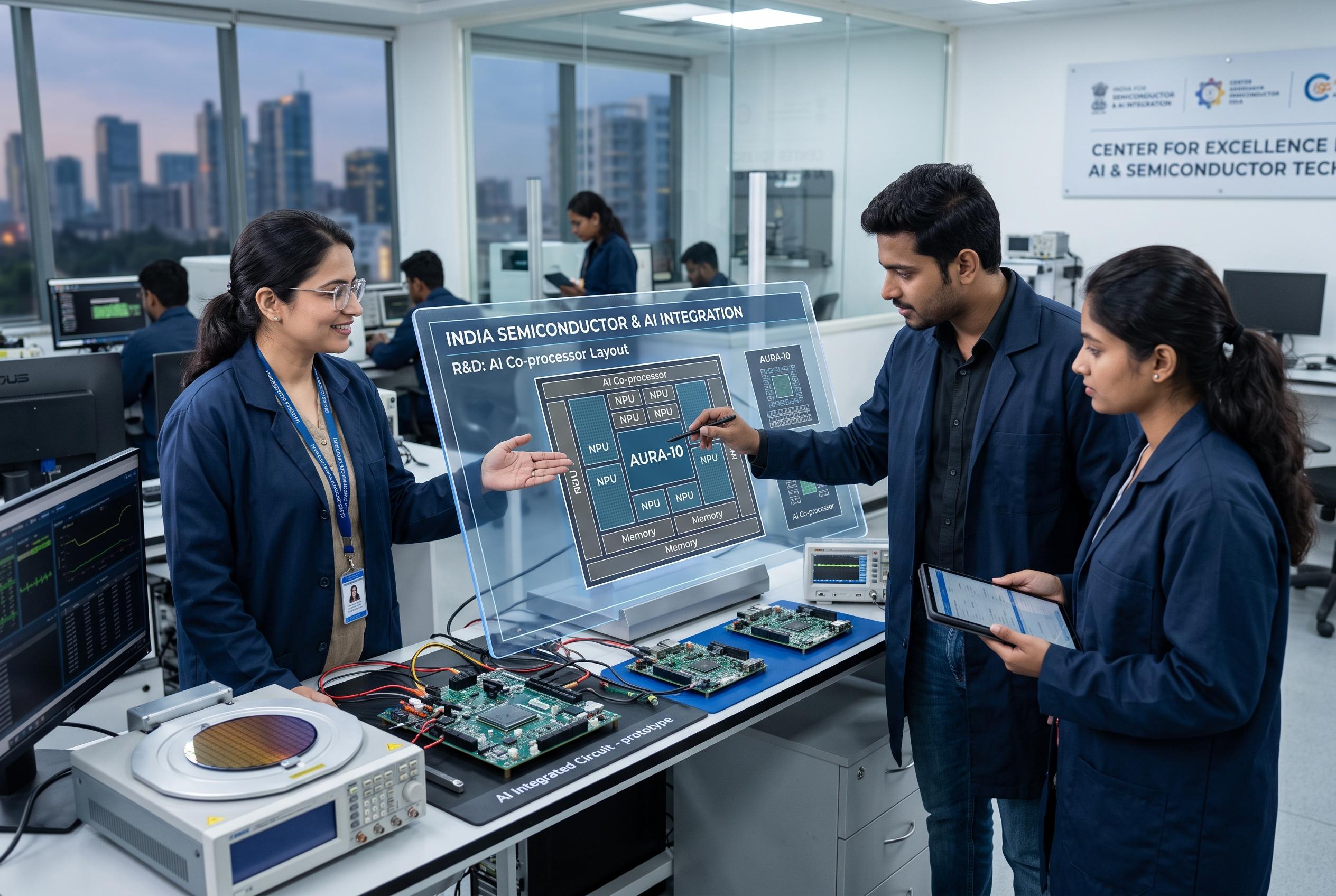

India is transforming its technological landscape by merging semiconductor manufacturing with artificial intelligence development, backed by substantial government funding and international alliances, signalling a shift from policy ambition to industrial realisation.
India’s semiconductor and AI push is moving from policy ambition to industrial capacity, with the two sectors now increasingly treated as one strategy. Semiconductors remain the physical base of modern computing, but the surge in AI demand is reshaping what chips are needed, how quickly they must be designed, and where the supporting infrastructure will be built. That convergence is also changing India’s industrial priorities, from chip design and fabrication to compute, packaging and domestic model development.
The semiconductor programme has already advanced beyond announcement stage. According to the material cited by DQ India, 12 projects have been cleared across six states, with pledged investment exceeding ₹1.64 lakh crore. These include silicon and compound semiconductor fabs, display fabrication and advanced packaging units, and three facilities have already started commercial output. The first phase of the government’s Semicon push used a ₹76,000 crore outlay to build the ecosystem, while Semicon 2.0, approved in July 2026 with a ₹1,27,500 crore allocation, broadens the focus to equipment, materials, R&D, talent and indigenous intellectual property.
That build-out is being reinforced by global supply-chain links. Tom’s Hardware reported that India has joined Pax Silica, a U.S.-led initiative aimed at deepening collaboration across semiconductors, AI infrastructure, rare-earths and advanced manufacturing. The move places India alongside partners including the US, Japan, South Korea and the UK, and comes as New Delhi works to widen its role in critical technology supply chains. At home, major industrial partners are adding momentum: ASML and Tata Electronics have signed an agreement for equipment support at India’s first commercial fab in Dholera, while Intel has also expanded its strategic engagement with Tata Group.
The AI side of the equation is advancing in parallel. The IndiaAI Mission, backed by about ₹10,372 crore, has expanded shared computing capacity to more than 45,000 GPUs and, by August 2026, had supported 237 projects across 93.18 lakh GPU hours. It has also selected 20 indigenous foundation model proposals from 506 applications and built out the AI Kosh repository, which now hosts over 14,000 datasets and 331 AI models. The government says 62 AI prototypes have been developed and 20 solutions deployed across public-sector institutions, while 58 AI centres of excellence have been approved to support domain-specific work.
The broader market context is also favourable. Tom’s Hardware reported that Creative Strategies expects the semiconductor industry to enter a “giga cycle” driven by AI infrastructure, with revenues potentially passing $1 trillion by the end of the decade. That demand is helping to lift chips, memory, networking and packaging together, not just leading-edge processors. India is trying to capture more of that value chain while building domestic skills, with EDA tools deployed in 320 academic institutions and more than 68,000 students trained under skilling programmes. The result is a strategy that links manufacturing, research and AI deployment, and aims to turn India from a large consumer of technology into a deeper participant in its design and production.
Disclaimer: This content is intended for informational purposes only. Readers are advised to exercise their own judgement, conduct due diligence, or consult a qualified expert before acting on any information provided.