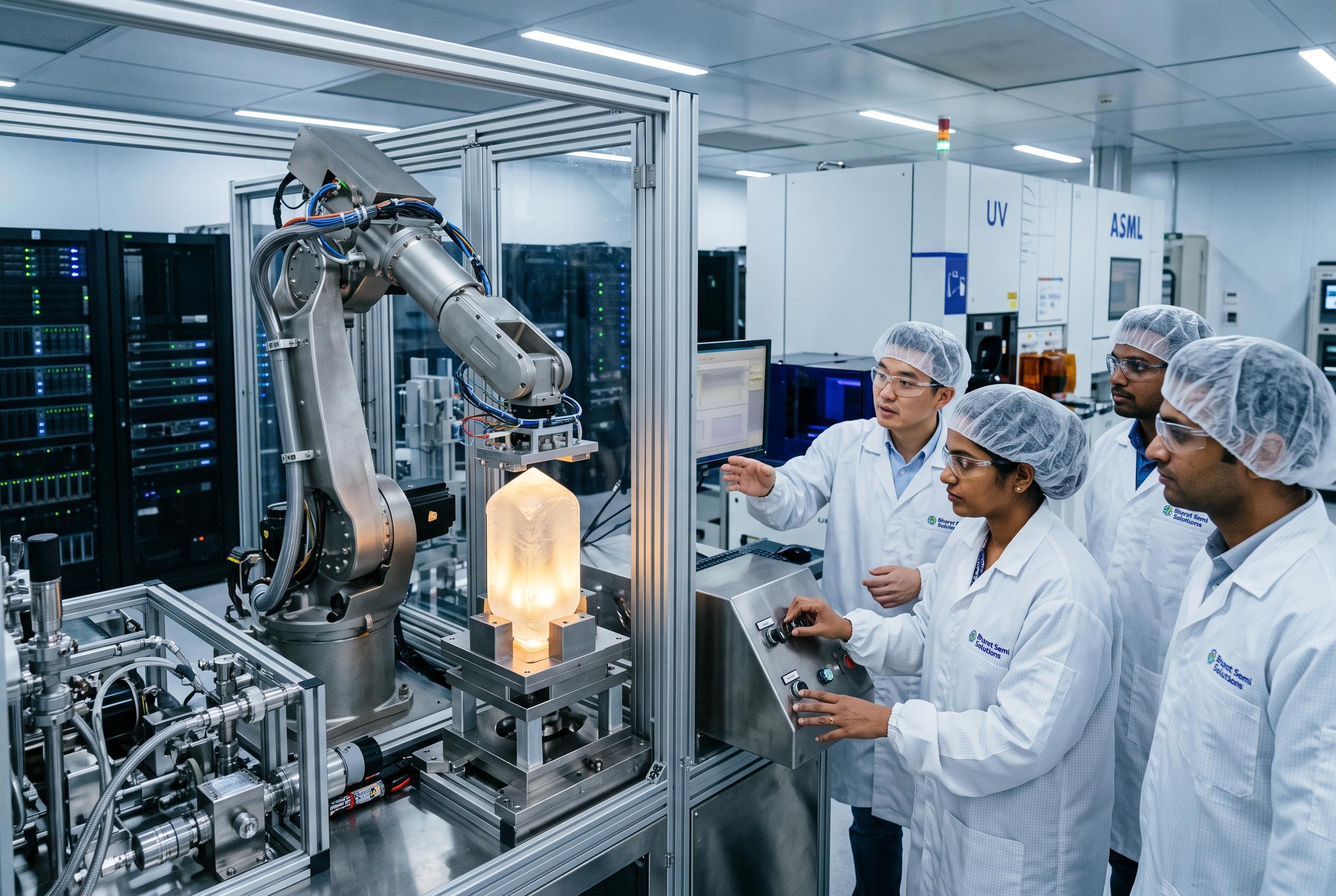

India’s growing collaboration with the United States on critical minerals signals a broader shift towards securing high-tech industries through strategic cooperation, including new initiatives like Pax Silica and domestic semiconductor development.
India’s partnership with the United States on critical minerals is becoming a wider industrial strategy, not just a raw-materials arrangement. The shift reflects a growing view in both capitals that semiconductors, artificial intelligence and advanced manufacturing cannot be secured without firmer control over the minerals, processing capacity and supply routes that sit beneath them. In May 2026, New Delhi and Washington signed a Strategic Critical Minerals Cooperation Framework designed to reduce dependence on concentrated supply sources and widen access to materials used in high-end industry. India’s later move into Pax Silica added another layer, linking mineral security directly to chips, AI infrastructure and resilient technology supply chains.
Pax Silica, announced as a U.S.-led coalition, is meant to cover the full chain from mining and refining through to chip production and AI deployment. According to reporting from Tom’s Hardware and Business Standard, India joined the initiative in February 2026 at the India AI Impact Summit in New Delhi, becoming the 12th member. The initiative also brings together countries including Japan, South Korea and the UK, and is explicitly aimed at reducing dependence on China, which still dominates key parts of rare-earth processing and older semiconductor manufacturing. That matters because the semiconductor industry is only as secure as the materials pipeline supporting it.
The May framework between India and the US was shaped by recent supply shocks, including China’s export restrictions on rare-earth magnets in 2025. Reuters-style accounts cited by Livemint, Al Jazeera and the Tribune India say the agreement covers mining, processing, recycling and investment, and extends beyond extraction to include refurbishment and scrap recovery. That broader approach is important because critical minerals are needed not only for chips, but also for batteries, defence systems, telecoms, data centres and clean-energy equipment. The collaboration also sits alongside the India-US AI Opportunity Partnership and the Forum on Resource Geostrategic Engagement, or FORGE, which was launched to address resource security more formally.
For India, the attraction is clear: deeper cooperation could help build domestic processing capacity, support local firms and lower exposure to single-source supply risks. The country is also advancing its own semiconductor agenda through ISM 2.0, launched in the Union Budget 2026-27 with ₹1,000 crore allocated for the fiscal year. That programme is intended to strengthen chip-design capability, equipment and materials manufacturing, and the wider domestic ecosystem. The practical test now is delivery. If projects move from diplomatic statements into commercially viable mines, refineries, recycling systems and fabrication-linked investments, India could move closer to being a more consequential node in global technology supply chains.
Disclaimer: This content is intended for informational purposes only. Readers are advised to exercise their own judgement, conduct due diligence, or consult a qualified expert before acting on any information provided.