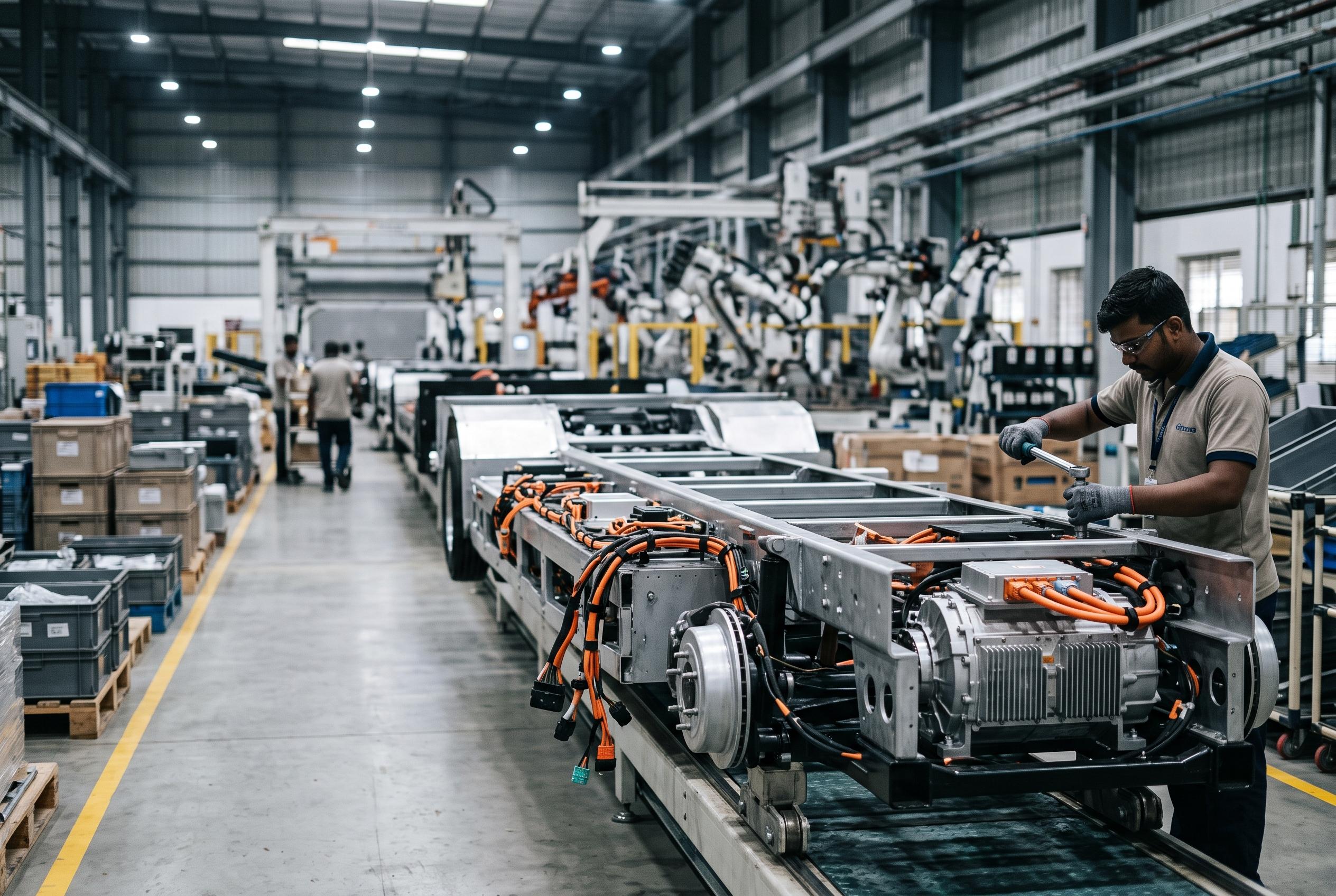

India has extended the localisation timetable for electric buses and trucks under the PM E-DRIVE scheme, recognising ongoing supply chain challenges due to China’s export restrictions on rare earth magnets, delaying the most complex assembly steps until April 2027.
India has recast the localisation timetable for electric buses and trucks under the PM E-DRIVE scheme, shifting to a staged tightening after months of warnings from manufacturers that rare earth magnet supplies remain too uncertain to support full domestic motor production. Notifications issued by the Ministry of Heavy Industries on 3 September leave some assembly requirements in force from this month, but push the most difficult step – fitting magnets into traction motors – to 1 April 2027 for M2 and M3 buses and for N2 and N3 trucks.
The latest change is not simply another blanket reprieve. For electric buses, manufacturers must from 1 September carry out rotor and stator assembly, bearing, enclosure, connector and cable fitment in India. From 1 April 2027, magnet and shaft fitment are added to that requirement. Moneycontrol reported that the ministry has also deepened localisation rules for traction motor controllers, including inverters, so that from April 2027 the domestic process must cover assembly of electronic components, semiconductors and connectors on the printed circuit board, along with high-voltage connectors, cables, heatsinks, enclosures and software or firmware flashing. UNI said comparable deadlines now apply on the truck side, including for integrated motor-transmission systems covered by the phased manufacturing programme.
The policy shift follows a fresh industry appeal made in July. Business Standard and Rediff reported that the Society of Indian Automobile Manufacturers wrote to the ministry on 22 July asking for a seven-month postponement, from 1 September 2026 to 1 April 2027, for localisation of traction motor and motor controller systems used in electric buses and trucks. SIAM argued that extra time was needed to avoid production disruption while vehicle makers and component suppliers tried to build domestic supply chains and manufacturing capacity.
That request was the latest step in a long sequence of deferrals. The Centre had originally intended these localisation rules to bite from 1 September 2025. A 30 September 2025 amendment moved implementation to March 2026. Then, on 13 March 2026, the ministry allowed manufacturers to continue importing traction motors containing rare earth magnets until 31 August 2026, effectively moving compliance to 1 September 2026. Reuters, in a March report carried by The Economic Times, said the earlier targets had been 1 March for electric buses and 3 March for electric trucks before the six-month grace period was granted.
SIAM’s July letter set out the industry’s complaint in unusually direct terms. According to Business Standard and Rediff, the body said China’s export controls on heavy rare earth elements such as dysprosium and terbium, as well as on permanent magnets, had “significantly altered global supply chains for permanent magnets”. It added: “Although export licences have been granted for certain shipments, procurement remains subject to regulatory approvals, extended lead times, and supply uncertainty.” The same representation said instability in West Asia had worsened transit times, freight costs and uncertainty around the availability of critical parts.
Mint had already reported in late July that manufacturers were discussing a third exemption because locally made heavy rare earth magnets were still unavailable. The newspaper said bus and truck makers raised the issue in SIAM’s electric mobility group on 23 July, citing an agenda document. It also reported that the problem is more acute for heavy commercial vehicles than for smaller electric models: two- and three-wheelers can switch to alternative light rare earth magnets or magnet-less motor designs, but larger vehicles such as electric buses and trucks still require heavy rare earth magnets in their traction motors, and those can be sourced only from China.
That dependence has persisted despite a domestic policy response. Mint reported that India announced a ₹7,280 crore incentive programme in November 2025 to create 6,000 tonnes a year of indigenous rare earth magnet capacity, but the tender closing date had to be extended because industry interest was weak. That gap helps explain why localisation rules designed to raise domestic value addition under PM E-DRIVE have proved harder to enforce in heavy electric vehicles than policymakers first expected.
The truck framework has become especially intricate. UNI reported that the 3 September amendment rewrote serial numbers 8, 9 and 10 of the e-truck manufacturing schedule, and that the truck PMP had already been amended on 30 September 2025, 13 March 2026 and 29 April 2026. Some obligations have been in place for longer: for combined motor-transmission systems, local assembly of the motor, motor controller and transmission controller, including software updates, has applied since 1 September 2025. What moves to 1 April 2027 are the deeper manufacturing steps, including magnet fitment and more detailed controller production requirements.
The outcome is a compromise rather than a reversal. New Delhi is still pressing ahead with tighter domestic manufacturing rules for the core motor and controller systems used in electric buses and trucks, but the revised timetable accepts that the most sensitive input in that chain remains difficult to secure. Unless Indian magnet production becomes viable or Chinese approvals become materially more predictable, manufacturers will spend the next several months navigating a localisation regime that has been strengthened on paper while being delayed at its hardest point.
Disclaimer: This content is intended for informational purposes only. Readers are advised to exercise their own judgement, conduct due diligence, or consult a qualified expert before acting on any information provided.