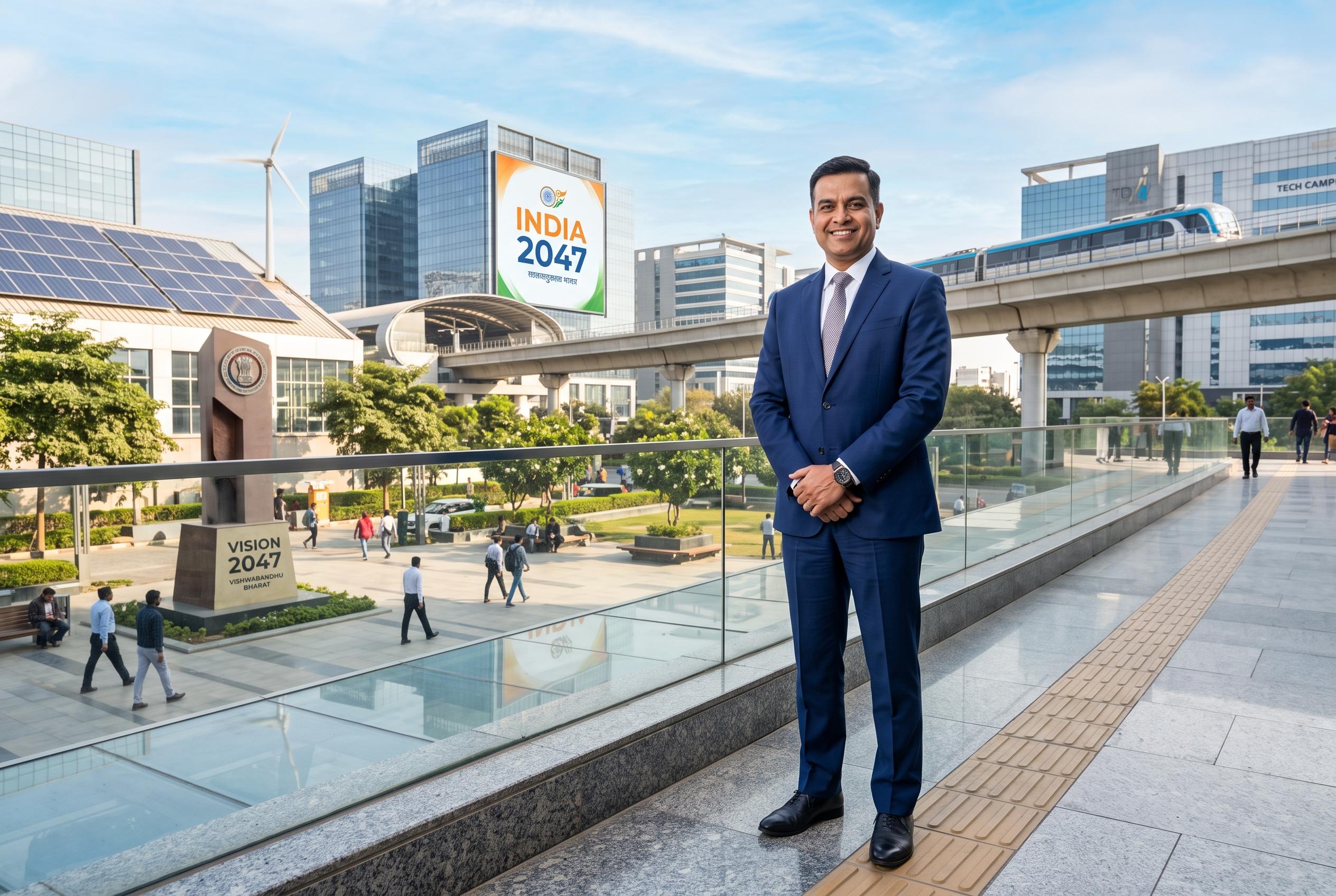

Prime Minister Narendra Modi outlined an expansive roadmap during India’s 80th Independence Day speech, aiming for a developed India by 2047 through a seven-part framework focusing on manufacturing, technology, energy, and social inclusion.
Prime Minister Narendra Modi used India’s 80th Independence Day address to set out a renewed pitch for a developed nation by 2047, framing the goal as a long-term national project built on manufacturing strength, technological ambition, cleaner energy and wider social participation. Speaking from the Red Fort, he described the coming decades as decisive for what he called Viksit Bharat, or developed India, and linked that vision to both economic performance and strategic self-reliance.
The speech also sought to place the plan in a broader record of change. According to the Prime Minister’s remarks and the government’s published account of his previous Independence Day address, India has moved from being counted among the so-called Fragile Five to becoming the world’s fastest-growing major economy. He said poverty had fallen sharply, social protection had widened and industrial output had accelerated in areas such as mobile phones, rail coaches, defence and digital payments. Government figures cited in the address pointed to a steep rise in solar capacity as well.
At the centre of the new roadmap was a seven-part framework he termed Sapt Dhara. The pillars cover manufacturing, agriculture, technology, infrastructure, defence, the green and blue economy, and soft power. On manufacturing, Modi urged firms to focus on zero-defect, high-precision production and to use India’s trade agreements to reach global supply chains. He also pressed farmers to expand chemical-free cultivation and food processing, while setting out an ambition for India-built 6G technology and a larger semiconductor base.
The technological and infrastructure elements were equally ambitious. Modi said the government would train 1 crore young people in artificial intelligence over the next year and back additional semiconductor plants over the next decade. He paired that with a push for high-speed rail, port modernisation, inland waterways and logistics links, arguing that transport and energy systems must be integrated more tightly if India is to sustain industrial growth. He also highlighted defence exports, drone systems, hypersonic capability and the expansion of civil defence planning.
Energy and social policy featured prominently in the wider package. The Prime Minister said nuclear power capacity should rise to 100 GW by 2047 and pointed to progress in fast breeder reactor work, alongside the expansion of rooftop solar under the PM Surya Ghar scheme. He also emphasised the blue economy, cultural exports and digital content as part of India’s external influence. On inclusion, he said the target for women entrepreneurs under the Lakhpati Didi programme had already been exceeded, while youth development would be supported through sports and talent scouting ahead of India’s bids for major international events.
Disclaimer: This content is intended for informational purposes only. Readers are advised to exercise their own judgement, conduct due diligence, or consult a qualified expert before acting on any information provided.