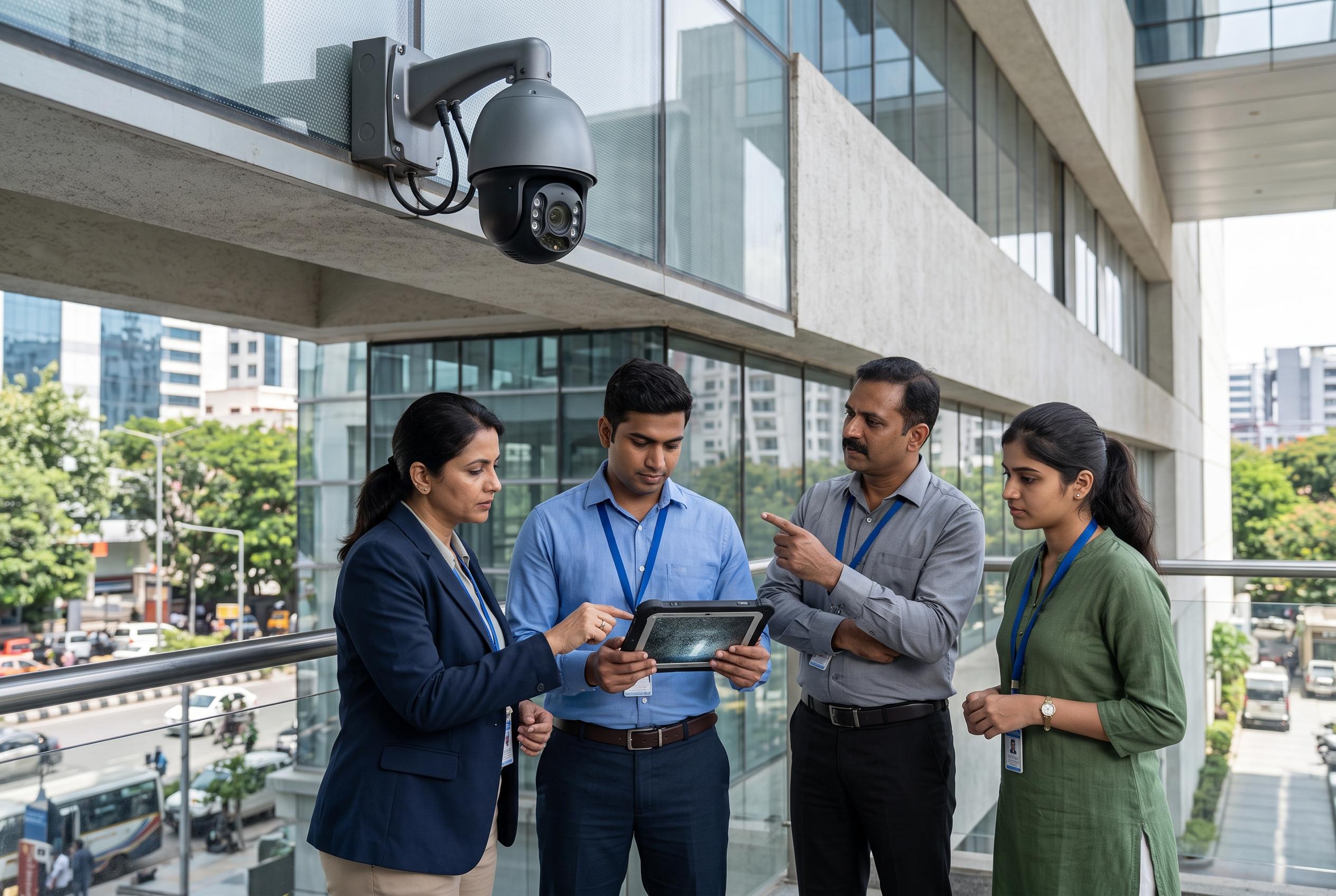

India’s new compliance regime has significantly decreased Chinese CCTV imports, boosting local and international OEMs, and reshaping the competitive landscape through stricter certification and localisation efforts.
India’s market for internet-connected security cameras has been reshaped by a compliance regime that, in practical terms, has squeezed Hikvision and Dahua out of India’s IP-camera business and opened more room for domestic suppliers and other manufacturers willing to build locally. The shift is already visible in market share: Chinese brands had accounted for about a third of CCTV sales until last year, while Counterpoint Research told The Economic Times that Indian companies controlled more than 80% of the market by February 2026. Moneycontrol reported that global original equipment manufacturers are also stepping up local production to capture demand released by the change. (m.economictimes.com)
The legal mechanism, however, is narrower and more technical than many of the early headlines suggested. A 16 January 2026 office memorandum from the Ministry of Electronics and Information Technology withdrew an earlier relaxation that had allowed the sale of CCTV cameras imported or made before 9 April 2025 without meeting the new Essential Requirements for security. From 1 April 2026, that grace period ended. Security Today argued that this was not a fresh country-specific ban, but the enforcement of an existing compliance framework, and it quoted a clarification attributed to Prama Hikvision India saying claims of a blanket prohibition were “unverified, incorrect and false”. (meity.gov.in)
The policy architecture has been building for more than two years. In a 4 February 2026 circular, MeitY said CCTV cameras had been notified under the public-procurement rules on 6 March 2024 and under the compulsory-registration order through a Gazette notification dated 9 April 2024, with those measures taking effect on 7 June 2024 and 9 April 2025 respectively. STQC, the government’s testing arm, says CCTV cameras fall within its IoT System Certification Scheme. India Today, citing the new regime and Reuters reporting, said cameras supplied to government buyers had already been subject to testing since June 2024, including checks for tamper-proof enclosures, malware detection, encryption, source-code analysis and, where necessary, inspection visits to overseas factories. (meity.gov.in)
That has altered the competitive balance, but not in favour of Indian brands alone. The Economic Times said CP Plus, Qubo, Prama, Matrix and Sparsh had reworked supply chains around Taiwanese chipsets and localised firmware. It also said Bosch and Honeywell had taken the premium end of the market. That broadens the picture set out by government officials: one official told Moneycontrol that “global established OEMs” as well as Indian companies would benefit and were increasing local production. STQC’s published certification listings support that mixed outcome, showing approvals not only for Indian names such as Aditya Infotech, Matrix, Prama and Vicon, but also for Honeywell International India. (m.economictimes.com)
The public record on approved models is less straightforward than some tallies imply. STQC now says the product-certified list for network cameras “is no longer being updated” and is retained only as a historical reference. Even so, recent search snapshots of the same official page still show multiple entries for Prama India, Aditya Infotech, Matrix Comsec, Honeywell International India, Equus Digital Solution and Samriddhi Automation. The result is a market in which certification clearly matters, but public counts may not capture every live approval or distinguish neatly between older and current listings. That is an inference from STQC’s own presentation of the data, rather than an express statement by the agency. (stqc.gov.in)
A second contest is now under way further down the supply chain, in camera silicon. Mint reported in June that Prama India had signed a memorandum of understanding with Chennai-based Mindgrove Technologies to integrate Mindgrove’s vision system-on-chip into Prama products once the chip is ready for commercial deployment. The two companies said they would work together on product development, certification and regulatory requirements. Mint also noted that the arrangement is not yet a purchase order: it must move through qualification and then a master sales agreement before volumes are fixed. Mindgrove’s chief executive, Shashwath T.R., told the newspaper that the early engagement could help get “volumes flowing within three or four months of mass production”. (livemint.com)
This is why the argument over whether India has “banned” Chinese cameras matters. Security Today said STQC certification is mandatory only for IP cameras and not for every surveillance category, adding that HD or analogue cameras, DVRs, NVRs, video door phones, access-control systems, intrusion alarms, dashcams and storage devices do not fall under the same requirement. Yet the commercial effect on connected cameras is still severe. The Economic Times said the government was refusing certification to products from Hikvision and Dahua and to products using Chinese chipsets, while India Today said TP-Link CCTV products were also hit in the early phase of enforcement. In other words, the regulatory language may be technical, but the market outcome for non-compliant connected devices is blunt. (securitytoday.in)
What comes next will determine whether the policy becomes merely a procurement filter or a genuine industrial shift. Government officials expect more local manufacturing from both Indian vendors and overseas OEMs, but the chip story is still at an early stage: Mindgrove described its Prama tie-up as its first major customer engagement around the vision chip, not proof of volume deployment. India has therefore moved faster in rewriting the rules of market access than in fully indigenising the most valuable components. The next test is whether certification-led localisation can turn into sustained domestic design, production and export capability. (moneycontrol.com)
Disclaimer: This content is intended for informational purposes only. Readers are advised to exercise their own judgement, conduct due diligence, or consult a qualified expert before acting on any information provided.