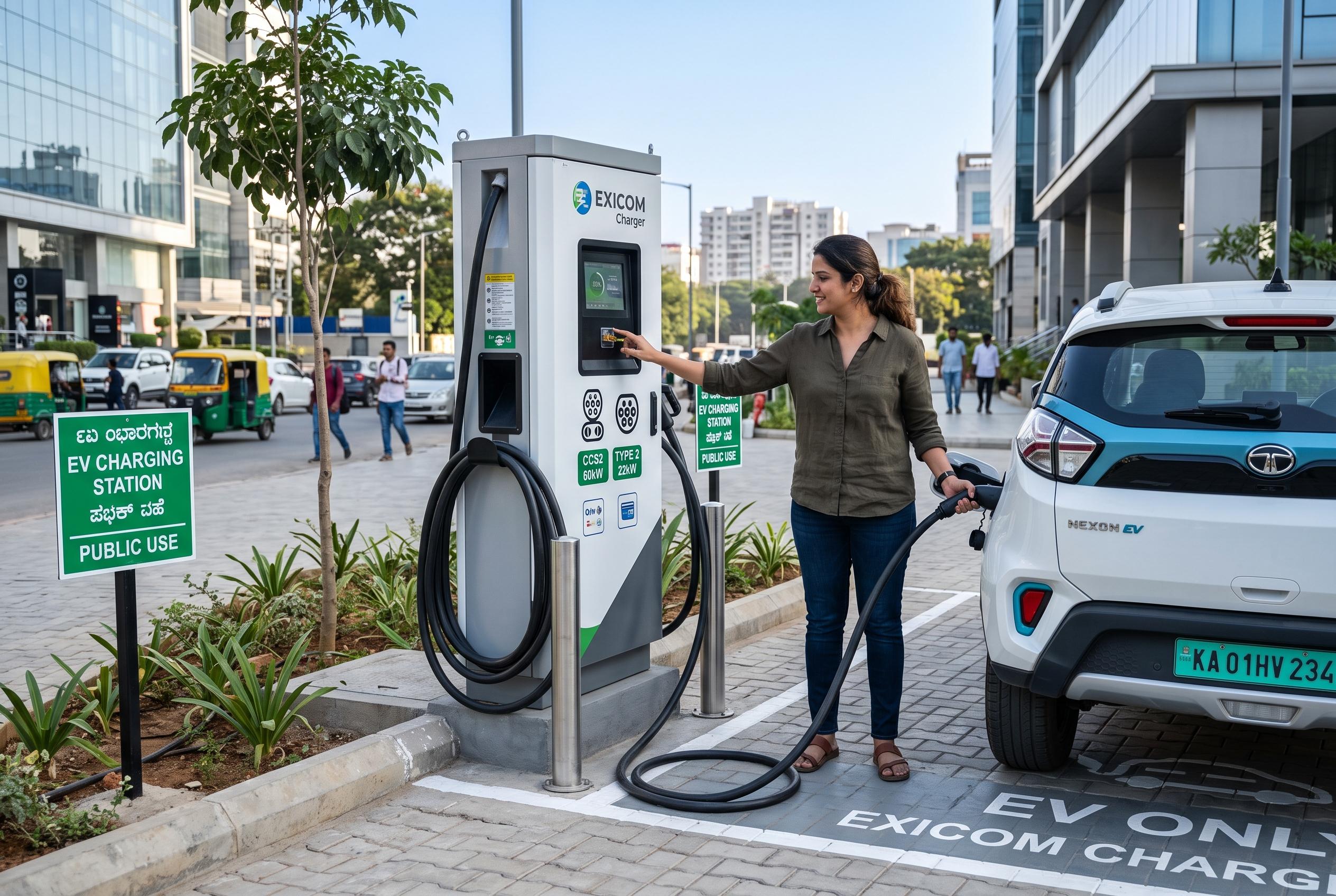

India’s EV charging market is evolving rapidly, with breakthroughs in interoperability, targeted site development, and specialised hardware signalling a shift towards integrated and profitable charging networks amid ongoing policy support.
India’s EV charging market had a busy week, with interoperability, consolidation and site strategy all moving forward at once. Pulse Energy said it has become one of the early certified technology enablers for Unified Bharat eCharge, a public digital layer intended to simplify charger discovery, session control, payment, roaming and settlement across participating networks. The company says its network spans more than 100 charge point operators and over 10,000 chargers, underscoring the scale at which standardised access could begin to matter.
That push towards common access also throws a sharper light on the commercial side of the business. Gentari is reportedly exploring a sale of its Indian charging operation, a portfolio said to include about 3,000 charging points across 11 states. While no deal has been confirmed, the possibility of a transaction points to a wider question that now hangs over the sector: whether public charging networks can generate returns quickly enough to justify rapid expansion.
The economics of utilisation came into focus elsewhere too. Indofast Energy and GLIDA announced plans to build combined energy hubs that bring together high-power charging and battery swapping at the same site. The first phase begins with 10 quick interchange stations in Chennai, Bengaluru and Hyderabad, before a planned expansion to 50 sites and more than 100 swapping stations within a year. The model suggests that operators are increasingly looking for ways to squeeze more revenue from the same grid connection and plot of land.
State policy is also shifting from headline charger counts to location strategy. Maharashtra is looking at charging facilities at MSRTC depots and Regional Transport Offices, and is also considering stations under flyovers through public-private partnerships. That approach reflects a practical constraint in charging rollout: access to land with power connectivity and reliable traffic can matter as much as charger hardware itself.
Himachal Pradesh is taking a more targeted route, building its charging plan around tourist corridors rather than dense urban ownership. The state has notified six Green Corridors covering roughly 2,000 kilometres, with chargers planned at about 25-kilometre intervals along routes including Shimla, Manali, Dharamshala, Chamba and Spiti. It has also identified 80 petrol-pump locations and more than 66 hotels for charging, indicating that destination traffic, not local vehicle ownership, is driving the business case.
Manufacturing capacity is expanding in parallel with deployment. Plugzmart signed an agreement with the Tamil Nadu government to invest ₹100 crore in EV charger manufacturing, research and development, and wider charging infrastructure. The company makes AC and DC charging systems from 3.3 kW to 360 kW, along with controllers, communication modules and charger management software. The plan includes scaling production at its Oragadam/Vallam facility and creating more than 500 direct skilled jobs over three years.
Product design is becoming more specialised as the market matures. Bolt.Earth received Automotive Research Association of India certification for its Blaze DC 3 kW Dual Gun charger, aimed at electric two- and three-wheelers and fitted with Type 6 and Type 7 connectors. The company says the unit can add about 40 kilometres of range in 15 minutes, depending on the vehicle. That kind of hardware reflects a broader shift away from one-size-fits-all charging toward equipment built around specific battery sizes, dwell times and fleet patterns.
Commercial partnerships are also moving charging closer to the vehicle purchase process. ChargeZone and Landmark Cars said buyers of electric vehicles through Landmark dealerships may receive 51,000 charging credits for ChargeZone’s public network. With Landmark operating more than 140 outlets in 32 cities and ChargeZone claiming more than 15,000 charging points across highways, cities and commercial sites, the deal is as much about customer acquisition as it is about a perk for new owners.
The policy backdrop remains supportive for now. The Ministry of Heavy Industries has extended the PM E-DRIVE framework to 31 March 2028 and raised its overall outlay to ₹11,900 crore, with charging infrastructure still eligible for funding. But the real test for the market will be how much sanctioned capacity actually progresses from approval to commissioning and then to meaningful use. In a sector now marked by interoperability, niche hardware and mixed ownership models, utilisation will matter more than the number of pins on a map.
Disclaimer: This content is intended for informational purposes only. Readers are advised to exercise their own judgement, conduct due diligence, or consult a qualified expert before acting on any information provided.