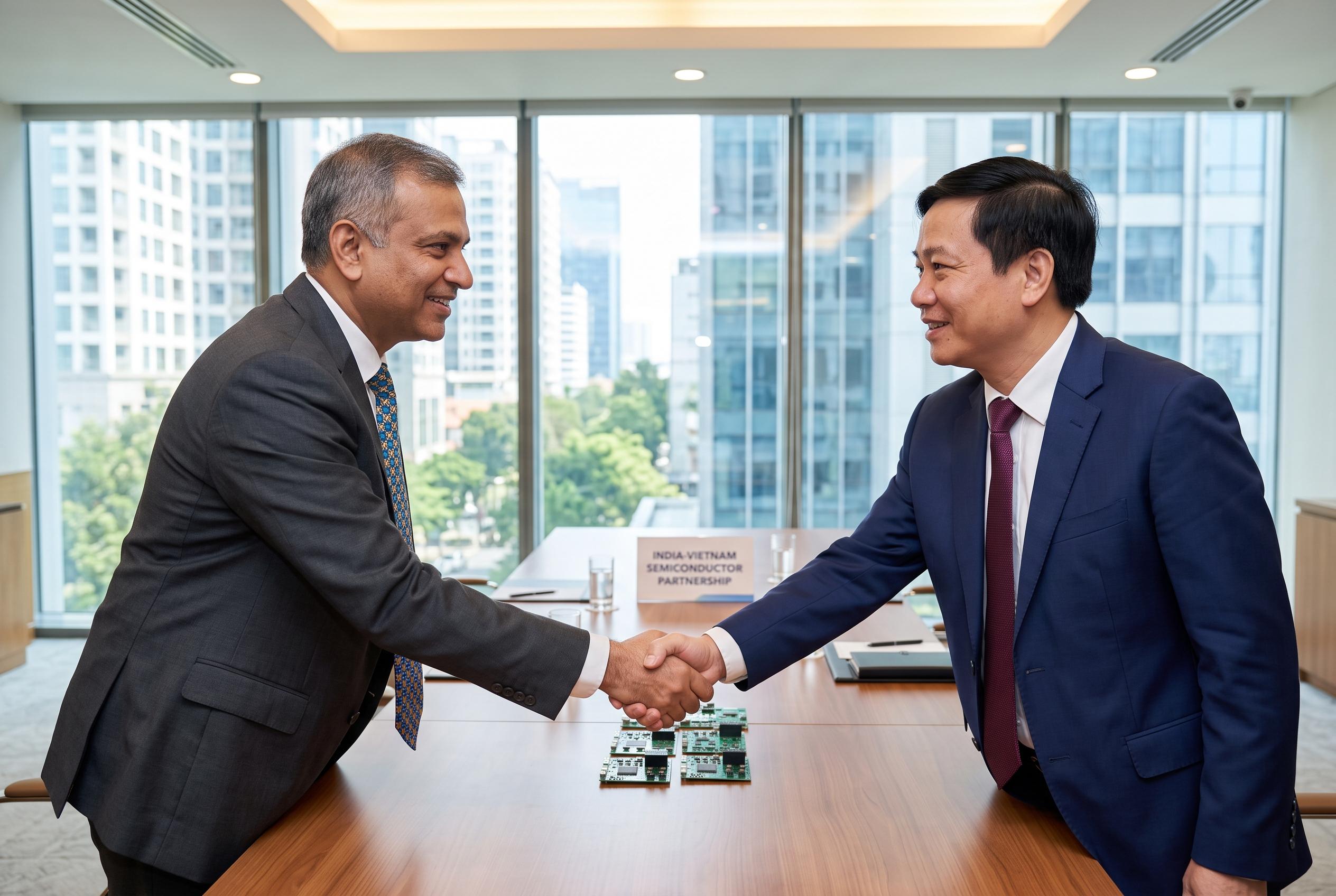

India accelerates its semiconductor ecosystem with a focus on mature technologies, strategic partnerships, and regional cooperation, notably with Vietnam, to mitigate supply risks and climb the value chain.
India’s semiconductor strategy is becoming more concrete, and its main logic is deliberately pragmatic. Rather than chasing the most advanced chip nodes first, New Delhi is concentrating on mature technologies, packaging and testing, the parts of the supply chain where demand is broad and the barriers to entry are lower. Business Standard reported in June 2025 that India had built a pipeline of roughly $21 billion in semiconductor projects, while government disclosures in 2026 pointed to a wider approved investment base of about ₹1.65 trillion across 12 plants. (business-standard.com)
That approach reflects both industrial necessity and strategic caution. India still imports most of the chips its economy consumes, which leaves it exposed to supply shocks. At the same time, global manufacturers have been seeking alternatives to China and Taiwan, creating an opening for India to position itself as a reliable back-end manufacturing base. Official figures from the India Semiconductor Mission show that the first wave of support has focused on fabrication, assembly, testing, marking and packaging, with fiscal backing of up to 50% of project costs in selected categories. (ism.gov.in)
The build-out is already visible in a cluster of projects. India has approved a Tata Electronics fabrication plant in Gujarat with Taiwan’s PSMC as a technology partner, a Tata assembly and test facility in Assam, Micron’s packaging plant in Gujarat, Kaynes Semicon’s OSAT unit in Sanand and the HCL-Foxconn joint venture in Uttar Pradesh, among others. A 2025 government presentation listed these projects as the core of the country’s emerging ecosystem, with the Tata Assam plant designed for 48 million chips a day and the Gujarat fab targeted at 50,000 wafer starts a month. (indianexpress.com)
India’s longer-term advantage may lie less in factories than in people. Industry voices estimate that the country already accounts for around one-fifth of the world’s semiconductor design engineers, thanks to decades of work by multinational companies in Bengaluru, Hyderabad and Noida. That gives India an established design base, even if it still lacks enough experienced staff to run fabrication lines at scale. Reuters-style reporting from the broader ecosystem also shows how India is pairing this talent base with overseas partnerships, including equipment and technology ties that strengthen the supply chain around domestic plants. (business-standard.com)
The Vietnam angle is increasingly important. During the state visit by To Lam to India from May 5 to 7, 2026, the two countries elevated their partnership and agreed to deepen cooperation in artificial intelligence, semiconductor technology, digital infrastructure and innovation. Vietnam’s Ministry of Science and Technology said both sides also backed work on rare earths, including a cooperation agreement between Vietnam’s Institute for Technology of Radioactive and Rare Elements and India’s IREL on research, deep processing and refining. That matters because semiconductor manufacturing depends on critical minerals, specialised materials and stable industrial inputs. (pmindia.gov.in)
For Vietnam, the practical lesson from India is not to mirror the whole strategy, but to choose the right segment. India is trying to climb the value chain in stages, and that staged approach offers a model for countries that want to avoid spreading capital too thinly. In technology terms, the real opportunity lies in complementary roles: India in design and process capability, Vietnam in electronics manufacturing, assembly and testing, with both sides building links in materials, digital payments, standards and research. (pmindia.gov.in)
Disclaimer: This content is intended for informational purposes only. Readers are advised to exercise their own judgement, conduct due diligence, or consult a qualified expert before acting on any information provided.