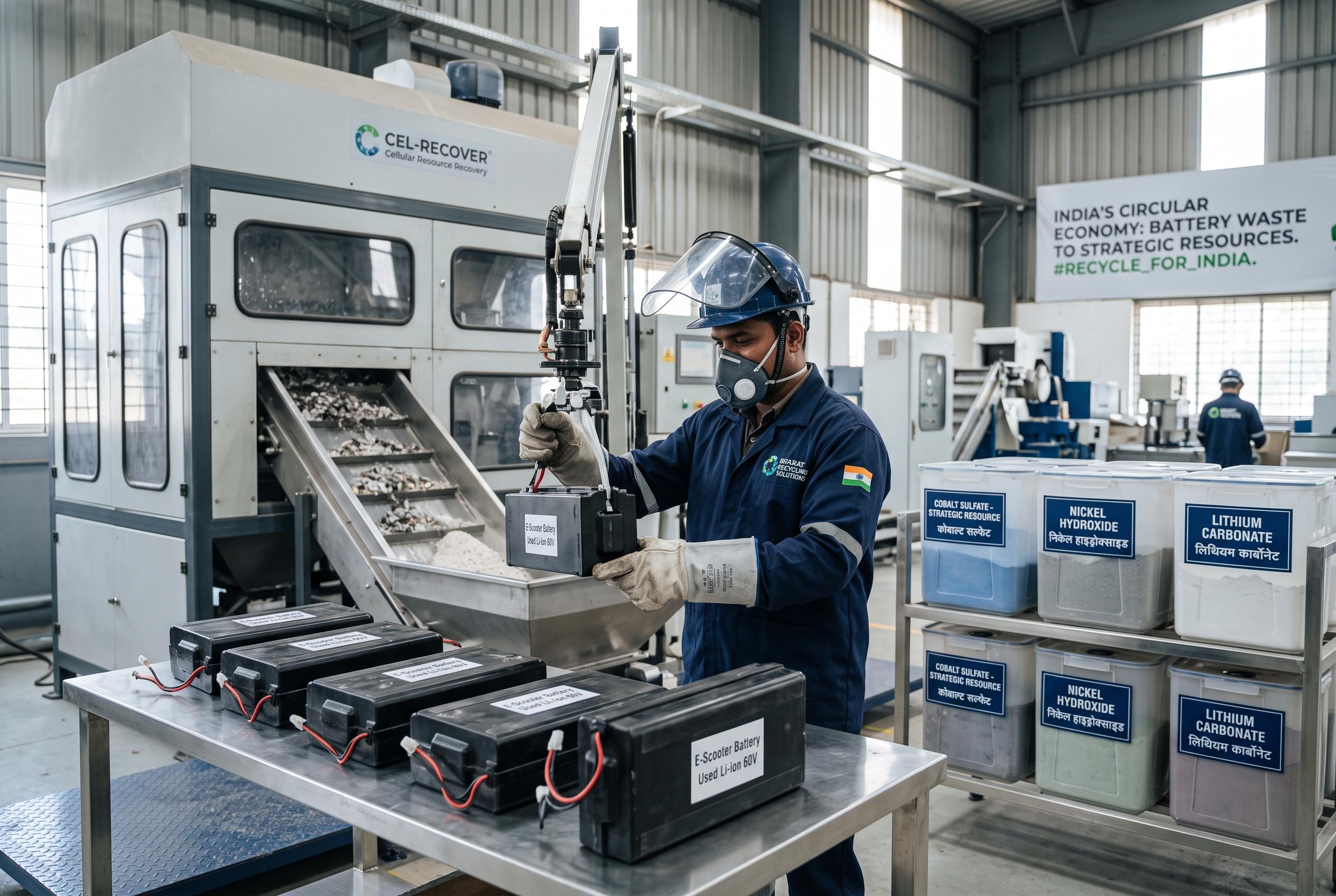

As India’s EV market accelerates, the country is increasingly viewing discarded batteries not as waste but as a vital source of strategic minerals, prompting policy shifts and technological innovation to harness their industrial value.
What looks like a dead scooter battery is increasingly being treated as a reservoir of industrial value. Once a lithium-ion pack falls below roughly 70% state of health, it is often removed from service, but the material inside it still has commercial importance. In India, that matters because the country’s electric vehicle expansion is set to create a much larger stream of used batteries, and the question is no longer only how to dispose of them safely but how to recover strategic minerals for future manufacturing.
India Energy Storage Alliance has projected EV sales could rise to 30.4 million units by 2032, while NITI Aayog and the Green Growth Equity Fund Technical Cooperation Facility estimated in 2022 that the country could generate about 128 GWh of battery waste by the end of the decade, with EVs responsible for nearly half that total. That waste stream is effectively an urban ore body. WRI India has said the projected volume could contain about 17,500 tonnes of lithium, 22,600 tonnes of nickel, 2,600 tonnes of cobalt and 141,800 tonnes of graphite. For a country trying to reduce exposure to imported raw materials, that is not a side issue; it is a supply-chain strategy.
The recycling process is more complex than simple dismantling. Batteries differ by chemistry, design, charge state and physical condition, so safe handling comes first. They are discharged under control, then broken down in a sealed environment before being shredded to separate plastics, copper and aluminium. The fine residue left behind, known as black mass, contains the concentrated active materials that can be refined into metals or salts and returned to industry. Recovery rates above 90% are possible in advanced systems, according to industry accounts, but the value is only captured when that refining happens domestically.
That is why black mass exports have become a policy concern. Shipping the material abroad effectively sends away value that could be retained within India’s own battery, chemical and advanced materials industries. A Rocky Mountain Institute report has argued that a circular battery economy could represent a $9 billion opportunity for India and could, by 2050, meet more than 40% of domestic demand for lithium, nickel and cobalt. The argument is not just environmental. It is about industrial capability, import resilience and the ability to build a local materials base around the clean-energy transition.
Yet the economics are uneven, especially as lower-cost lithium iron phosphate, or LFP, batteries gain ground. Unlike nickel manganese cobalt batteries, LFP packs do not contain nickel or cobalt, which are the most lucrative outputs for recyclers. Lithium, iron and phosphorus can still be recovered, but current commodity prices often do not cover processing costs. That leaves recyclers with a strong incentive to prioritise higher-value chemistries unless governments provide viability gap funding or other chemistry-specific support. Without that, large volumes of lower-value battery waste could remain uneconomic to process even if the technology works.
Feedstock remains the other major bottleneck. The article’s estimate that 70% to 90% of India’s battery waste disappears into the informal sector points to a deeper enforcement problem. Unsafe recovery practices can damage the environment and also destroy material value that should be channelled into formal recycling. The Battery Waste Management Rules, 2022 introduced extended producer responsibility, which places more of the burden on manufacturers to ensure collection and recycling, but implementation and traceability are critical. NITI Aayog’s broader work on sustainable consumption and production shows India is already improving in waste treatment and recycling in other sectors, yet battery waste will need a tighter system if it is to become a reliable industrial feedstock rather than an unmanaged hazard. The central challenge is clear: India will need both recycling capacity and policy discipline if it wants battery waste to become a strategic resource rather than a growing liability.
Disclaimer: This content is intended for informational purposes only. Readers are advised to exercise their own judgement, conduct due diligence, or consult a qualified expert before acting on any information provided.