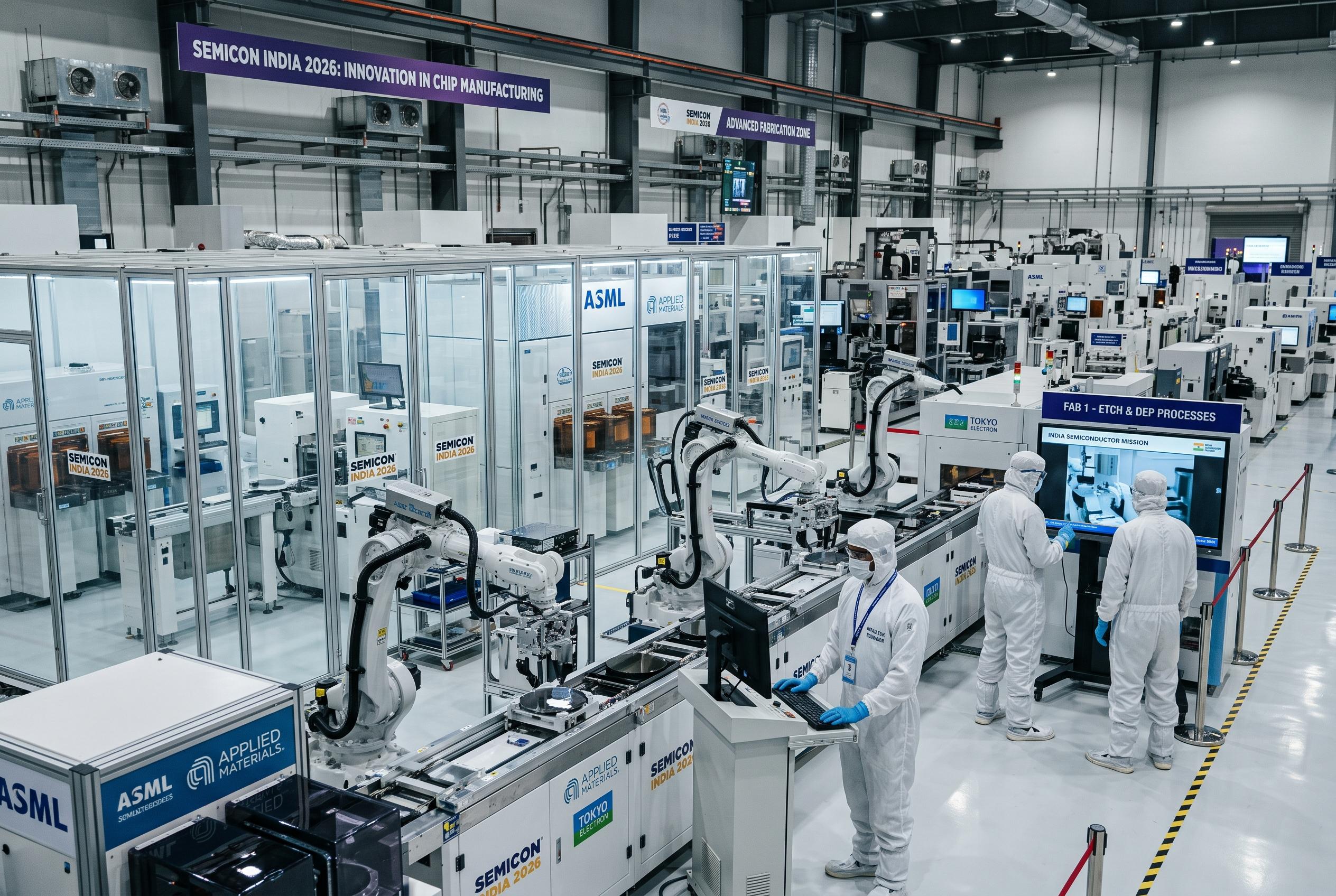

As India prepares for SEMICON India 2026, the government highlights tangible progress with operational chip factories and expansion plans, signalling a decisive move from policy to industrial realisation.
India will use next month’s SEMICON India 2026 to signal that its chip manufacturing push is moving from policy to production. More than 240 overseas companies are expected in New Delhi for the three-day event at Yashobhoomi from September 17 to 19, while Prime Minister Narendra Modi is due to chair a separate session with senior semiconductor executives on September 16 before opening the conference the following day, according to NDTV Profit. The government expects sizeable delegations from Japan, Taiwan, Singapore and the Netherlands, and says the meeting should also deliver commercial announcements, even though it has not set a formal investment target.
The timing matters. S. Krishnan, secretary at the Ministry of Electronics and Information Technology, said the first wave of factories backed by the India Semiconductor Mission is now starting to come on stream. NDTV Profit reported that three of the 12 approved projects under the current programme have already begun production, with another two or three likely to enter commercial output by the end of 2026 and the balance expected in 2027 and 2028. That gives the event a different tone from earlier showcase meetings: it is being held as India tries to demonstrate that its industrial policy is yielding operating plants, not only memoranda and construction sites.
The broader pipeline is still relatively small by global standards, but it is growing. The Indian Express reported that the first phase of the India Semiconductor Mission has approved 12 plants with cumulative planned investment of about ₹1.64 lakh crore across Gujarat, Assam, Andhra Pradesh, Uttar Pradesh and Odisha. Among the most significant projects is Tata Electronics’ chip fabrication facility in Gujarat, widely described as India’s first commercial-grade fab, while Micron Technology’s assembly and testing plant in the same state began commercial production in February. Business Standard said the government’s aim is to deepen domestic value addition and position India more firmly inside the global supply chain.
The Cabinet has also cleared India Semiconductor Mission 2.0, with guidelines expected shortly, according to NDTV Profit. That suggests the September event will not only be a review of the first phase but also an attempt to shape the next one, with the focus shifting towards a wider manufacturing ecosystem. Recent approvals underline that expansion: NDTV Profit and Hindustan Times reported that two additional Gujarat projects, worth about ₹3,936 crore, were sanctioned under the first phase, including a GaN-based Mini/Micro-LED display facility and an outsourced semiconductor assembly and test unit. Together, the government says, these projects are meant to build capability across chips, packaging and displays rather than isolate one part of the chain.
Disclaimer: This content is intended for informational purposes only. Readers are advised to exercise their own judgement, conduct due diligence, or consult a qualified expert before acting on any information provided.