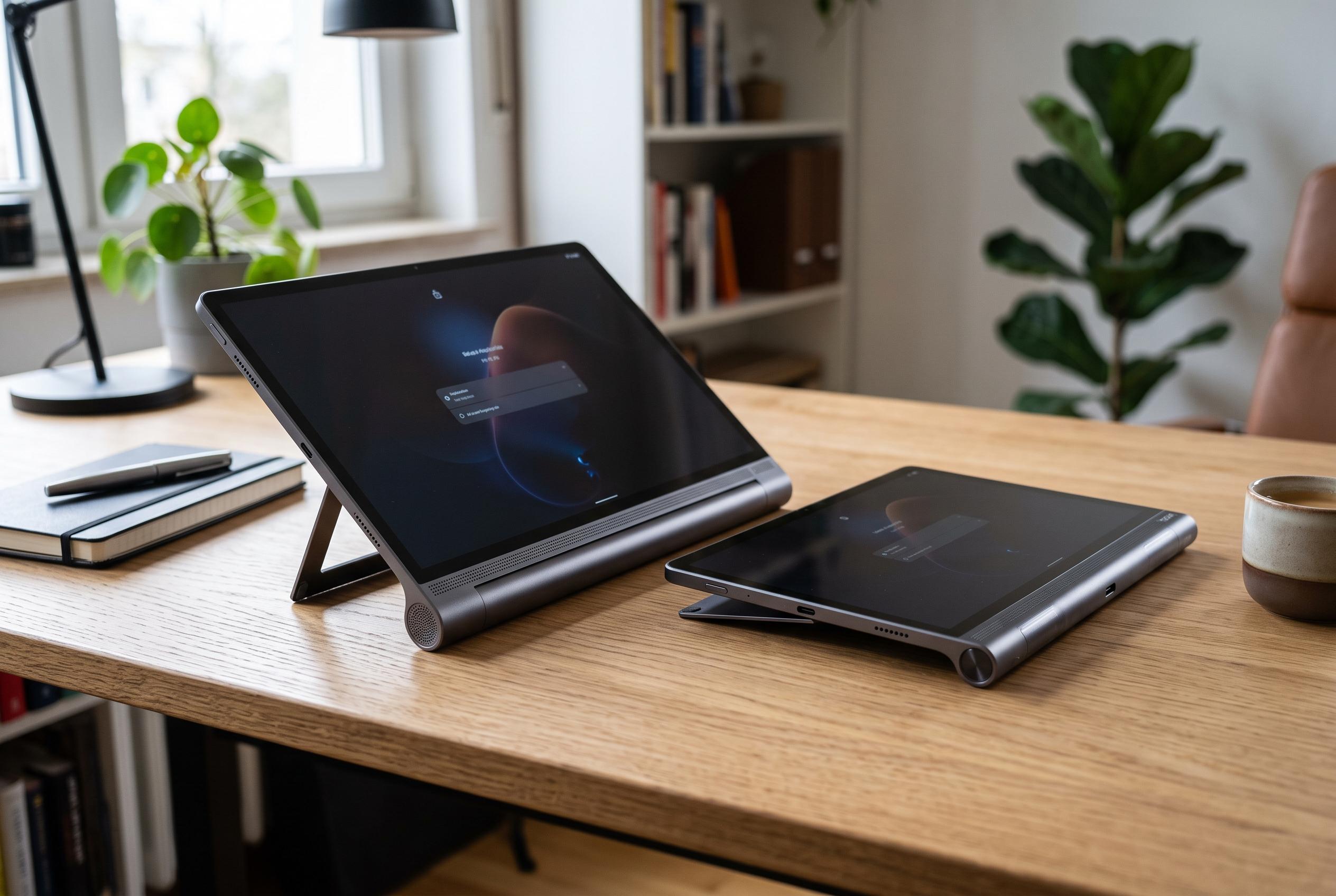

Lenovo has unveiled the Yoga Tab Gen 2 and Plus Gen 2 at IFA 2026, showcasing a pioneering seven-year OS upgrade commitment that could reshape consumer expectations for Android tablet longevity and productivity features.
Lenovo has used IFA 2026 to make an unusually long-lived bet on Android tablets, unveiling the Yoga Tab Gen 2 and Yoga Tab Plus Gen 2 with a seven-year software commitment that runs far beyond what has typically been offered in this category. The company says both devices launch on Android 17, are scheduled to receive seven operating-system upgrades through Android 24, and are due to begin shipping in September 2026. (news.lenovo.com)
That support window is the central development in this launch, more than any single hardware component. AndroidPure framed the policy as the headline reason the tablets matter, and Lenovo itself says the pair “include seven OS upgrades through Android 24, as well as up to seven years of security updates through 2033”. For buyers who keep a tablet for work, study or creative use over several replacement cycles, that materially changes the purchase equation. (news.lenovo.com)
The two products are closely related in design, but they are not identical. Lenovo’s published specifications, echoed by Android Authority and TechRepublic, show an 11.1-inch Yoga Tab Gen 2 and a 13-inch Yoga Tab Plus Gen 2, both using 4K 3:2 displays with refresh rates up to 144Hz and peak brightness of 1,100 nits. Both also support Wi-Fi 7, Bluetooth 6.0, USB-C 3.2 Gen 1, expandable microSD storage and optional keyboard accessories, placing them firmly in the premium productivity-and-creation bracket rather than the entry-level media segment. (news.lenovo.com)
The smaller model looks more like a compact high-end tablet than a stripped-back entry point. According to 9to5Google and Android Authority, it uses MediaTek’s Dimensity 9500s, carries an 11,000mAh battery, and is offered with up to 12GB of RAM and 256GB of storage. Lenovo’s specification sheet lists 68W charging, while Android Authority reports four speakers, a 13MP rear camera, and an 8MP front camera paired with a 0.3MP sensor. TechRepublic adds that it weighs about 480g and supports microSD expansion up to 2TB. Lenovo’s own launch material puts the European starting price at €649 including tax, while 9to5Google reported a US starting price of $729.99. (news.lenovo.com)
The larger Plus version is the more performance-led of the two. Lenovo and Notebookcheck say it uses Qualcomm’s Snapdragon 8 Elite, with configurations rising to 16GB of RAM and 512GB of storage, backed by a 12,700mAh battery and a six-speaker Harman Kardon audio system. Notebookcheck reports dimensions of 291.78mm by 200.35mm, thickness of 8.27mm and a tablet-only weight of about 605g, while also noting that Lenovo has chosen an older Qualcomm flagship platform rather than the very latest chip. There is also a pricing discrepancy worth noting: Lenovo’s Berlin announcement says the device is expected to start at €849 including tax, whereas Notebookcheck reported an expected starting price of €999. US coverage from 9to5Google put the starting price at $999.99. (news.lenovo.com)
Lenovo is also trying to differentiate the range through the pen rather than through thinness alone. 9to5Google reported that both tablets carry a small status display on the rear and support stylus shortcuts such as Squeeze to Create, Double Tap, Click pen tail to Draw, Double-click pen tail to Record and Flip to Erase. In a short hands-on test in Berlin, ITPro said the pen’s reverse-end eraser was “cute and clever” and that there was “a good degree of control” compared with other styluses. Lenovo’s own specifications list 8,192 pressure levels, tilt detection and palm rejection. (news.lenovo.com)
Beyond the hardware, Lenovo is layering on a broad set of software features under its own branding. The company says the tablets include Lenovo Qira, AI Vision, Smart AI Input, AI Note, AI Creation Tools and Live Transcript, all intended to help users move between handwriting, typed text, voice capture and image-based input. Optional magnetic keyboards are meant to shift the devices from pen-first tablets to more conventional work machines without changing the core platform. Whether those additions prove useful in everyday work will be judged later, but they show Lenovo is pitching the Yoga pair as creator tools first and entertainment devices second. (news.lenovo.com)
What is clearer already is Lenovo’s broader message. The company is not merely refreshing two premium tablets with brighter panels and larger batteries; it is trying to answer a long-standing weakness in the Android tablet market by making longevity a specification in its own right. Availability is slated for September 2026, although Lenovo says update timing can vary by device and region. Even with that caveat, the package is unusually direct: an 11.1-inch model from $729.99 or €649, a larger creator-focused version around the $999.99 level in the US, and a software policy designed to keep both devices current through 2033. (news.lenovo.com)
Disclaimer: This content is intended for informational purposes only. Readers are advised to exercise their own judgement, conduct due diligence, or consult a qualified expert before acting on any information provided.