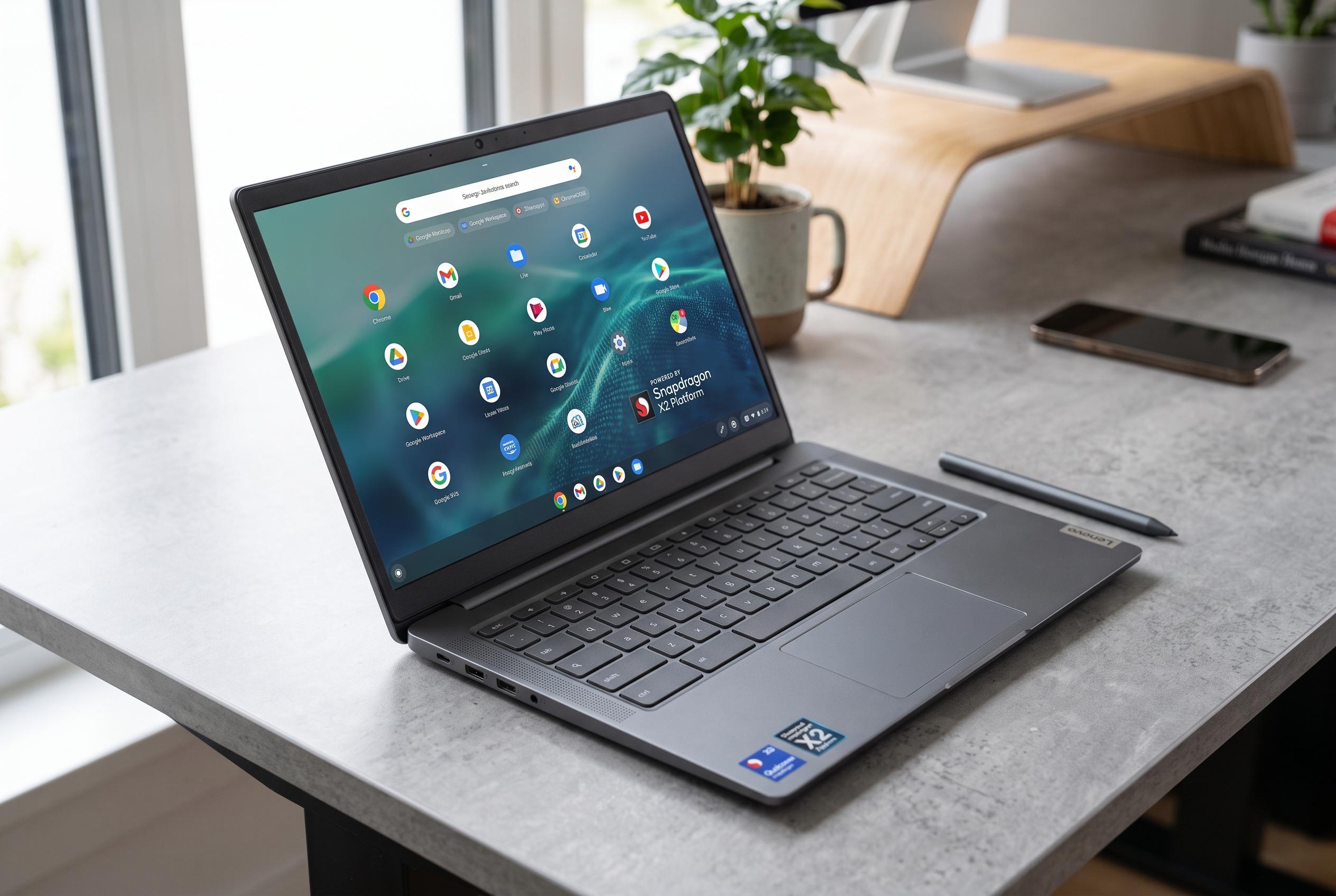

Leaked development boards suggest Lenovo is expanding its Googlebook lineup beyond Intel and MediaTek chips, with the new device potentially leveraging Qualcomm’s Snapdragon X2 for enhanced AI and battery performance, signalling a wider Chromebook strategy.
Chromium code suggests Lenovo may be preparing another Googlebook device under the codenamed “Meru”, extending a fast-growing programme of ChromeOS hardware that now appears to span several chip families. The development board surfaced in Chromium Gerrit on 6 August, and the early commits indicate that it is being built on Qualcomm’s Snapdragon X2 platform rather than the Intel and MediaTek variants already associated with other Googlebook projects. According to the Chrome Unboxed report, the work is still at an early stage, so the device is unlikely to be ready for the imminent autumn launch cycle.
The significance of “Meru” lies in what it implies about Lenovo’s wider strategy. Chrome Unboxed says the commits are linked to Lenovo engineering, which would make this the company’s third distinct Googlebook track alongside earlier Intel-based and detachable MediaTek models. That breadth matters because it suggests Lenovo is not treating the platform as a single-product experiment, but as a broader family that can be adapted for different price points, sizes and use cases.
If the Snapdragon X2 connection holds, the device would fit Qualcomm’s current pitch for its laptop silicon: long battery life, strong on-device AI performance and thin, fanless designs. Qualcomm says the Snapdragon X2 Elite can deliver up to 85 TOPS of NPU performance, while the wider Snapdragon X line is aimed at multi-day battery life, integrated graphics and local AI workloads. In practical terms, that points to machines designed to handle Gemini-style on-device features without leaning heavily on cloud processing.
There is, however, one important caveat. Chrome Unboxed notes that “Quartz”, the base branch for “Meru”, is also tied to the HP Googlebook 14c, so the board’s eventual destination is not certain yet. More commits should clarify whether Lenovo is indeed the target or whether another partner is involved. For now, the evidence suggests Google’s Chromebook-style expansion is moving well beyond a single launch wave and into a longer rollout across multiple processors and form factors.
Disclaimer: This content is intended for informational purposes only. Readers are advised to exercise their own judgement, conduct due diligence, or consult a qualified expert before acting on any information provided.