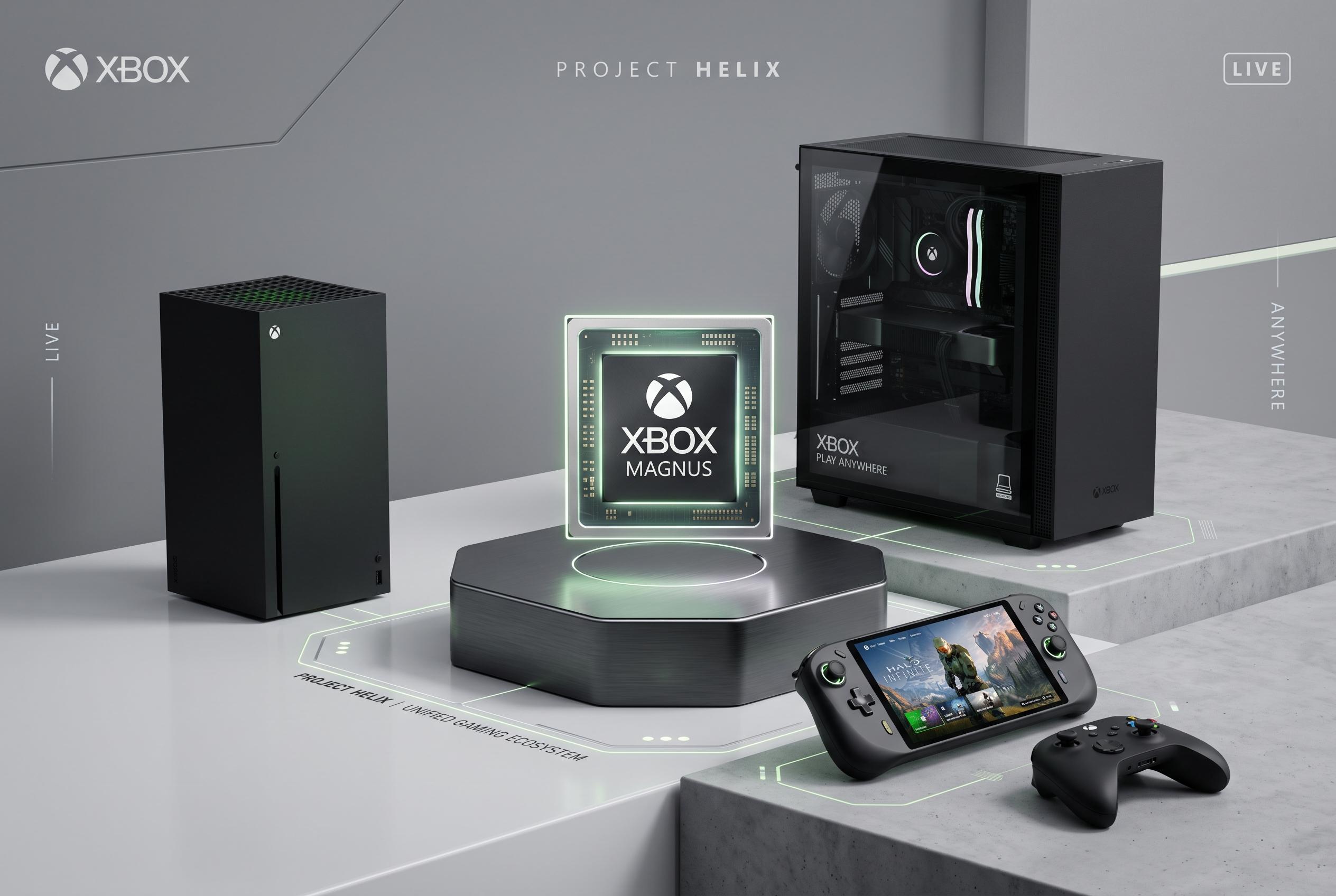

Microsoft’s new Project Helix signals a move towards a seamlessly integrated gaming experience across consoles, PCs, and handheld devices, featuring a shared ecosystem centred on the innovative Xbox Magnus chip and backward compatibility.
Microsoft’s Project Helix points to a more tightly joined Xbox strategy, with the company now publicly tying its next hardware cycle to a single ecosystem that spans consoles, PCs and handheld devices. Reporting from Geeky Gadgets says the initiative is built around the Xbox Magnus chip, a processor developed with AMD and designed to support AI features, ray tracing and frame rates of up to 120 frames per second. TechSpot likewise says Microsoft has confirmed Helix as a hybrid direction for the brand, with the aim of making Xbox and PC software feel less separate.
The clearest change is that Microsoft is no longer presenting Xbox hardware as a single box. Instead, Project Helix is being framed around three product classes: a hybrid console, Xbox-integrated PCs and portable devices. Tom’s Guide reported that Xbox executives described the plan as a way to support both console and PC games in one model, while Geeky Gadgets says the idea is to serve different players without sacrificing continuity across devices.
Backward compatibility remains central to the pitch. According to Geeky Gadgets, the platform is meant to keep original Xbox and Xbox 360 titles available through Microsoft’s own emulator, with improved image quality and performance on newer systems. GamesRadar has also reported that Microsoft has already begun a backward-compatibility programme on PC, starting with a small set of early Xbox titles and adding enhancements such as higher resolution scaling and better anti-aliasing.
The hardware story is equally important. Geeky Gadgets says Microsoft is working with brands including ASUS, Razer, Samsung and Dell on modular designs that could allow upgrades such as more memory and storage. PC Gamer has separately reported that the Helix chip is expected to underpin third-party gaming devices as well, although not as a consumer retail component. That suggests Microsoft is trying to extend Xbox standards beyond its own first-party machines and into a wider partner network.
There is also a longer historical thread behind the plan. Windows Central reported that former Microsoft gaming vice-president Ed Fries said the original Xbox had once been intended to resemble a console-PC hybrid, but market conditions and technical constraints changed that approach. Project Helix, by contrast, appears to arrive at a moment when hybrid gaming is far more plausible. Geeky Gadgets says the first first-party consoles are currently targeted for November 2027, with developer kits expected in spring 2027 and early manufacturing having begun in 2024.
Disclaimer: This content is intended for informational purposes only. Readers are advised to exercise their own judgement, conduct due diligence, or consult a qualified expert before acting on any information provided.