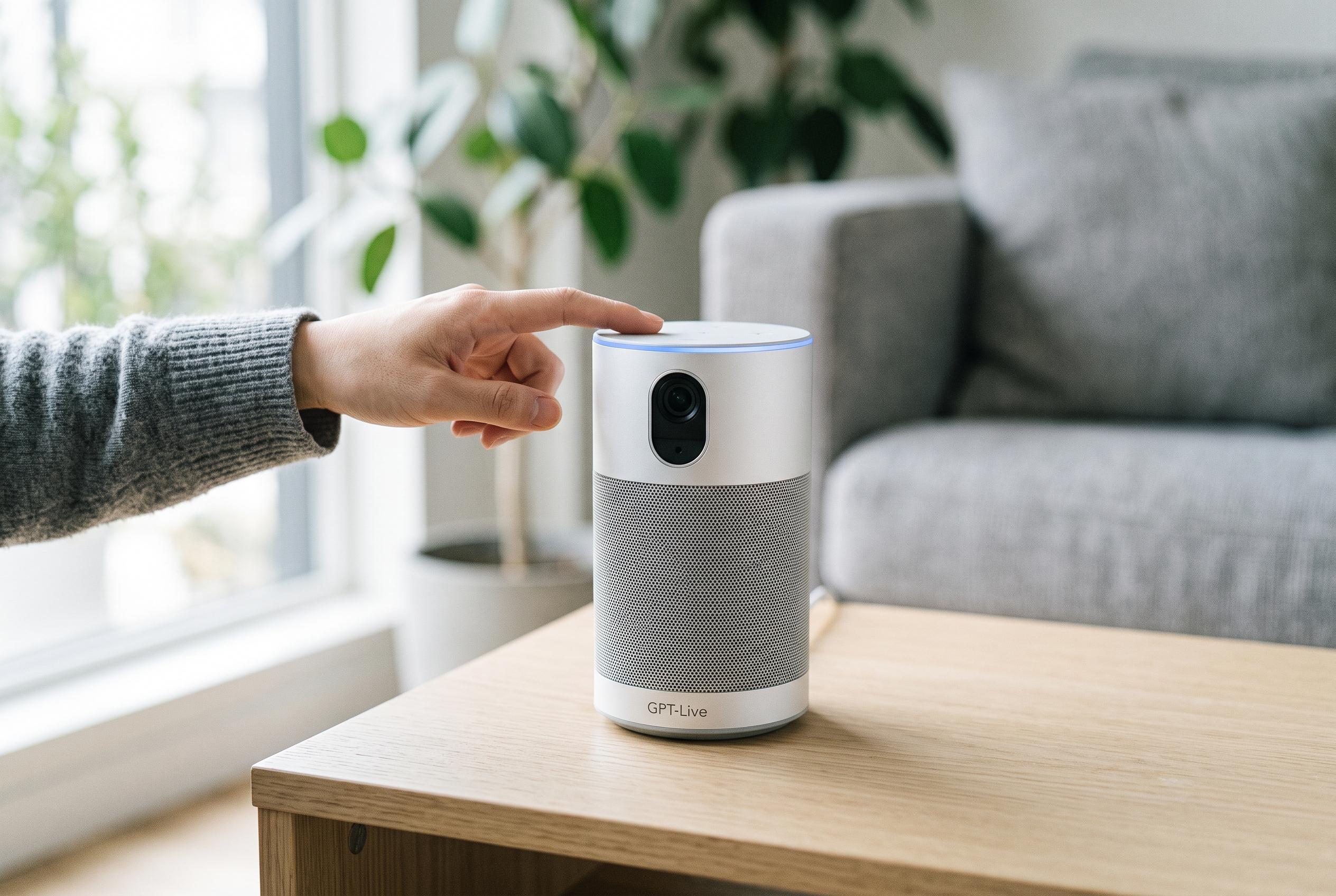

OpenAI unveils a premium, camera-equipped, battery-powered home speaker featuring GPT-Live architecture, developed with Jony Ive’s studio, signalling a new category of AI hardware aimed at conversational and autonomous interaction, amid privacy and legal complexities.
OpenAI is preparing its first consumer hardware product: a small, battery-powered speaker without a display, designed to move around the home and respond in a more conversational way than today’s smart speakers. Bloomberg, cited in later coverage, described the device as donut-shaped, fitted with a camera and mechanical parts that move on their own, with a planned price of about $300 to $400. That would place it well above most mainstream smart speakers, but also well below the cost of a laptop or tablet, underscoring that OpenAI appears to be aiming at a new category rather than a conventional voice assistant.
The key distinction is technical rather than cosmetic. OpenAI’s GPT-Live architecture, introduced in July, is built for full-duplex interaction, meaning it can listen and speak at the same time instead of waiting for one party to finish before responding. In earlier voice systems, the process was more sequential, with speech converted to text, processed and then converted back to audio. GPT-Live separates low-latency conversation from deeper reasoning, allowing one model to manage the flow of dialogue while a second model handles harder tasks in the background. That design, according to OpenAI’s engineering account, is meant to make the interaction feel continuous rather than episodic.
The hardware is also being shaped by an unusual design pedigree. The device is being developed with LoveFrom, the studio founded by Jony Ive, after OpenAI bought Ive’s hardware start-up, io Products, in a deal valued at about $6.5 billion. Tang Tan, a veteran Apple designer now serving as OpenAI’s chief hardware officer, is leading product design. That has added a legal dimension to the project: Apple has sued OpenAI, alleging trade-secret misuse involving hardware design and supply-chain information. The complaint has not stopped development, but it could complicate recruitment, manufacturing and disclosure around OpenAI’s planned public listing.
The pricing is likely to attract the most scrutiny. MacRumors and other outlets had previously reported a lower range of $200 to $300, so Bloomberg’s higher figure suggests either a more ambitious specification or a recognition that the economics of an always-on AI device are not those of a basic speaker. Amazon’s Echo business showed how hard that model can be. The company absorbed enormous losses on its devices division while trying to subsidise hardware with shopping and subscription revenue. A camera-equipped speaker running continuous, multimodal inference is more expensive to operate than a simple wake-word device, which makes a premium price easier to justify than a loss-leader strategy.
Privacy will be central to whether the product gains traction. A screenless device with a camera, always listening and designed to understand its surroundings, is closer to a home sensor than a traditional speaker. That will raise immediate questions about what data is processed locally, what is sent to OpenAI’s servers, how long it is stored and whether it is used to train models. OpenAI has not publicly detailed those controls. The company is clearly trying to position the product as the first in a broader hardware family, and reportedly wants it to act as an AI companion for everyday tasks such as answering questions, controlling home devices, playing media and handling messages. Whether consumers accept that proposition will depend less on the novelty of the form factor than on trust, cost and privacy safeguards.
Disclaimer: This content is intended for informational purposes only. Readers are advised to exercise their own judgement, conduct due diligence, or consult a qualified expert before acting on any information provided.